
Feature
Social Networking
among the Yangban
By Kim Jong-sung
Imagining the yangban class of the Joseon Dynasty (1392–1910) calls up an image of a scholar neatly attired in a wide-brimmed black hat and long white gown while deep in the study of a book. However, this scholarly archetype is not the full story of the yangban, a term literally meaning “civil and military officials” but more generally referring to the ruling class of the Joseon Dynasty. They were no different from contemporary Koreans in seeking to forge a wide social network. Just as people today communicate through various internet-based social networking services, the Joseon-era yangban actively participated in diverse social clusters. With no duty to provide labor, the yangban could take advantage of various social opportunities to expand their political influence and appreciate cultural activities. The social groups in which they took part broadened the boundaries of their social spheres. Although accounting for only a small portion of the population, the yangban were able to efficiently regulate Joseon society. Their entitlements to land and slaves underpinned their leadership, but their strenuous efforts at social networking were an important component as well.
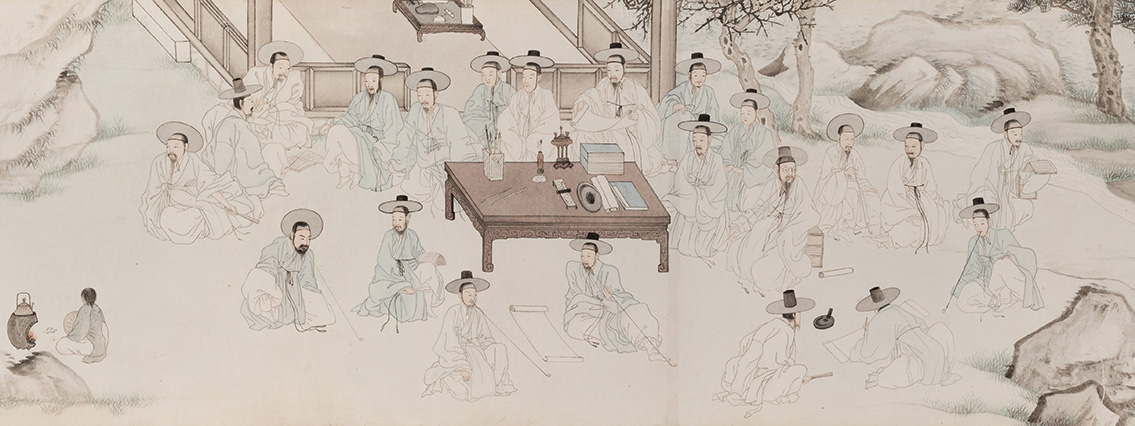
Part of The Customary Cleansing of the Body on the Third Day of the Third Lunar Month by Yu Suk
The painting depicts a gathering of 30 scholars assembled at a riverside to write poems in 1853. The event was organized in honor of a gathering the Chinese writer Wang Xizhi organized at the Orchid Pavilion in 353.
Influencing Local Governance through an Exclusive Yangban Club
First of all, yangban participated in a hyanghoe, or “local assemblies.” These were regional advisory bodies formed at the county level. No one could not claim yangban status without membership in a hyanghoe. Within the context of a hyanghoe, the term yangban meant the ruling group of a particular locality. Credentials for attaining membership in the hyanghoe varied across different areas. There were, however, four main common requirements:
(1) Living a yangban lifestyle.
(2) Family members who passed the civil service examination or became prominent scholars.
(3) Membership in a clan that has lived in the area for several generations.
(4) Having a spouse from a family meeting the other three criteria.
The “yangban lifestyle” referred to such practices as observing ancestral rites, offering hospitality to guests, and practicing academic and mental cultivation. The longstanding residence of members of a particular clan in one area usually meant extensive local landholdings. These criteria all include elements open to subjective interpretation, and terms such as the “yangban lifestyle,” “prominent scholar,” or “several generations” could be defined differently. Some people who seem to fit the definition of yangban according to today's understanding were not awarded yangban status in their hometowns. Some of the high-level civil and military officials in the Joseon central government were not actually treated as yangban back home.
One clear example of this is the civil servant Song Sun (1493–1582). After passing the civil service examination at age 26, he eventually advanced to high office over his career. He was once selected as emissary to China, an official posting usually assigned to high-ranking officials. Despite his success as a civil servant, Song was initially denied yangban status in his hometown of Damyang. The hyanghoe there pointed out that his maternal family was not native to the area and there were no renowned scholars in his family. It was only years after he was appointed to the office of Inspector-General that the Damyang hyanghoe finally admitted him as a member. The example of Song Sun demonstrates how closed these yangban assemblies could be.
As a privileged club of local leaders, hyanghoe wielded great influence over regional society. They made decisions regarding a range of local issues and had a strong voice in the selection of advisors for the local magistrate. The magistrate would rely on the local leadership to combat people’s resistance to taxation and support the collection of duties. A local government led by a magistrate dispatched from the central bureaucracy could not fully function without cooperation from the local leaders' club. It would not be too exaggerated to state that it was the local leaders’ club rather than the office of the magistrate that held the real power in local governance.

Tuho, or “pitch-pot”
In this traditional game, players standing at a set distance toss arrows into
a lugged cylindrical jar.

Black hat
This horsehair hat was worn by the Joseon-era yangban.
Spending Time with Other Would-be Civil Servants
Another networking avenue for the yangban was a samaso, a private association of local scholars. Distinct from other local scholarly organizations such as a public school (hyanggyo) or private academy (seowon), a samaso was comprised of people who had passed one of the two primary civil service examinations respectively testing candidates’ understanding of the Chinese classics or their literary abilities. These classics licentiates (saengwon) and literary licentiates (jinsa) assembled at a samaso to prepare for the final level of the civil service examination. The average age of successful candidates at this final level during the Joseon era was roughly 37. While there were candidates in their 20s and 30s, there were of course those in their 40s as well. This indicates that many Joseon scholars spent a considerable portion of their lives in these local scholars' associations. It would be difficult to imagine that they always did nothing but study. These future civil servants certainly gathered for other purposes as well.
They held assemblies for entertainment when the weather was pleasant in the spring or autumn, inviting entertainers and appreciating their dancing and music. A skilled kite flier might be called in to perform aerial feats. They also rolled up their sleeves and played games themselves. One common game featured at these scholars’ picnics was tuho, or “pitch-pot.” Players standing at a set distance tossed arrows into a lugged cylindrical jar. Pitch-pot was often held at the sidelines of a drinking party. Those who failed at the arrow tossing were forced to drink wine as punishment. As much as throwing skills, the ability to compose poetry was critical for winning the game. Players would be required to create poetry on the spot after throwing an arrow. If they failed in this literary skill, they also faced the penalty of drinking wine.

Inkstone
Inkstones were an important part of the writing utensils required by Joseon yangban.
They ground an inkstick on an inkstone before writing or painting.

Black leather shoes
A male yangban in the Joseon era wore black leather shoes as part of his daily outfit.
Shoes were considered a marker of status at the time.
Sharing Feelings with Like-mined Poets
At the highest level of the civil service examination, skill at composing poetry was considered more important than knowledge of the Chinese classics. Those who had taken the literary examinations were generally more successful at getting promotions within the officialdom compared to those from the classics track. In response, poetry became a critical element in the education of the yangban. Children born into a yangban family leaned about composing poetry from an early age. There were even five-year-old yangban boys known for their poems. After this childhood education, poetry writing often became entrenched as a habit among many yangban adults. They might find inspiration in anything new they came across on the road. A good example is Jeong Mong-ju, a Goryeo scholar who died in 1392 but was a respected figure among the literati throughout the Joseon period. In the poem “Drinking Wine,” he admonished, “Don’t blame yourself for spending all the money on the road / You gained a handful of new poems in your silken pocket.” Jeong considered composing poems to be a boon, even if it meant having no money to get by.
Jeong was not alone in living surrounded by poetry. Whenever there was a gathering of yangban, there was writing and reciting poetry. Those with a particular passion for the pleasures of poetry composition made it a regular event by establishing a sihoe, or “poetry society.” One example is the poetry society set up by the civil servant Chae Je-gong, who spearheaded a renaissance in art and culture during the reign of King Jeongjo. A member of the Namin (Southerners) minority political faction, Chae brought together junior scholars from his group to create a poetry society. Chae helped the members in preparing for the civil service examinations and entering politics. Poetry composition could be enjoyed by female members of the yangban class as well. Lady Kim (penname Geumwon) from the late Joseon period travelled across the country composing poems. She assembled other female poets at her pavilion, Samhojeong, along the Hangang River. Her poems were published in the compilation Hodongseorakgi.
These are some leading examples of the social groups the yangban class joined in order to expand and strengthen their social networks. Through them, they could participate in central politics or local governance. They could also make friends and have fun together. This is not to say that these exclusive yangban clubs were only positive. Their main purpose resided in building up internal networks and solidifying social status. They enhanced the benefits of the privileged members of society and undermined social equity. They also assisted the state and landlords in exploiting people through heavy taxes. When the traditional social order showed signs of crumbling after the Japanese invasions of the late 16th century, people rose up and established opposing social groups composed of members of the lower classes. This indicates how people believed that they needed to form their own groups in order to bring more justice to the world.
However, yangban clubs such as hyanghoe, samaso, and sihoe definitely had positive impacts on Joseon society as well. Their literary and artistic productions are one example. These activities made great contributions to the cultural advancement of Korea. The social groups formed by the yangban were a foundation of their continual leadership throughout the Joseon era. The real power of the ruling class did not stem from reading books in solitude, but from maintaining extensive networks with others.
Text by Kim Jong-sung, History Columnist
Photos by the National Folk Museum of Korea

조선 시대 양반들의 사교 공간
조선시대를 이끌어간 양반들은 선비의 모습을 띠었다. 하얀 도포에 갓을 쓰고 단정히 앉아 책을 읽거나 담뱃대를 물고 있는 모습이 그들의 전형적인 이미지였다. 하지만, 이것이 다는 아니었다. 인터넷이나 SNS으로 세상과 소통하는 현대인들처럼, 그들 역시 네트워크 활동의 중요성을 모르지 않았다. 생산노동의 부담에서 자유로웠던 그들은 매우 활발하게 네트워크 활동을 했다. 다양한 모임을 통해 사회활동 혹은 정치활동도 하고 문화적 여유도 즐기면서 삶의 영역을 확장해 나갔다. 이들이 소수였는데도 사회를 이끌 수 있었던 것은 노비와 토지에 대한 지배권이 있었기 때문이기도 하지만, 다양한 교류를 통해 지방적 혹은 전국적 네트워크를 형성한 결과이기도 하다.
가입 조건이 까다로운 양반들의 모임, 향회(鄕會)
양반들이 참여한 대표적 클럽은 향회(鄕會)였다. 지금의 군(郡) 단위로 활동한 이 단체는 원칙상 양반만 가입할 수 있었다. 그래서 이곳에 가입해야 양반이란 말을 들을 수 있었다. 양반은 무반과 문반을 통칭하는 용어이기도 했지만, 지배층을 뜻하는 의미로 보다 더 많이 사용됐다. 지배층을 뜻할 때는 각 지역 향회 구성원을 가리키는 용어였다. 향회의 가입 자격은 지역마다 조금씩 달랐다. 하지만 대체적으로 네 가지 공통 조건이 있었다.
(1) 양반의 생활양식을 실천할 것
(2) 과거시험 급제자나 대학자를 배출했을 것
(3) 그 지역에서 여러 세대에 걸쳐 집성촌을 형성했을 것
(4) 앞의 세 가지 요건을 갖춘 집안과 혼인을 맺은 가문일 것
양반의 생활양식이란 조상에게 제사를 지내고, 외지 나그네를 접대하며 학문과 자기수양에 힘쓰는 것 등을 가리켰다. 친척들이 수 세대 동안 집성촌을 이뤘다는 것은 이 가문의 토지가 그곳에 많았음을 의미했다. 경제력과 사회적 영향력이 양반 여부를 분간하는 표지 중 하나였던 것이다. 하지만 위의 조건들은 어느 정도는 주관적인 것이었다. ‘양반의 생활양식’, ‘대학자’, ‘여러 세대’등은 해석 여하에 따라 달리 판단될 수도 있었다. 그래서 오늘날 우리가 볼 때는 분명히 양반 같은데도 실제로는 양반 대우를 받지 못한 사람들이 적지 않았다. 임금을 알현하는 고위 관료인데도 지역 사회에 가면 양반이 아닌 사람들이 있었던 것이다.
유명한 문신인 송순도 그중 하나였다. 1493년에 출생한 그는 26세 때 과거에 급제한 뒤 고위 공직자가 됐다. 명나라에 사신으로 다녀온 적도 있다. 하지만 그의 고향인 전라도 담양의 향회에서는 그가 태어나고 성장한 외가가 담양 토박이가 아니라는 점과 그의 가문에 저명한 관료가 없다는 이유로 그를 양반으로 인정해주지 않았다. 그러나 그가 오늘날 검찰총장에 해당하는 대사헌이 되어 지역 원로들에게 후히 대접한 이후에야 담양 향회는 그를 회원으로 받아주었다. 70대 중반을 넘어서야 비로소 양반 대우를 받게 됐던 것이다. 향회가 가진 양반들의 배타성을 보여주는 사례라고 할 수 있다.
향회는 양반 특권층의 클럽으로 인식됐기 때문에 지역 사회에 미치는 영향력은 상당했다. 이곳에서 지역의 현안과 풍속을 논의하기도 하고, 수령 자문기구인 향청의 임원 구성에 개입하기도 했다. 수령은 향회의 도움을 빌려 조세 수취의 부담을 덜 수 있었다. 조세 저항이 심한 경우에는 이들의 지원에 의존하는 수밖에 없었다. 그 정도로 향회의 협력 없이는 수령의 직무 수행이 쉽지 않았다. 그래서 지방을 이끄는 실질적 힘은 수령이 있는 동헌이 아니라 양반들이 모이는 향회였다고 해도 과언이 아니다.
과거시험 1단계 합격자들의 모임, 사마소(司馬所)
양반들의 네트워크는 향회가 아닌 다른 형태로도 구현됐다. 사마소(司馬所)를 통한 네트워크 활동도 그중 하나였다. 경상도 경주의 경우에는, 만석꾼인 최 부자 집 옆에 사마소가 있었다. 관립학교인 향교나 지역 공립학교인 서원과 달리, 사마소는 사마시(司馬試)로도 불리는 1단계 과거시험에 합격한 사람들이 사적으로 만든 곳이었다. 이곳에 생원과 진사들이 모여 2단계 과거시험을 준비했다. 생원은 경전 이해력을, 진사는 작시(作詩) 능력을 평가 받아 1단계를 통과한 선비들이었다. 조선왕조 5백년의 최종 급제자 평균 연령이 36.7세였으므로, 과거 수험장에는 2, 30대뿐 아니라 40대 선비들도 모여들었다. 최종 급제까지 인생의 절반가량이 소요됐기 때문에 사마소는 인생의 상당 부분을 보내는 곳이었다. 그러니 이곳에 모이는 사람들이 공부만 할 리는 없었다. 봄가을에 정기 모임을 갖거나, 술을 마시며 우의를 돈독히 하는 등의 다양한 친목 활동이 이루어졌다.
양반들이 우의를 돈독히 하거나 친목을 다지는 방법은 다양했다. 기생을 초빙해 단체로 검무를 감상하거나 연날리기 고수를 불러 솜씨를 구경하는 경우도 있었다. 남의 묘기를 감상하는 데 그치지 않고 직접 게임을 할 때도 있었다. 활쏘기의 변형인 투호가 이런 때 활용됐다. 양쪽에 두 귀가 달린 병을 향해 멀찍이서 화살을 던져 넣는 투호는 술자리를 겸해 열리곤 했다. 패자는 벌주를 마셔야 했다. 벌주를 피하려면 화살도 잘 던져야 했지만, 시도 잘 지어야 했다. 화살을 던진 직후에 즉석으로 시를 짓지 못하면 벌주를 마시는 경우도 있었다.
시를 통해 감성을 나누는 모임, 시회(詩會)
과거시험에서 경전 이해력보다는 작시 능력이 더 중시됐고, 생원 출신보다는 진사 출신의 승진이 빨랐기 때문에 양반가의 조기 교육에는 시가 빠지지 않았다. 그래서 양반들은 어려서부터 시 짓기에 익숙했다. 다섯 살 정도에 시를 짓는 아이들도 있었다. 이렇게 어려서부터 작시(作詩)에 길들여지다 보니, 습관적으로 시를 짓는 양반들이 많았다. 여행 중에 새로운 게 눈에 띌 때마다 시적 감흥에 빠지는 이들도 있었다. 조선이 건국된 1392년에 세상을 떠났지만 조선시대 선비들의 존경을 받은 정몽주도 그랬다. <술을 마시다>라는 시에서 그는 “집에 돌아가 돈 떨어졌다고 자책하지 말자/ 새로운 시들이 비단주머니에 가득 남았으니까”라고 읊었다. 여행 경비가 떨어지더라도 시를 많이 짓는 게 이익이라고 생각했던 것이다.
정몽주처럼 시에 빠져 사는 사람들이 많았기 때문에, 양반들이 모인 자리에서는 시 읊는 소리가 들리곤 했다. 시에 미친 사람들은 이런 모임을 일회성으로 끝내지 않고 아예 시회(詩會)를 만들기도 했다. 조선 후기에 한양 남쪽인 용산 한강변의 삼호정(三湖亭)에 모이는 시인들도 그런 사람들이었다. 이곳 주인인 김금원은 전국 각지를 여행하면서 시를 썼고, <호동서락기(湖東西洛記)>를 통해 시를 남겼다. 조선 후기의 문예부흥을 이끈 채제공도 그런 시회를 운영했다. 소수파인 남인당에 속했던 그는 당파 후배들을 모아 시회를 운영하고 그들의 과거 급제와 정계 진출을 돕기도 했다.
이처럼 양반들은 다양한 클럽을 만들어 인적 네트워크를 강화했다. 이를 통해 중앙 정치나 지역 행정에 참여하기도 하고 과거시험에 필요한 정보를 얻기도 하고 여가 생활을 함께할 벗을 얻기도 했다. 이들의 주된 목적 중 하나는 상호 연대를 통해 사회적 지위를 공고히 하는 데 있었지만, 이들의 단체 활동은 조선의 문화 수준을 한층 풍요롭게 하는 데 기여했다. 문학작품이 나오고 문화 공연들이 벌어졌으므로 이들의 모임이 문화 발달에 기여한 공로는 결코 작지 않았다.
물론 양반들의 클럽 활동이 긍정적 기능만을 한 것은 아니다. 특권층 중심의 사회체제를 강화하고 사회적 형평성을 저해하는 측면도 컸다. 또 국가와 지주의 과도한 수탈을 돕는 기능도 있었다. 1592년에 발발한 임진왜란을 계기로 전통적 사회질서가 약해지고 서민들의 발언권이 강해지던 조선 후기에 일반 백성들이 시회를 만들거나 또는 향회에 맞설 새로운 조직을 강구한 것은 양반들의 클럽만으로는 좋은 세상을 만들기 힘들었기 때문이라고 볼 수 있다.
그런 한계가 있기는 했지만, 향회·사마소·시회 등등의 클럽은 양반들의 상호 유대를 돈독히 하는 동시에 정보 교류 및 문화 발달을 촉진시켰다. 그런 활동에 힘입어 양반층은 조선왕조 5백년을 이끌어갈 수 있었다. 홀로 앉아 책을 읽으며 수양하는 것이 아니라, 여럿이 함께 네트워크를 구축하는 것이 양반을 양반답게 하는 진짜 힘이었다고 말할 수 있다.
Text by김종성, 한국사 칼럼니스트
Photos by 국립민속박물관