
Feature
Ritual Spaces of the Joseon Dynasty
By Cho Jaemo
Jeonghae jinchandobyeong This painting mounted on a folding screen depicts a royal banquet held in 1887 to celebrate the 80th birthday of Queen Sinjeong. (Photo courtesy of the National Museum of Korea)
Form and function were long considered inseparable in architecture prior to the advent of the notion that “form follows function” attributed to the American architect Louis Sullivan (1856–1924). Examples of this idea are abundant, from the pyramids built as royal tombs in ancient Egypt, the ancient shrines in the Acropolis of Athens, to the Gothic cathedrals erected in Europe during the Middle Ages. State rituals are prominent among the many functions inspiring forms of architecture across human history. Such rituals serve as a vehicle for expressing the abstract concept of the government’s power or authority, and consequently require an architectural space that accentuates this purpose. This article explores the state ceremonies of the Joseon Dynasty (1392–1910) and the buildings that accommodated them.
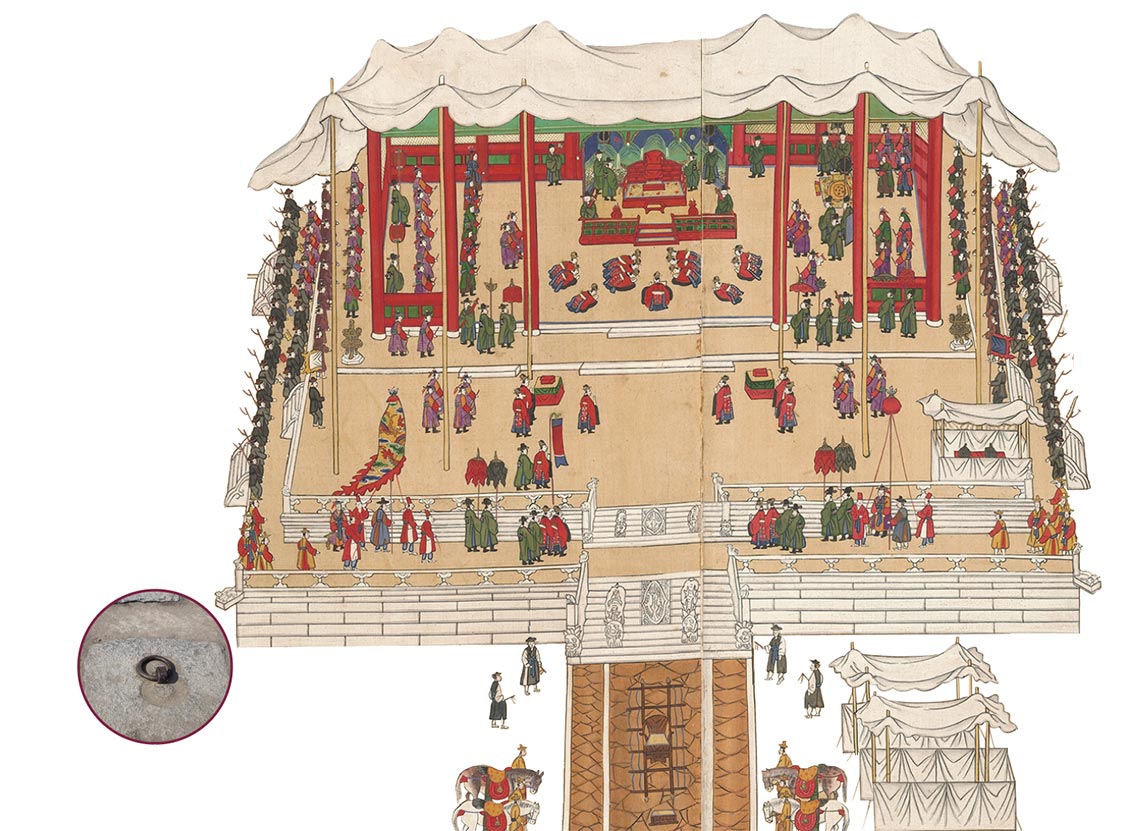
Performances are staged on a platform, which is intended to elevate the performers and improve the view for the guest of honor.
In the picture, an extensive white canopy is erected on high poles with ropes fastened to iron rings in the courtyard ground. Iron rings can still be found in the courtyard of Geunjeongjeon Hall.
The Five Joseon State Ceremonies
The state rituals of the Joseon Dynasty were prescribed in the book Gukjo oryeui (The Five Rites of the State) published in 1474. This rulebook grouped these rituals into five categories of rites: gillye, state rites for gods associated with the peace and prosperity of the nation; garye, celebratory occasions for members of the royal family; billye, ceremonies welcoming envoys from abroad; gullye, performative rites involving the military; and hyungnye, or royal funerals. These state events went beyond the rituals observed in the private sector to mark important transitions in an individual’s life (such as coming-of-age rites, marriages, funerals, and ancestral rites) to include ceremonies and occasions exclusive to the state. It goes without saying that these state rites surpassed private rituals in terms of their scale and splendor. The numerous rites and occasions encompassed under each of the five categories of ritual were held in spaces offering architectural environments suited to their purposes.
The buildings of choice for a background for state rites were the palaces, Jongmyo Shrine, and the royal tombs. These royal structures providing spaces for residences, official work, ancestor worship, and burials of the kings other members of the royal family were grand in scale and elaborately decorated. Events falling within the gillye category could be held in diverse places depending on the ritual requirements, such as Jongmyo Shrine (the royal ancestral shrine of the Joseon Dynasty), Sajikdan Alter (the royal alters for the gods of land and crops), Munmyo Shrine (the memorial shrine for Confucius at Sunggyungwan Academy), and the respective alters for the gods of farming, sericulture, and wind, clouds, and thunder. Garye rites were mostly held at the palace. Garye that occurred outside the palace include the receipt of royal messages or edicts held at Mohwagwan Hall, state examinations to select military officers that took place at the royal altar for the god of land, and a school entrance ceremony for the crown prince at Sunggyungwan Academy. Royal funerals mainly took place at the palace, but included elements at Jongmyo and the royal tombs. The relatively infrequent billye and gullye rites respectively were held at Taepyeonggwan Hall and the alter for the god of land.
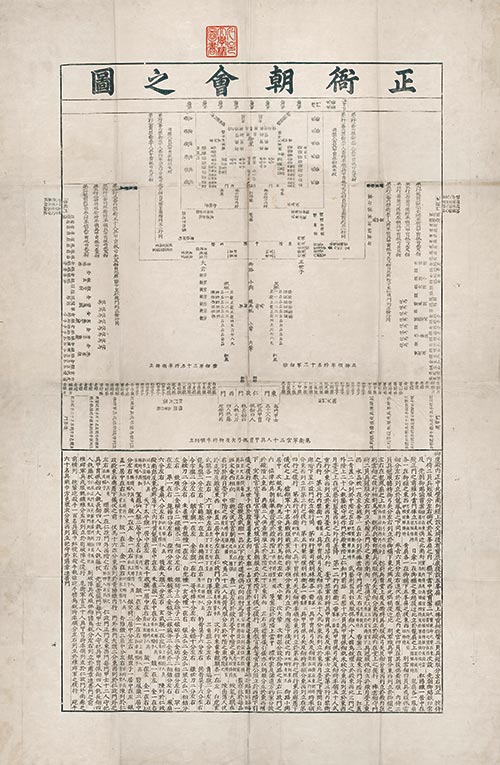
Jeonga johoejido
This line drawing depicts a morning assembly held in front of the throne hall
at Changdeokgung Palace. It indicates the designated seats for the participants and items.
(Photo courtesy of the Kyujanggak Institute for Korean Studies)
The Versatility of the Palaces
Among the buildings used to hold state ceremonies, the palaces provided the most versatile spaces. The Five Rites of the State specifies several buildings within Gyeongbokgung Palace, the dynasty’s main palace through its early period, as the arena for a state ritual. They include Geunjeongjeon Hall (the throne hall), Geunjeongmun Gate, Sajeongjeon Hall (the king’s executive chamber), the living quarters for the king or the queen, the East Palace (the residence of the crown prince), and the royal mortuary. After Gyeongbokgung Palace sustained severe damage during the Japanese invasions of the late 16th-century and subsequently lost its position as the main Joseon palace, buildings with similar functions in other royal palaces were used for state rites instead. The Five Rites of the State details what kinds of rites are to be held in which of these spaces, when they should be held, who should participate, how they should dress, where to place the honor guard, the range of ceremonial instruments, the order of procedures, and the layout of the event. This guidebook was legally binding and therefore difficult to change.
Geunjeongjeon, the throne hall within Gyeongbokgung Palace, is set on a high platform. State assemblies were held here. According to The Five Rites of the State, the wide stone-surfaced area in front of the throne hall should be filled with people and items during the morning assembly. Scholarly and military officials and royal family members attended these events along with an honor guard, musicians, and event assistants. Their locations and movements were strictly controlled. There were designated gates and specific conduct regulations for each group as well. A clear view of the layout of these participants and ceremonial objects can be found in Jeonga johoejido (Morning Assembly at the Throne Hall), a line drawing produced in 1778 that indicates the designated seats for the participants and items. This painting depicts a morning assembly held in front of the throne hall at Changdeokgung, the Joseon royal palace that took over the role of main palace in the late 16th century.
According to surviving Joseon records, iron rings were firmly driven into the courtyard of Geunjeongjeon Hall. Jeonghae jinchandobyeong, a 10-part painting on a folding screen produced in 1887, depicts a royal banquet celebrating the 80th birthday of Queen Sinjeong. The first two parts of the painting feature Geunjeongjeon Hall and show an extensive white canopy installed over the platform of the throne hall. It was fixed by erecting high poles and fastening ropes to the iron rings in the courtyard ground. A long major event required considerable physical endurance, particularly under a strong sun. While banquets and celebrations were held inside a building in some cultures, they mostly took place outdoors in Korea. Canopies were indispensable for a Joseon court ceremony where people had to endure the ritual under the direct rays of the sun.
Like these canopies, a range of temporary installations were required for the formalities of a dignified state ceremony. For example, in the case of ceremonial events taking place in the palace living quarters, screens and curtains were needed. These installations were used to block the view of female members of the royal family in attendance. The third to ninth panels in the above-mentioned painting depict a celebration in front of Mangyeongjeon Hall, one of the buildings in the Gyeongbokgung Palace living quarters. This scene features canopies, screens, and curtains that were installed in layers in the court. These screens and curtains were rearranged along with the progress of the event. It confirms that performances were staged on a platform. This structure was intended to elevate the surface for the performers in consideration of the line of vision of the guest of honor, who was watching the show while seated on the raised wooden floor of Mangyeongjeon Hall.
As seen above, various buildings at the palace could be converted into ideal spaces for various state ceremonies with just the addition of temporary installations. Since these large-scale state rites were not held in dedicated spaces, existing buildings within the palace had to be adapted. These everyday buildings could become ritual spaces using various ceremonial props.
There were also architectural spaces exclusively reserved for rituals, such as Jongmyo Shrine. A diverse range of occasions were held there, but all of them were forms of ancestral rites and were characterized by similar patterns of behavior. With the standing positions and routes for officiants permanently marked on the floor, Jongmyo Shrine provided a ready-made stage for royal ancestral rites.
All aspects of Joseon state rites were rigorously prescribed, from the participants and ceremonial objects to the background music, stage effects, and spatial composition of the arena. Joseon state rites strictly followed regulations regardless of whether an occasion took place in a building temporarily adapted for ritual use or at a permanent ceremonial structure. These ceremonial events always prioritized protocols and formalities rather than simply pursuing an aesthetic effect. This spotlights an important aspect of Joseon society.
Text by Cho Jaemo, School of Architecture of Kyungpook National University
Photos by the National Museum of Korea, and the Kyujanggak Institute for Korean Studies

조선시대 국가의례의 장소들
형태는 기능에 따라 규정된다(“Form follows function”, Louis Sullivan(1856~1924))는 근대건축의 기능주의적 선언 이전에도 공간과 기능은 매우 밀접한 관계를 갖고 있었다. 특별한 기능과 행위는 그게 알맞은 위상과 의미를 공간에 부여하기 마련이다. 파라오의 피라미드, 아크로폴리스의 신전들, 높고 장엄한 고딕의 성당, 불교 사찰, 힌두교나 이슬람교의 사원, 서원과 향교, 종묘와 사직에 이르기까지 건축은 역사 속에서 전형성을 만들어왔다. 특히 그 행위가 구체적인 규범으로 정의되어 있는 국가의례라면 행위가 요구하는 공간의 구성과 장소의 위상은 더욱더 구체적이어야 한다. ‘유일한 장소’라는 속성을 획득하기 위해서는 배타적이고 차별적인 무엇이어야 하였다. 권력은 장소와 공간으로 인해 가시적으로 발현되는 것이기 때문이다. 종종 그 장소나 공간의 ‘이름’ 마저도 권위를 만드는 장치이다.
조선시대 5대 중요 국가 행사 ‘국조오례의’
조선시대의 국가 의례는 [국조오례의]로 대표되는 법전에 의해 정의되어 있다. 길례吉禮, 가례嘉禮, 빈례賓禮, 군례軍禮, 흉례凶禮 등 다섯 가지의 카테고리로 분류되어 있었으며, 각각은 신적 존재에 대한 국가적 제사, 국가와 최상위 신분 계층의 각종 의례, 외국의 사신을 맞이하는 의식, 군대를 통솔하는 사열, 왕실 주요 인물들의 장례에 해당한다. 민간의 의식이 관례, 혼례, 상례, 제례 등 인간이라면 마땅히 겪게 되는 통과의례의 관점에서 정의되어 있는 것과는 완전히 다른 구성이다. 왕세자의 관례, 임금의 혼례, 조상신에 대한 제사, 부모의 장례 등 성격상 민간에서도 필요한 행사가 포함되어 있기는 하지만, 그 의식의 규모와 위상은 확연한 차이를 가지고 있으며, 그 나머지는 오로지 국가와 왕실에서만 필요한 의식들로 구성되어 있다. 각각의 카테고리에 속한 수많은 의식, 즉 행사들은 국가 의례의 권위를 담보할 수 있는 공간적 장치를 필요로 하고 있었다.
이들 국가 의례는 궁궐, 종묘, 왕릉 등을 배경으로 펼쳐졌다. 주거이자 업무시설로서의 궁궐, 사당으로서의 종묘, 무덤으로서의 왕릉은 민간의 그것들과는 차원이 다른 규모와 의장으로 꾸며졌다. 길례에 해당하는 각종 제사들은 종묘와 사직, 성균관의 문묘, 선농단, 선잠단, 풍운뇌우단 등 각각 별도의 국가 시설을 요구하고 있었다. 가례에 속하는 행사들은 주로 궁궐에서 진행되었으며, 조서와 칙서를 맞이하는 의식의 일부는 모화관에서, 무과의 과거 시험은 사단에서, 왕세자의 입학과 교육은 성균관에서 진행되기도 하였다. 흉례의 의식들도 대부분 궁궐에서 진행되었고, 왕릉, 종묘 등에서의 의식이 포함되었다. 태평관 등에서의 빈례, 사단 등에서의 군례에 대한 항목은 비교적 소략하다.
궁궐, 복합적이고 실용적인 행사의 장
가장 복합적인 행사 장소는 궁궐이다. [국조오례의]에 거론된 궁궐 내의 행사 장소는 근정전, 근정문, 사정전, 임금의 대전, 중궁의 정전, 왕세자의 동궁, 문소전, 혼전과 빈전 등이 대표적이다. 임진왜란으로 경복궁이 소실되어 있었던 조선후기에는 창덕궁, 경희궁 등 다른 궁궐의 같은 유형의 전각을 사용하였다. 이들 공간에는 각각에 해당하는 의식의 종류와 시기, 참여하는 인물과 그들의 복식, 움직임, 의장대와 호위 군사의 기물과 위치, 의식의 세부 절차와 공간 이용 등에 대해 매우 소상하게 정의되어 있었다. 심지어 이러한 정의는 법적 성격을 갖고 있어서 임의로 바뀌지 않는 것들이었다.
경복궁 근정전의 넓은 마당과 월대는 무엇을 위한 것이었을까? 의례서에 명시된 대조회의 매뉴얼에 따르면 이 마당은 문관과 무관, 왕세자와 종친, 의장대와 악공 등 행사에 참여하거나 스텝으로 일하는 인물들과 각종 의장용 기물들이 빼곡하게 채우게 되어 있었다. 그들의 자리와 움직임은 절차에 따라 명확하게 규정되어 있었고, 신분에 따라 드나드는 문과 행동 규정 또한 확인된다. 정조대에 창덕궁 인정전을 대상으로 명시된 [정아조회지도正衙朝會之圖]와 같은 그림 자료를 통해서 공간의 사용을 한눈에 파악할 수 있다.
근정전 마당을 살펴보면 바닥에 쇠로 만든 고리가 설치되어 있는 것을 볼 수 있다. 이 고리를 사용하는 방식은 [정해진찬도병丁亥進饌圖屛]의 ‘근정전진하도’ 등과 같은 그림을 통해 확인할 수 있다. 그림을 보면 근정전의 월대 위로 흰색의 천막을 크게 쳐 두었는데, 이를 ‘차일’이라 불렀다. 말 그대로 해를 가리는 장치인데, 높은 장대를 세우고 바닥의 고리에 줄을 연결하여 설치하였다. 긴 시간 동안 진행되는 행사는 지금이나 옛날이나 힘들긴 마찬가지이다. 특히 대규모의 실내 공간을 마련하여 연회를 진행하는 문화권과 달리, 대부분의 행사에 실외의 공간을 이용하였던 조선의 문화에서 해를 피할 나무 한 그루 없이 마당에 자리를 지키고 있어야 했던 행사에 차일은 꼭 필요한 설치물이었다.
이렇듯, 화려하면서도 격식을 갖추어야 하는 행사를 원활하게 진행하기 위해서는 임시 설치물들이 필요하곤 하다. 왕실 가족들이 생활하는 내전에서도 연회 등의 행사가 진행되는 일이 많았는데, 여기에는 좀 더 복잡한 설치물들이 필요하였다. 대비전 등 왕실 여성 어른이 참석하는 내전의 행사는 시선을 차단하기 위한 발, 장막 등의 장치가 동원되었다. 1887년 왕대비 신정왕후의 팔순을 기념하였던 진하례는 근정전과 함께 내전의 만경전이 사용되었다. [정해진찬도병]의 다른 폭을 보면, 차일 뿐만 아니라 마당을 겹겹이 에워싼 발과 장막을 볼 수 있으며, 행사의 성격과 단계에 따라 가림막을 설치하는 위치가 변화하는 모습도 확인된다. 또한 무대 공간은 원래의 바닥에서부터 일정한 높이를 올려 구성한 것을 볼 수 있는데, 이러한 시설을 ‘보계補階’라고 불렀다. 주빈의 객석이 건물의 대청마루에 놓여 있기에 무대 또한 적절한 높이와 면적을 확보하는 것이 시선에 알맞기 때문이다.
이렇듯, 궁궐의 공간은 행사의 성격에 따라 부분적인 개작을 거쳐 활용되었다. 행사용으로 완벽하게 세팅된 공간을 확보하고 있다면 고정적인 시설을 만들겠지만, 이러한 대규모의 행사가 자주 있는 것은 아니다. 평소에는 일상적인 공간으로 사용되던 기존의 전각을 활용하기 때문에 임시 설치물은 공간을 융통성 있게 사용하기 위한 장치로 활용된 것이다.
반면, 특정한 형식의 의례만 행해지는 공간은 그 결이 달랐다. 예를 들어 종묘에서도 많은 종류의 대규모 행사가 있지만 이들은 모두 제사행위라고 하는 일정한 패턴을 가지고 있는 유사한 행사들이며 궁궐과 같은 일상적인 생활이 존재하지 않는 공간이다. 그래서 제관의 동선, 서 있을 자리 등이 바닥에 표시되어 있는 등, 종묘는 이러한 제례 의식에 알맞게 완벽하게 세팅된 공간으로 구성되었다.
조선시대의 국가 의례는 그 중요성만큼이나 행사의 모든 절차와 기물, 음악과 무대효과 등을 문서로 정의하고 있었고, 장소의 위엄 있는 구성과 사용 방식 또한 엄격하게 규정되었다. 고정적인 행사장이건 가변적인 임시 행사장이건, 행사 공간에 대한 이해는 이 엄밀한 규정으로부터 시작되고 마무리된다. 감각적인 화려함을 추구하기 보다 절차와 예법을 중시한 행사의 관점은 조선시대 문화의 중요한 단면이다.
Text by 조재모, 경북대학교 건축학부 교수
Photos by 국립중앙박물관, 규장각