
Feature
Another World Heritage Nomination in Preparation
By Kim Young-soo

The Mt. Inwangsan section of Hanyangdoseong
For Inscription as World Heritage
The Seoul Metropolitan Government and the Goyang City Government in Gyeonggi- do Province are pushing ahead with a plan to apply for the inscription of three fortresses within their jurisdictions onto UNESCO’s World Heritage List. The three fortresses Hanyangdoseong, Bukhansanseong, and Tangchundaeseong will be presented as a serial property for inscription on this global heritage registry. World Heritage is an international heritage designation program based on the Convention Concerning the Protection of the World Cultural and Natural Heritage adopted at the General Conference of UNESCO in 1972. Details on the operation of the World Heritage List are specified in the 1972 Convention's Operational Guidelines. The World Heritage List consists of cultural and natural properties that display a remarkable and irreplaceable importance to humanity and therefore merit collective efforts by the international community on behalf of their protection. For successful inscription, candidate properties should be considered of Outstanding Universal Value, a concept referring to a significance that is so exceptional as to transcend national boundaries and to be of shared importance for the present and future generations of all humanity. Therefore, efforts must be focused on effectively justifying the transboundary and intergenerational value of the three fortresses to ensure their inscription as World Heritage.
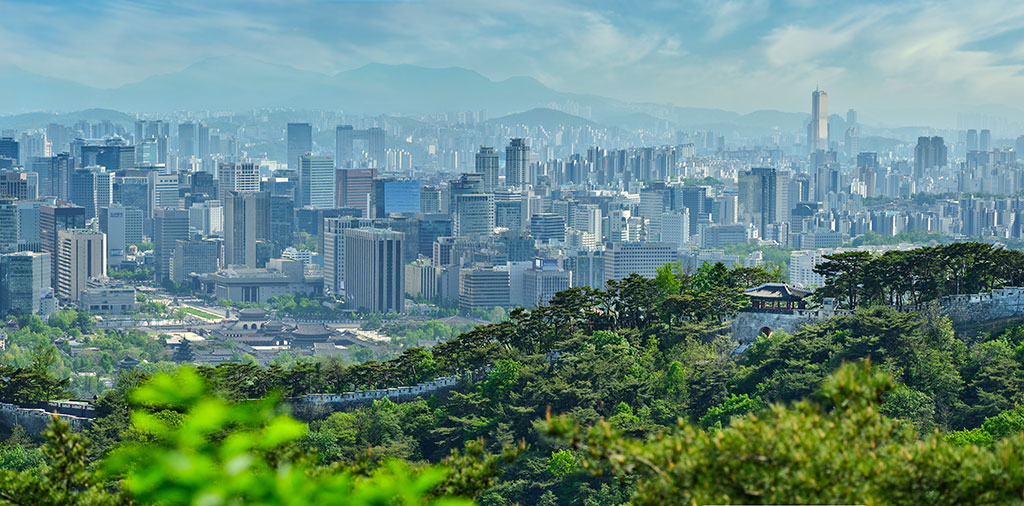
The north gate of Hanyangdoseong stands on the left with skyscrapers seen beyond the wall
Exceptional Fortification System for a Capital City
The three fortresses comprise the overall fortification system for Hanyang (today’s Seoul), as the capital of the Joseon Dynasty (1392–1910) was known. Hanyangdoseong was constructed along the borders of Hanyang soon after the foundation of the new dynasty in the late 14th century. Bukhansanseong was built in the 18th century in response to a growing need to strengthen the fortifications for the capital. A few years after the completion of Bukhansanseong, Tangchundaeseong was constructed as a wall connecting the two fortifications around the capital. The history and significance of each component of this three-part fortification structure for the capital of Joseon are as follows.
Hanyangdoseong was constructed in 1396 as the original wall enclosing the capital of Joseon. It functioned as the foremost symbol of state authority and as the primary means of protection for the people living inside its perimeters throughout the history of the dynasty. Sections of the wall originally constructed with earth were replaced with stone in the 15th century. The Japanese and Manchu invasions of Korea that took place in the late 16th and early 17th centuries inflicted tremendous damage on Hanyangdoseong. However, the city wall was restored to its original form after a large-scale reconstruction project in the early 18th century and through continuous maintenance efforts that took place thereafter. Excepting only some short sections around its east gate, the walls were all filled in on the uphill side to take advantage of the sloping topography. In the 18th century, the size of the stone blocks used was regularized. While common people were drafted as laborers for the city wall construction projects in the 14th and 15th centuries, professional masons did the work in the 18th century under the supervision of the three military camps responsible for the defense of Hanyang (Hullyeondogam, Eoyeongcheong, and Geumwiyeong). Hanyangdoseong sustained damage during the 20th century, a tumultuous period in Korean history dotted with successive catastrophes including colonial rule, the Korean War, and reckless urbanization and industrialization. Today, 14.5 kilometers of the original 18.6 kilometers of wall are visible above ground. Along with the ramparts, many defensive structures can be seen as well, including gates, bastions, and a chemise wall. Within the walled enclosure are found a series of the structures that comprised the capital of Hanyang, including royal palaces, the royal ancestral shrine, altars for the gods of earth and grain, and sites of military camps. Hanyang was surrounded by four mountains—Mt. Baegaksan, Naksan, Mongmyeoksan, and Inwangsan. Hanyangdoseong makes the most of the given topography by meandering along the ridges of these four guardian mountains and hilly areas as well as through the flatlands.
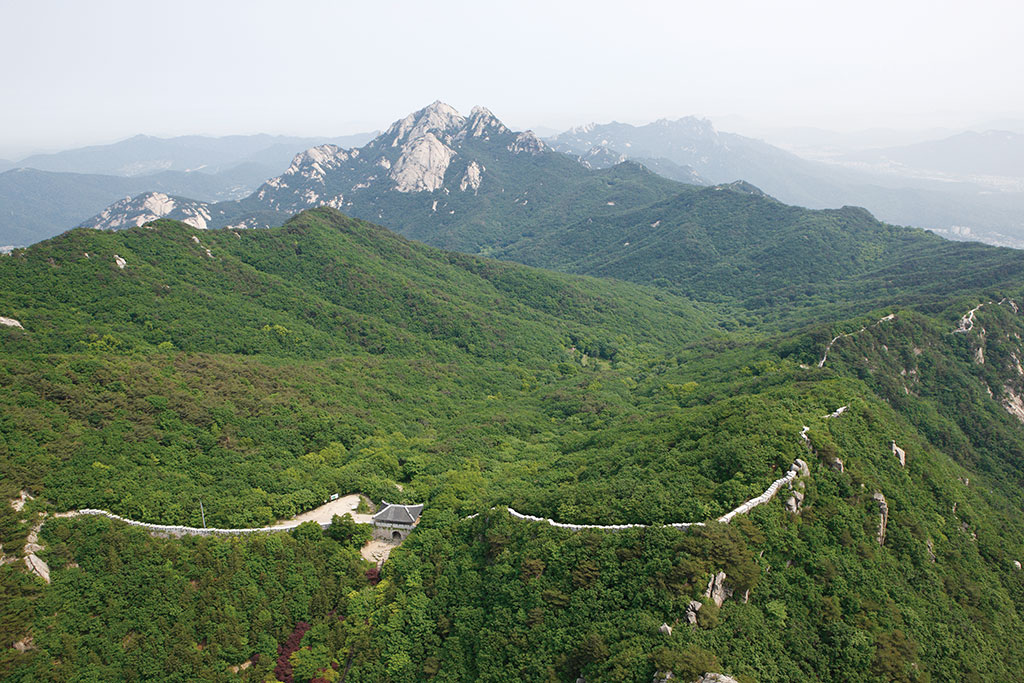
An arial view of Bukhansanseong
Bukhansanseong was built in 1711 on Mt. Bukhansan to provide an additional layer of protection to the capital and a shelter for the king and his subjects in times of war. The construction of this mountain fortress followed the reconstruction of Hanyangdoseong by a few years as part of the efforts to strengthen the capital defenses after the earlier invasions by the Japanese and Manchus. Bukhansanseong followed in Korea's long-standing tradition of building fortresses on mountains. Located to the north of Hanyang but in close proximity to the capital, Mt. Bukhansan provided rocky topography well positioned to function as emergency shelter for the royal court. Conceived as a temporary wartime capital, Bukhansanseong featured a wide range of facilities to support governance by the royal court and the everyday lives of people. The full length of the 11.6-kilomenter wall remains intact today, and within it is a temporary palace, training sites for the fortress troops, a storage facility, and Buddhist temples. As with Hanyangdoseong, the walls of the fortress on Mt. Bukhansan were filled on the uphill side of the given topography. The responsibility for supervising the construction was split across the three capital-defense offices, and professional masons and Buddhist monks participated in the work alongside common laborers. The management of Bukhansanseong was carried out by a dedicated office known as the Gyeongnicheong with the help of Buddhist monks.
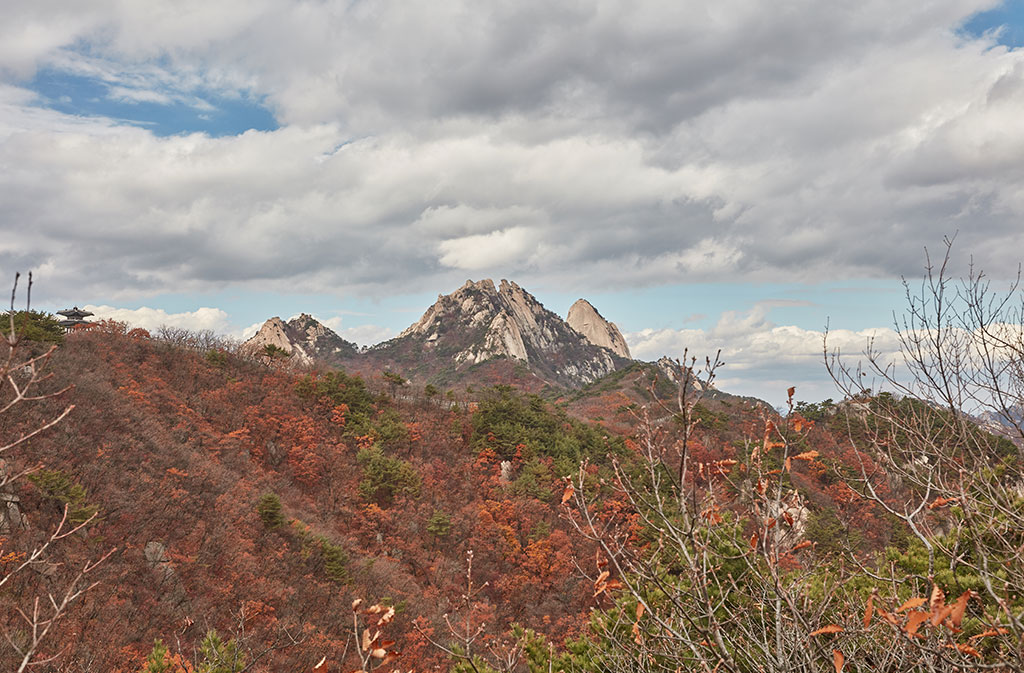
The peaks of Mt. Bukhansan embraced by Bukhansanseong
Tangchundaeseong was built in 1715 to connect Hanyangdoseong to the fortified emergency refuge on Mt. Bukhansan. The wall of Tangchundaeseong runs north from Mt. Inwangsan (the western guardian mountain for the capital) over a series of mountain ridges and peaks to reach Bukhansanseong. Out of its entire 5.15 kilometers, 4.38 kilometers is stone walls and the rest is earthen walls or simply rocks and other existing geographical features. Some gates and other defensive facilities remain along with the ramparts. The walls were filled on the uphill sides of this fortification as well. The construction of Tangchundaeseong was conducted under the direction of the Chongyungcheong, a military camp tasked with the protection of the outskirts of Hanyang. Masons and local residents provided the labor. The management of Tangchundaeseong originally fell under the responsibility of the Chongyungcheong, but was later transferred to the Gyeongnicheong. With the completion of Tangchundaeseong, a new and stronger system of capital defense was completed.
These three fortresses were based on traditional Korean fortress- construction and city-defense traditions while exhibiting distinctive characteristics in the forms of their fortifications, purposes of construction, and management methodologies. The three fortresses collectively exhibit an outstanding system of capital defense that benefitted from the creative approaches to fortifications taken in 18th-century Korea.
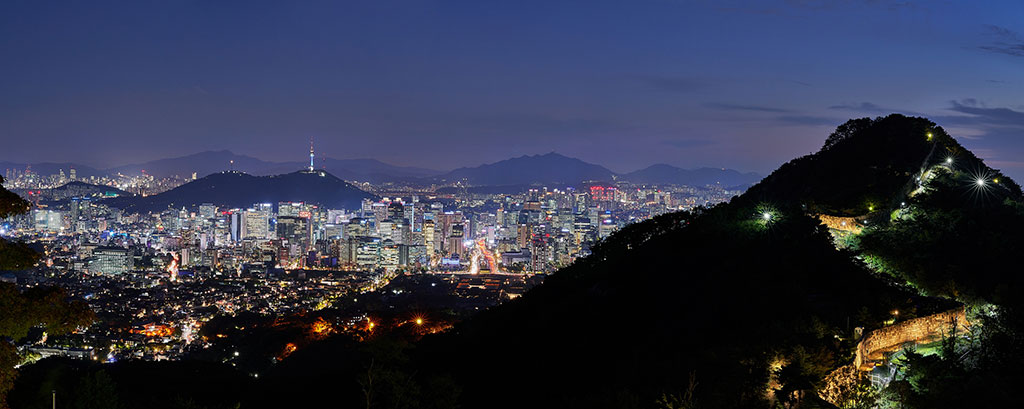
Hanyangdoseong walls on Mt. Baegaksan at night with the city center in the background
Responsibility for Conservation
World Heritage inscription brings international recognition of a property’s transboundary and transgenerational significance, but it also entails great responsibility. The journey of a World Heritage site does not stop with the listing of the property: Conservation and management are equally important. The exceptional significance for which a property was recognized at the time of inscription should be maintained—and even enhanced—through systematic and effective management and conservation so that future generations can enjoy the site as we do in the present. All three fortresses are rigorously protected within the framework for heritage protection provided through the Cultural Heritage Protection Act. It should be noted, however, that the management responsibilities for the three fortresses are divided between three different entities—the Seoul Metropolitan Government is responsible for Hanyangdoseong and Tangchundaeseong and the Gyeonggi-do Province Government and Goyang City Government are in charge at Bukhansanseong. An integrated management system will have to be established in the coming years for the purpose of managing the three sites as a single potential World Heritage property. Special attention also needs to be paid to monitoring, a conservation duty that is increasingly being emphasized within the World Heritage system. I hope that the central and local governments, academics, and local communities can pool their efforts in successfully establishing these three Joseon-era fortresses as World Heritage.