
Feature
Seonbi, the Moral Pillars of the Joseon Era
By Choi Young-sung, Professor, Korea National University of Cultural Heritage Photography by World Heritage Integrated Mana
Korean Confucianism is most eloquently characterized by the central position of uiri (義理), a form of moral theory combining the two philosophical concepts of “righteousness” (義) and “principles” (理). At the heart of Korean Confucianism lies the principle of righteousness. After adopting Neo-Confucianism as its governing philosophy, the Joseon Dynasty (1392– 1910) made sustained efforts over its five centuries to cultivate Confucian intellectuals and deploy them as resources for governance. Rather than placing a complete focus on their studies, the Confucian elite pursued an ideal of harmonizing learning with political participation. When involvement in institutional politics was impossible, they turned to the countryside as a space for putting into practice what they had learned. Confucian scholars living in rural villages worked to guide communities in ethical thinking, unify divided opinions, and nurture civic virtue. The Chinese character for “Confucian scholars” (士) denotes their role in unifying diverse opinions by combining the character “十,” meaning “ten” with “一,” meaning “one.”
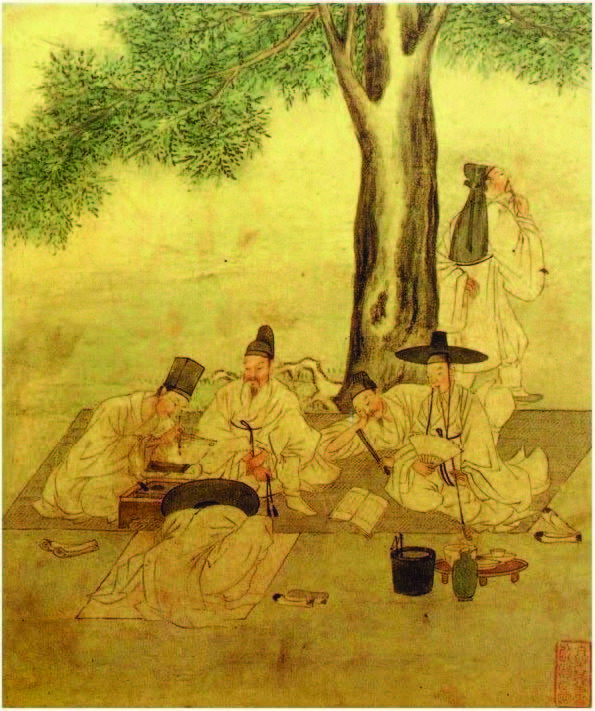
Seonbi in the Midst of Composing Poems produced in the 1740s by the late-Joseon painter Gang Hui-eon
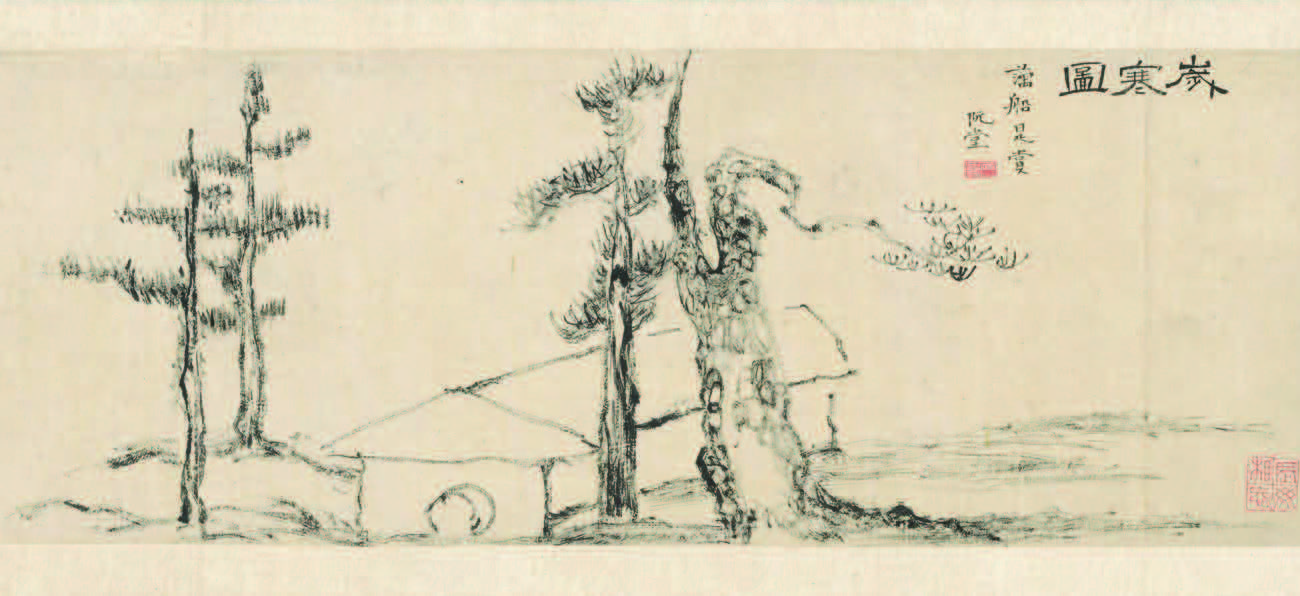
Sehando (Winter Scene) created in 1844 by the renowned late- Joseon painter and calligrapher Kim Jeong-hui. The trees in the picture symbolize the steadfast moral conviction of seonbi.
Neo-Confucianism as the Governing Philosophy of the Joseon Dynasty
Neo-Confucianism provided the foundation for the statecraft in the Joseon era. The complex philosophy of Neo-Confucianism can be boiled down to the simple understanding that human nature is aligned with the moral order of the universe. This conception of inherent human moral inclinations begets such questions as what is wrong or right, what is evil or good, and what is unjust or just, all themes entailed within the compass of the righteousness principle. The righteousness principle is about mirroring the moral order of the universe within society. Joseon-era Neo-Confucian philosophy succeeded in harmonizing the ideal of cultivating moral integrity with the historical and social demand to put moral virtues into practice. Confucian scholars were often prominent both in number and expression of commitment among those who voluntarily came forward in times of national crisis and sacrificed themselves to defend the pride and sovereignty of the nation. This is a manifestation of the Confucian principle of moral duty at the core of Joseon Neo-Confucianism. The primacy of “principle” over “material force” or “vital energy,” a theory known as juriron (主理論), was another feature of Neo-Confucianism in the Joseon era.
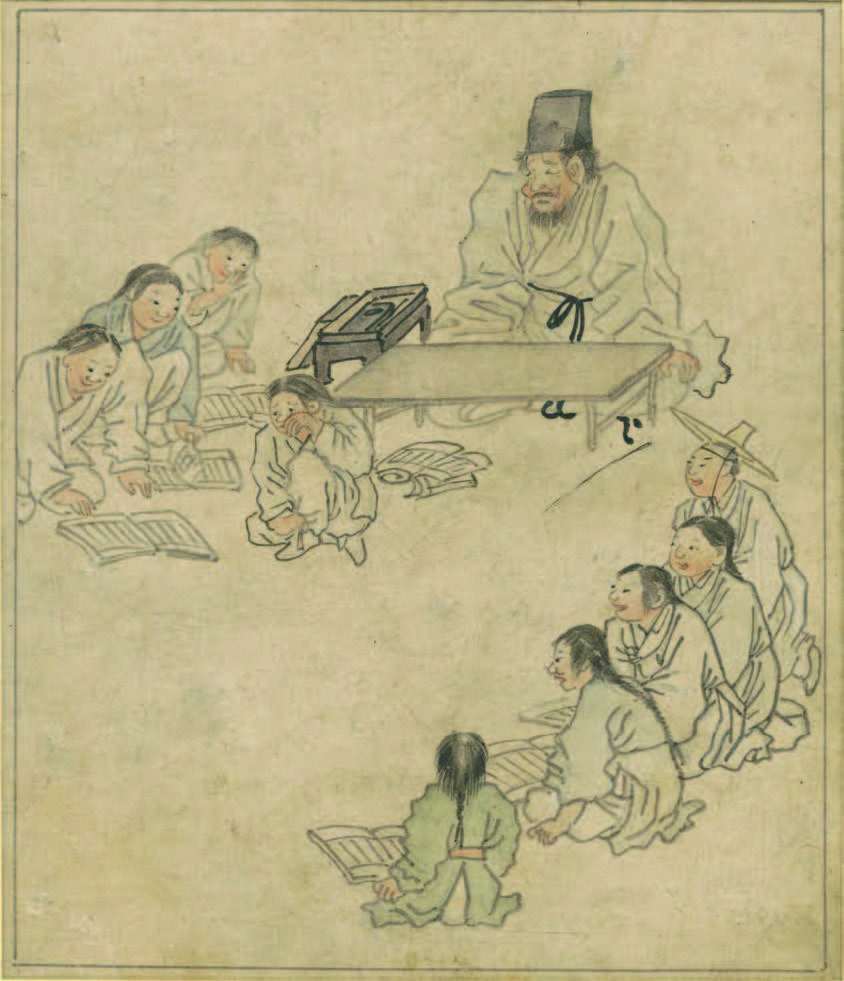
Seodang (Schoolhouse), a genre painting by Kim Hong-do from around 1780
Confucian Scholars and Their Ethos
The principle of righteousness defined the ethos of the Confucian scholars known as seonbi in
Korean. As a social group, the seonbi were at the forefront of actualizing Confucian ideals. By
studying Confucian classics at educational institutions such as seowon and hyanggyo, seonbi
both advanced learning and cultivated their moral character.
As expressed in the old saying “A seonbi needs the ability to tell right from wrong while not
seeking immediate benefits,” the seonbi of the Joseon era were expected to not pursue base
desires or worldly gains. They regarded themselves as guardians of Confucian ideals such as
“benevolence” (仁) and “righteousness” and held themselves ready to sacrifice themselves for
the protection of these virtues emanating from human moral tendencies. The moral spirit
of the seonbi was manifested in such sayings as “Killing their bodies for the achievement of
benevolence” and “Giving up on life for the attainment of righteousness.”
The seonbi social group was the embodiment of the righteousness principle. They were
expected not to take into consideration the probability of success or failure when shouldering
moral responsibilities. They placed the motivation for a project and how it would be carried
out before its likely results. They should act only according to their conscience and be willing
to endure any hardship along the way. Seonbi were perceived as representatives of the ideal
of fully realizing one’s moral potential and symbols of the ethical and intellectual ideals of the
era. Seonbi were often compared to “original vital energy” (元氣) as the energetic source of
all things. In many people’s eyes, seonbi were the primary force sustaining and advancing the
Joseon Dynasty through its 500-year history.
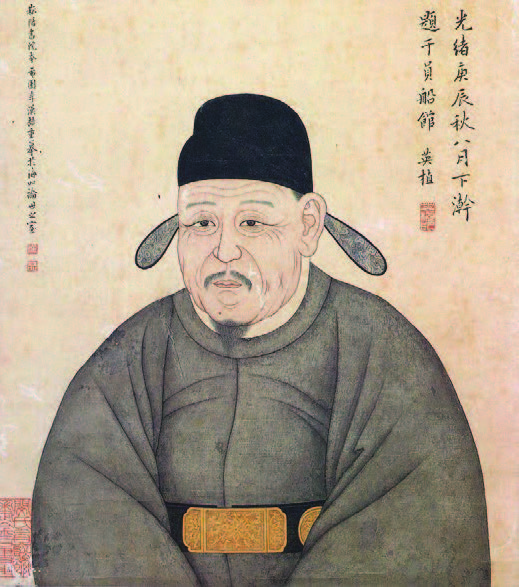
Jeong Mong-ju was one of the most prominent scholar-officials of the final years of the Goryeo era

A portrait of Hwang Hyeon, a seonbi, poet, and historian active during Korea's final years under Joseon rule. This portrait was produced in 1911 by the painter Chae Yong-sin, and has been designated a Treasure.
Jeong Mong-ju as the Epitome of the Seonbi Ethos
One well-known paragon of the seonbi ethos is Jeong Mong-ju (1337–92; penname Poeun), a
seonbi from the late Goryeo period (918–1392). He demonstrated all that was required of an
ideal Confucian gentleman—a lofty character, profound learning, and extensive experience.
He was an example of a fully realized person according to the moral, academic, and political
standards of his day. Jeong Mong-ju lost his life while striving to sustain the rule of the Goryeo
Dynasty in the face of the forces seeking to establish a new dynasty. His death epitomized
the Confucian ideal of “sacrificing oneself for the achievement of benevolence” (殺身成仁).
This is to say that his death was less about fidelity and more about morality. His life
illustrates the weight Confucianism placed on loyalty and morality.
Along with two other late-Goryeo scholars (Yi Saek and Yi Sung-in), Jeong Mong-ju was
exalted by Joseon-era seonbi as an example to follow. Reverence for Jeong Mong-ju persisted
throughout the Joseon era as an epitome of the seonbi ethos as well as the progenitor of
Korean Neo-Confucianism. The renowned Joseon Confucian scholar Song Si-yeol (1607–89)
accounts in his memorial, “The birth of Jeong Mong-ju was great fortune not only for Goryeo,
but also for our [Joseon] royal court.” This demonstrates how significant an influence Jeong
Mong-ju became on the spiritual and ideological realms of the Joseon period.
Hwang Hyeon and His Conscience
Another eloquent example of the seonbi ethos is Hwang Hyeon (1855–1910; penname Maecheon). Hwang spent the bulk of his life in what is now Gurye County in Jeollanam-do Province and never held an official position. He believed that giving up one’s life to accompany the fall of one’s country is required of seonbi—and put his beliefs into action. When Imperial Japan deprived Joseon of its sovereignty in 1905, Hwang Hyeon planned to go into exile in China but was unable to in the end. He killed himself upon the full annexation of Korea by Japan in 1910. In his will, Hwang laments, “I have no duty to die. However, after 500 long years of cultivating seonbi on this land, it is deplorable that no one has come forward and sacrificed his life on this day of our national demise. I am willing to sleep forever not to betray both the heavenly order and my lifelong learning. It [dying] is only a liberation.” He also says in a poem composed before his death, “On an autumn day, I close the book and reflect on the past by the lamp / It is hard to live the life of an intellectual.” Hwang Hyeon was a seonbi and intellectual in the true sense of the word as he only acted following the dictates of his conscience. In modern Korea, seonbi were often misunderstood as personifications of unrealistic stubbornness, irrational single-mindedness, and inhumane indifference. This is not what seonbi were at heart. They lived for justice, morality, and virtue. Maintaining a critical view of reality was one of the essential qualifications of becoming a seonbi: not blind obedience, but moral insight. They were morally driven actors who had the full capacity to sympathize with the hardships of the people.