
Feature
In Search for Historic Legacies of Korea
By Byeon Yeong-hwan
Cultural Cooperation in Archaeology
The National Research Institute of Cultural Heritage has been undertaking archaeological research on overseas historic sites that suggest associations with Korean history. Staring in the early 2000s, the effort to track Korean traces beyond the Korean Peninsula has been carried out through cultural cooperation with Russia, Mongolia, Uzbekistan, and Kazakhstan. This collaborative research covers areas in Central Asia that are located along the Silk Road.
The 15 years of joint investigations has enjoyed marked success in uncovering material legacies pertinent to Korea from Uzbekistan to the Altai Mountains and Siberia.
Well-established Partnership with Russia
Among the partners, Russia is the most long-standing. The partnership began in 2000 with a three-year joint research project on the Khabarovsk Suchu site along the lower reaches of the Amur River, and has continued into the present through investigations at different sites in Primorsky Krai, Russia. These include the Bulochka site (2003–05), Troitskoe site (2007), Dolgoe Ozero site (2008), Osinovoe Ozero (2009), Koksharovka site (2008–14), Sinelnikovo-1 site (2015–16), and Starorechenskoe site (2017). The archaeological remains brought to light through these projects cover an extensive historical span from the Neolithic era to the North and South States period, a historical phase starting from Silla’s subjugation of the rival kingdom Goguryeo in 668 to the fall of the northern state of Balhae in 926. Balhae emerged out of the northern stretches of the Goguryeo Kingdom about 30 years after it fell to Silla.
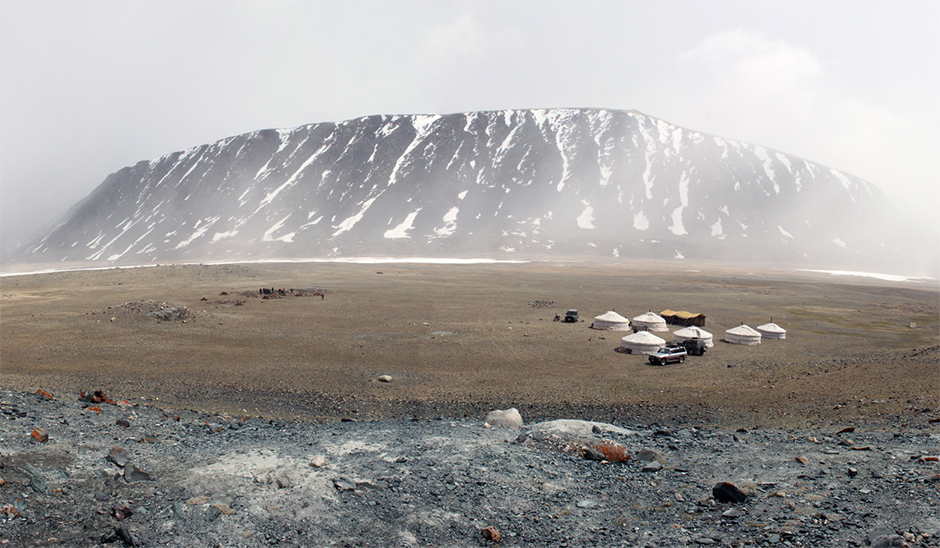
The Shiveet Khairkhan site in Mongolia
The archaeological research in Russia over the last 15 years has unearthed tangible evidence of the historical footprints of Koreans outside the Korean Peninsula that could not have been tracked through documentary research. The fruit of long-standing bilateral partnership, these research results are expected to help establish and disseminate a more comprehensive view of Korean history.
Contribution to the Understanding of Asian History
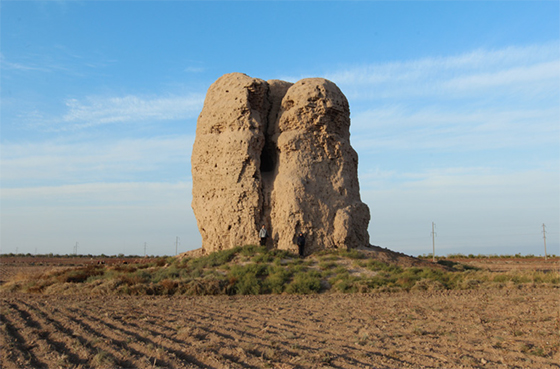
Zurumala Stupa near the Buddhist cave temple Karatepa in Uzbekistan
In Mongolia, the National Research Institute of Cultural Heritage has been carrying out research on historical sites in the area stretching from the Gobi Desert to the Altai Mountains from the perspective of archaeology, ethnography, and human genetics since 2009. Projects conducted through 2015 have generated a distributional map of about 8,000 tombs (including Pazyryk burials) and petroglyphs in the region. From 2016, excavation efforts began on Pazyryk tombs in the Altai Mountains. Since Pazyryk burials share similarities with stone mound tombs in Korea, the efforts in Mongolia are likely to provide critical evidence testifying to the historical connections between the two countries. It is also expected to provide input into the processes of exchange that took place between nomadic and agricultural societies and the movements of ancient people, ultimately allowing a better understanding of the overall history of Asia.
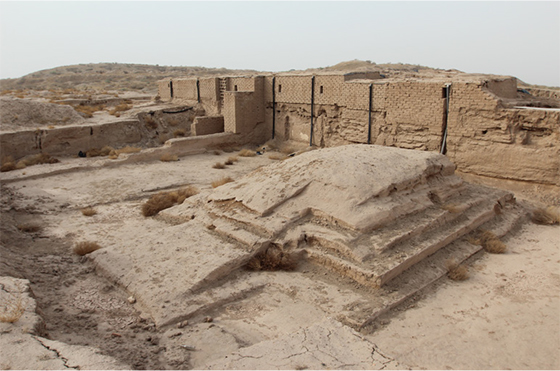
The northern section of the Karatepa site

A research site seen from a hill to the south of the Buddhist temple Karatepa
Links to Korea in Uzbekistan and Kazakhstan
In Uzbekistan, which served a cultural bridge across the Silk Road between the West and East, Buddhist monasteries at Karatepa near Tezmir were the subject of research from 2011–15, carried out in partnership with the Arts and Sciences Research Institute of the Academy of Sciences of Uzbekistan. Constructed around the time when Buddhism was introduced into the region, the Karatepa monasteries are useful for a comparative analysis of Buddhism as practiced in the Three Kingdoms period (57 B.C.–A.D. 668) in Korea.
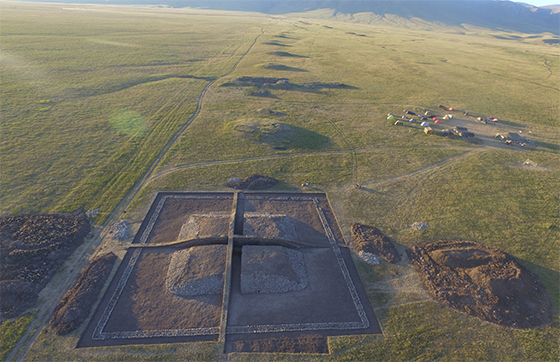
The Katartobe tombs site in Kazakhstan, as seen from the south
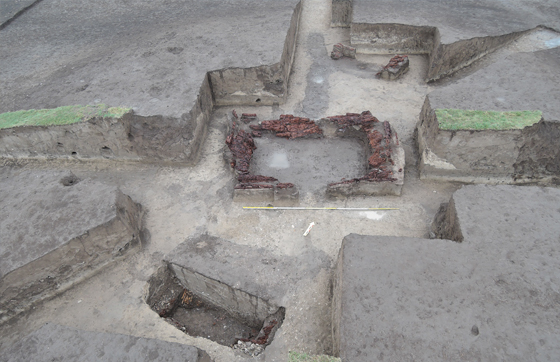
The center of Tomb No. 2-8 in the Katartobe tombs site
With regard to Kazakhstan, an agreement on bilateral cooperation was signed in 2014 with the Archaeology Institute of Kazakhstan, followed in 2015 by the initiation of the study of the Katartobe tombs site in a high grassy plain in southeast Kazakhstan. Research has been pursued through both non-intrusive investigation using Ground Penetrating Radar (GPR) and more traditional methods of excavation. The GPR investigation has brought to light data on the form and construction method of tombs that could not have been ascertained through traditional methods, producing valuable information for future conservation activities. Meanwhile, excavation research has confirmed that the main portion of the tombs where the body was interred is made of a wooden chamber over which an earthen mound was erected. This structure is similar to Korean stone mound tombs, hinting that further research in this regard could reveal cultural associations and mutual exchanges between the two countries.
The National Research Institute of Cultural Heritage has discovered vestiges of the Korean legacy beyond the limits of its current territory. What has been unearthed so far, however, forms just a small aspect of the grand historical puzzle of ancient Korea. The institute is continuing with its current collaborations and will develop more as part of its efforts to piecing together a more integrated picture of Korean history.
* This text has been extracted and revised from an article published in the Journal of Korean Archaeology in 2015.
Text by Byeon Yeong-hwan, Archaeology Research Division, National Research Institute of Cultural Heritage