Feature
Janchi, Korean Feasts
By Joo Young-ha
Painting of a Person’s Life Pyeongsaengdo, or “painting of a person’s life,” is a form of traditional painting from the Joseon era that depicts a series of joyous events experienced over the course of an aristocratic life, including rites of passage and selection for office. This pyeongsaengdo is believed to date to the late 19th–early 20th century. (Photo courtesy of the National Museum of Korea)
People in the United States and Canada have traditionally enjoyed a type of social gathering called a potluck where the host prepares a party space and the guests all bring a dish or two. Some speculate the term potluck derived from potlatch, a lavish ceremonial event practiced by indigenous North American peoples in the northwestern part of the continent. A potlatch could be held for rites of passage marking birth, coming of age, or marriage, and also for other important social occasions such as the inheritance of a father’s status by his son or the breaking of ground for the construction of a new house. Participants bring food or other gifts to a potlach, and the host gives away food or gifts when the event is completed. Korea naturally has its own event culture as well, including the celebratory feasts known as janchi.
Janchi and Its Food
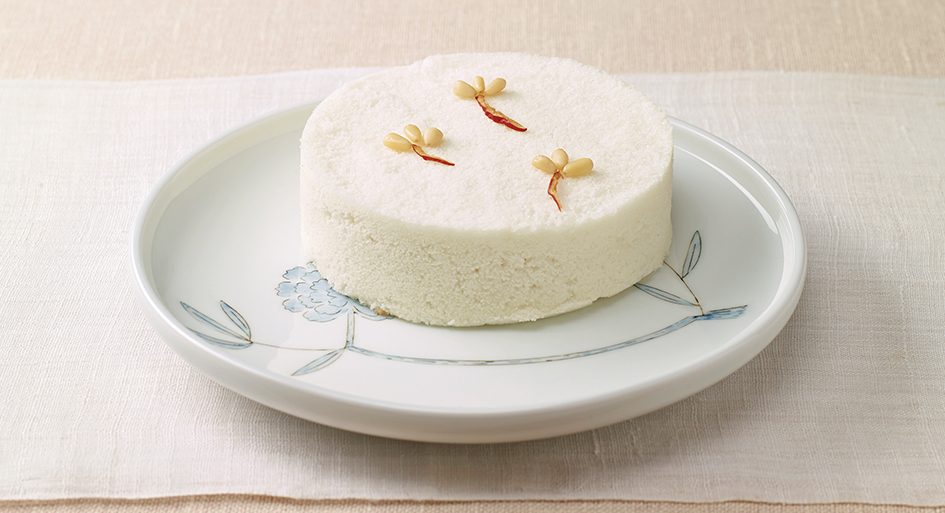
Photo courtesy of the Korean Food Promotion Institute
Rice Cake (Tteok)
Starting in the 1990s, the preferred location for a first birthday party gradually shifted from the home to a restaurant specializing in such events. The essential dishes for the celebratory meal remained unchanged, however. Even at a special banquet hall, baekseolgi white rice cake and red bean-coated millet balls are a must for the main table set in front of the parents and their baby. The guests are also treated with these traditional foods along with other dishes (beef rib soup, braised beef ribs, grilled fish, seasoned vegetables, kimchi, and steamed rice). Of course they should not arrive at a first-birthday party empty-handed: They conventionally offer money in an envelope, a golden ring for the baby, or other gifts.
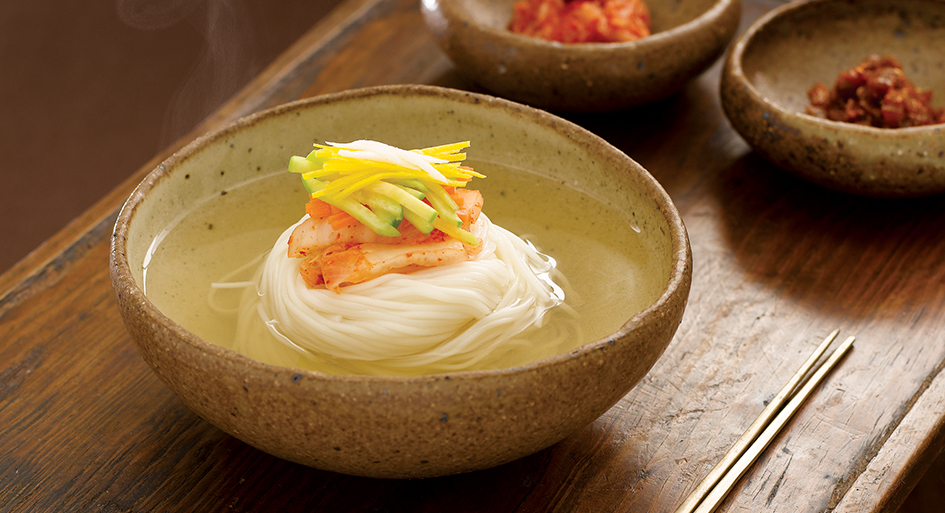
Photo courtesy of the Korean Food Promotion Institute
Noodles (Guksu)
At the beginning of the 20th century, noodles started to appear at wedding feasts. With an increase in domestic wheat production starting in the 1910s, both wheat and buckwheat flour began to be used for making these wedding noodles. Importantly, the United States started to give away surplus wheat to countries like Korea, Japan, Taiwan, and India in the 1950s. In the 1960s, wheat noodles became a fixture among the foods prepared for the guests at a wedding ceremony, whether it was held at home or in a commercial banquet hall. This developed into what has become known as janchi guksu, or “feast noodle,” a simple dish made by pouring hot anchovy broth over a bowl of noodles and garnishing it with julienned egg yok and grilled dried laver.
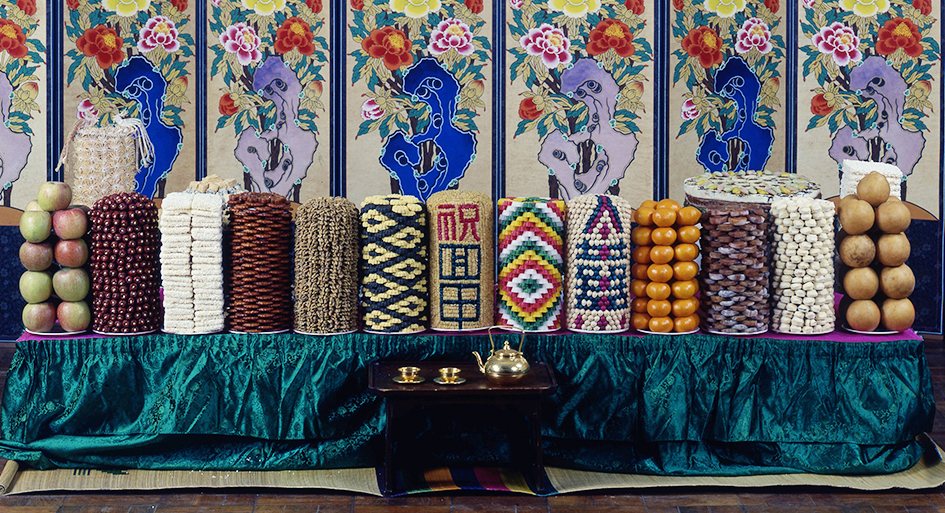
Photo courtesy of the Institute of Korean Royal Cuisine
Layered Foods (Goim Eumsik)
This royal practice of preparing layered dishes for a 60th birthday feast eventually spread beyond the royal court and into Joseon society in general. People celebrated the achievement of surviving to the 60th birthday by preparing layered foods 30-40 centimeters high. This form of ceremonial food can also be found on ritual tables prepared for death anniversaries. In Korea, family members gather on the death anniversary of their parents or grandparents and observe a rite that includes layered foods set out on a ritual table for their ancestors.
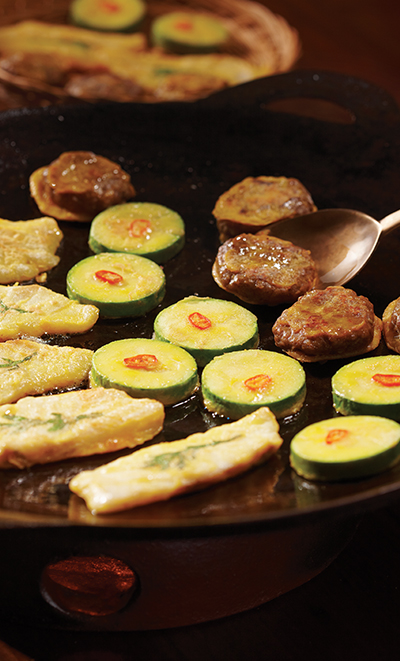
Photo courtesy of the Korean Food Promotion Institute
Pan-fried Delicacies (Jeon)
Jeon, literally “pan-frying,” traditionally refers to sliced meat, fish, or vegetables that are coated with flour and fried in oil in an iron pan. Documents from the Joseon era refer to pan-fried fish as jeon-yu-hwa, or “flowers fried in oil,” indicating that jeon made with fish are as pleasing to the eye as flowers. The term jeonyuhwa was eventually simplified to jeo-nya when it was spoken. When pan-fried delicacies were being made in a household, the smell of pan frying travelled across the neighborhood and let everyone know the family was celebrating.
As cooking oil became more affordable in the 1970s, jeon grew more popular as a party food. Around this time there was a transformation in the lineup of pan-fried delicacies popularly prepared for an event. The list of must-have jeon for Lunar New Year and Chuseok (a Korean harvest celebration) came to include donggeurangttaeng, a type of meatball made by mixing minced beef with chopped vegetables, flour, and egg yolk, forming it into balls, and frying them in a pan. Others include fish jeon, sliced fish meat coated in flour and egg yolk, and pan-fried skewered jeon made by skewering beef strips seasoned with soy sauce together with green onions, mushrooms, and other ingredients, dipping the skewers in egg yok, and then frying them. The labor-intensive task of making pan-fried delicacies for Lunar New Year and Chuseok was considered a ceremonial duty of female family members. In the 1990s, however, the longstanding practice of women making jeon on the traditional holidays started to be questioned from the perspective of gender inequality. In response, some families are trying to equalize the practice by sharing the duty for making ritual foods, including jeon: Each participant prepares an assigned dish and brings it to the site of the holiday ritual. An increasing number of Korean families are now collecting the dishes for Lunar New Year, Chuseok, and other festive events by means of a potluck.
Text by Joo Young-ha, Professor at the Graduate School of Korean Studies of the Academy of Korean Studies

한국식 포틀라치, 잔치 음식
미국과 캐나다에는 포틀럭(potluck)이라는 파티가 있다. 파티의 주관자는 장소만 제공하고, 참석자들이 요리 한 두 가지를 지참하는 이 포틀럭 파티는 북미 원주민들에 의해 행해졌던 의식 행사인 포틀라치(potlatch)에서 유래된 것으로 여겨진다. 포틀라치는 출생, 성년식, 혼인 등과 같은 통과의례 행사나 자식이 선친의 지위를 물려받는 장례, 새집을 짓기 시작할 때도 열렸다. 포틀라치 참석자는 음식이나 선물을 가지고 오고, 돌아갈 때 주관자는 참석자에게 음식과 선물을 주었다. 포틀라치는 한국어로 ‘잔치’이다.
잔치와 음식
떡
1990년대 이후 한국에서는 돌잔치를 가정에서 하는 경우가 드물고, 돌잔치를 전문적으로 대행하는 음식점을 이용한다. 이곳에서는 아이와 부모가 앉은 자리의 식탁에 백설기와 수수팥떡을 반드시 차린다. 손님들에게도 이 두 가지 떡을 제공하지만, 손님의 식탁에는 갈비탕, 잡채, 갈비찜, 생선구이와 밥•김치•나물 등이 차려진다. 참석자들은 아이를 위해서 금반지나 봉투에 넣은 현금을 선물로 내놓는다.
국수
20세기 이후 혼례식의 잔치에는 어김없이 국수가 올라왔다. 1910년대 이후 국내 밀 생산량이 늘어나면서 메밀국수와 함께 밀국수가 올랐다. 특히 1950년대 이후 미국 정부는 자국에서 생산하여 남아도는 밀을 한국을 비롯하여 일본•타이완•인도 등에 무상으로 제공해주었다. 1960년대 이후 가정에서 치르는 혼인 잔치나 음식점에서 열린 혼인 피로연에서는 참석자에게 국수가 제공되었다. 익힌 국수를 담은 그릇에 멸치를 삶아낸 국물을 붓고 그 위에 달걀의 노른자를 기름에 지져 실처럼 가늘게 썬 것과 구운 김 등을 올려낸 국수를 사람들은 ‘잔치국수’라고 불렀다.
고임음식
민간에서도 왕실의 고임음식을 모방하여 환갑잔치 때 떡•은행•과자 등을 30~40cm 높이로 쌓아 올려 장수를 축하했다. 또한 한국의 가정에서 쉽게 볼 수 있는 제사에서도 고임음식을 접할 수 있다. 세상을 떠난 조부모와 부모의 기일에 형제•자매•손자•손녀 등이 모여서 제사를 모시는데, 과일 세 가지, 떡, 그리고 고기와 생선을 각각의 그릇에 차곡차곡 쌓은 고임음식을 올린다.
전
1970년대 이후 식용유의 값이 싸지면서 각종 잔치 때 빠지지 않는 음식이 ‘전’이다. 이 무렵부터 전의 종류는 그 이전과 약간 달라졌다. 잘게 갈아낸 소고기와 채소에 밀가루와 달걀노른자를 넣고 동그랗게 반죽하여 지져낸 일명 ‘동그랑땡’, 얇게 썬 생선의 살에 밀가루, 달걀의 노른자를 차례로 묻혀 지져낸 생선전, 길쭉하게 썬 소고기에 간장으로 양념을 한 뒤 파•버섯 등과 함께 나무 꼬치에 끼워 달걀의 노른자에 담근 후 기름에 지진 꼬치전 등을 잔치나 설날과 추석 때 반드시 마련한다. 전을 부치는 일은 주로 여성들이 많았다. 1990년대 이후 설날과 추석 때 여성들이 몇 시간 동안 전을 만드는 일이 가족 내의 성 역할 불평등으로 사회적 논의가 되었다. 일부 가정에서는 형제•자매들이 서로 음식을 나누어서 미리 만들어오는 방법을 통해 이 문제를 해결한다. 이제 한국에서도 설날과 추석을 비롯한 잔치 때의 음식 장만을 ‘포틀락’으로 하려는 가정이 늘어나는 중이다.
Text by 주영하, 한국학중앙연구원 장서각 관장