Feature
Ramie Cloth in Korea and Japan
By Kim You-kyoung
Celebrated for being cool to the touch and providing superb ventilation, ramie has long been a fabric of choice for summer clothing in Korea. Cultivation of the ramie plant is only possible where appropriate soil and climate conditions co-exist. The Hansan area in Seocheon, Chungcheongnam-do Province has a longstanding reputation for ramie production. A similar heritage is flourishing in the neighboring country of Japan as well, represented by the ramie textiles of Ojiya-chijimi and Echigo-jofu in
the Uonuma region of Niigata Prefecture. The traditional production of this fabric in Korea and Japan is explored below. Ramie cloth woven by Bang Yeon-ok, nationally de
Weaving of Ramie Fabric as Global Intangible Heritage
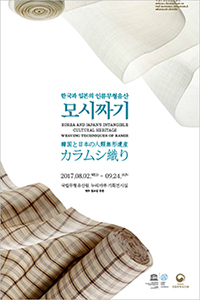
The poster for the special exhibition
Intertwined with the natural climate and cultural features, ramie weaving takes on various forms depending on the region and helps to define the identity of its practitioners. Among others, community cultures associated with Hansan ramie and Ojiya-chijimi and Echigo-jofu were respectively entered on the UNESCO Representative List of the Intangible Cultural Heritage of Humanity in 2011 and 2009.
Korea’s Hansan Ramie
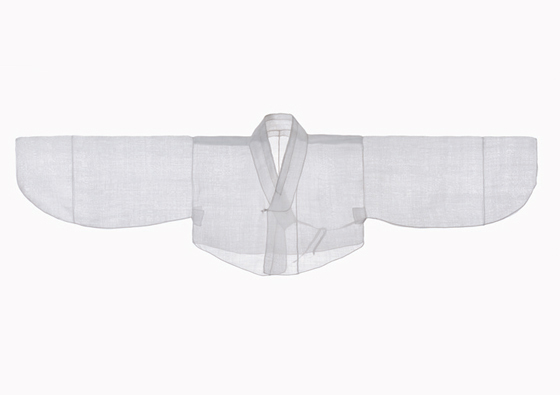
A woman’s ramie jacket (collection of the Gyeonggi Provincial Museum)
In traditional Korean society, the production of fabric, including ramie weaving, was carried out as a family operation by women. It was a primary means for them to contribute to family economies and to form communities for labor-sharing and cooperation.
There is an old saying in Korea that captures the essence of the arduous processof ramie weaving: “It makes grooves in teeth.” This refers to a situation where someone does something over and over until becoming accustomed to the job. It is derived from the constant repetition of splitting fibers with the teeth to the desired thinness for ramie production. The ramie cloth produced as a result of this laborious process boasts considerable refinement and elegance. Hansan ramie of a particularly fine weave is often compared to the wings of a dragonfly.
Japan’s Ojiya-chijimi and Echigo-jofu

A summer garment made of Echigo-jofu(collection of the Suzuki Bokushi Memorial Hall)
During the Edo period (1603–1867), a new technique was developed for weaving fine textures into the surface of ramie cloth. This crepe ramie, or chijimi, enhanced the charm of ramie clothes as summer garments by producing an additional cooling sensation. Weaving techniques continued to advance into the later Edo period, resulting in ramie fabrics woven with diverse decorative motifs and dyed in a variety of colors. Merchants from Edo, today’s Tokyo, flocked to Echigo for the trade in ramie textiles. Japan’s traditional ramie weaving is distinct from Korean practices in its addition of embellishing designs and bleaching by laying ramie cloth out in the snow. These time-honored characteristics of ramie weaving have been carefully maintained into the present.

A sample book showing Ojiya-chijimi textiles (collection of the Ojiya City Board of Education)
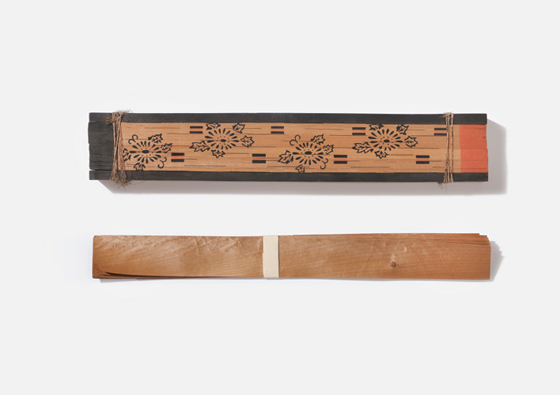 Japanese dyeing tools for ramie fabrics (collection of the Suzuki Bokushi Memorial Hall)
Ramie Traditions of Korea and Japan on Display
A special exhibition is underway at the National Intangible Heritage Center spotlighting the ramie traditions of Korea and Japan as global intangible heritage for all humanity. The exhibition will continue until September 24 of this year.
This special exhibition presents the ramie traditions of the two neighboring countries under several themes: the Korean section includes the tradition of ramie in Korean clothing, Hansan ramie as a global intangible heritage, Hansan ramie and other ramie textiles, and ramie weaving in Korea. For Japan, it covers the history and culture of Japanese ramie and Ojiya-chijimi and Echigo-jofu as global intangible heritage

The ramie garment with pleats under the armpit excavated from the
tomb of Yi Heum (1522–1562), a great-grandson of King Seongjong
(collection of the Gyeonggi Provincial Museum)
Regarding Japan’s ramie culture as defined by Ojiya-chijimi and Echigo-jofu, diverse weaving tools, a sample book showing ramie textiles traded by Edo merchants, ramie textiles and a ramie kimono, and a video clip on the production of chijimi are all on exhibit.
This special presentation of the ramie traditions of Korea and Japan is expected to provide visitors with a chance to better appreciate the meaning of the inscription of ramie weaving on a global heritage list, and also to gain a comprehensive understanding of ramie cloth as one of the most popular textiles in the history of clothing.