Feature
Unjusa Temple and Its Striking Array of Buddhist Statues and Pagodas
By Kim Hee-tae
Uniquely housing an amazing number of pagodas and statues scattered along either side of a north-south valley in addition to its buildings, the Buddhist monastery Unjusa Temple is best known for its nickname cheonbul cheontap, “a thousand statues and a thousand pagodas.” The numerous Buddhist monuments encompassed by Unjusa Temple have long been the subject of extensive academic research, and in March 2017 they were placed on the country’s Tentative List, a register of candidate heritage properties for future inscription on the UNESCO World Heritage List.
A Buddhist Temple Overflowing with Statues and Pagodas
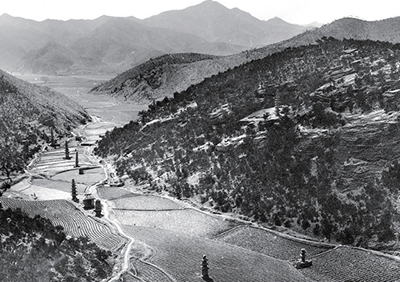
Unjusa Temple in 1917
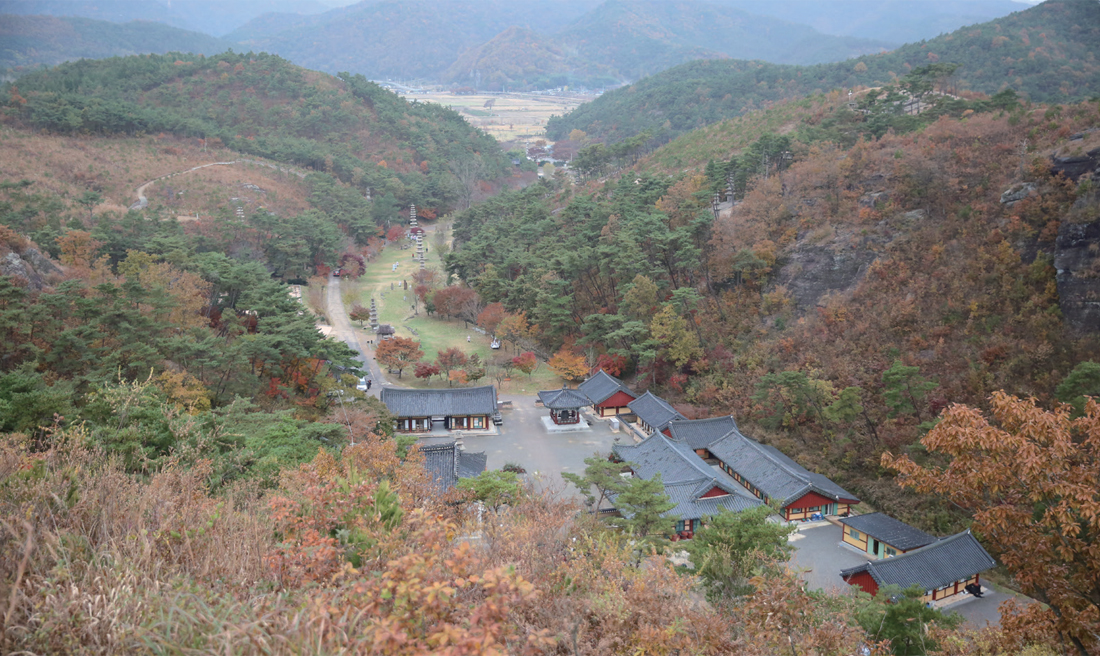
A panoramic view of Unjusa Temple
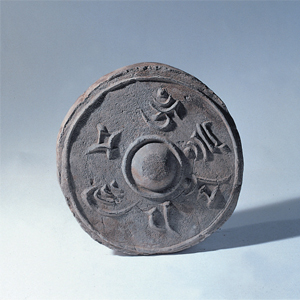
A roof-end tile inscribed with a fortuitous Buddhist
mantra, excavated from the Unjusa compound
Long a subject of dispute, the initial foundation of Unjusa Temple has been estimated to date to the late 10th or early 11th century in the Goryeo Dynasty according to excavation research performed from 1984–89 by Chonnam National University. Following its foundation in the late 10th or early 11th century, the temple enjoyed its apogee in the 12th century, but was forced to shut down following a fire during the Japanese invasion
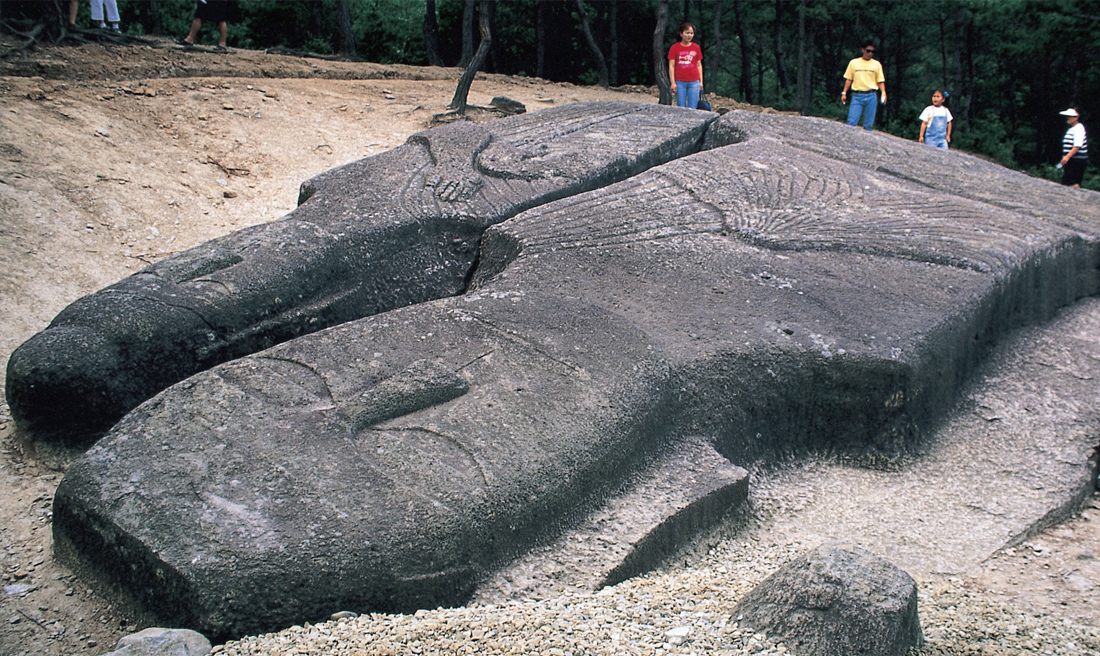
Reclining Buddhas provincially designated as Tangible Heritage No. 273; the one to the left measures 12.7 meters and is rendered with
crossed legs. The one to the right is 10.26 meters long. Despite not having legs, it is considered to represent a standing Buddha.
of 1597 during the Joseon era. Unjusa long remained closed, but in the early 20th
century it was subjected to a series of reconstruction efforts. It eventually reached its
current form of a handful of Buddhist buildings standing alongside the age-old statues
and pagodas.
Historical mention of Unjusa can be found in the Joseon geography Sinjeung
dongguk yeoji seungnam (Enlarged Edition of the Augmented Survey of the Geography
of Korea), published in 1530: “Situated on Mt. Cheonbulsan, Unjusa Temple has one
thousand stone statues and pagodas on each side of the hills to either side of the
temple…” From this account is derived the cheonbul cheontap (“a thousand statues and
a thousand pagodas”) phrase commonly associated with Unjusa.
Exceptional Morphological Diversity and Unique Spatial Arrangement
The Buddhist images at Unjusa Temple are presented in diverse positions— reclining, sitting, standing, and even two Buddhas seated back to back. Fully 62 have survived intact, and there are many partially remaining but missing the body or the head. They stand alone or in groups, with the free-standing images found in the more level middle sections of the hills and on their peaks or engraved in rocks. Buddha clusters are mainly in stone shrines made from rocks, generally in the form of a seated Buddha in the middle flanked by standing images.

Left: A 5.3-meter stone shrine for Buddha images, nationally designated as Treasure No. 797
Right: A seven-story stone pagoda with unique circular body stones, nationally designated as Treasure
No. 798: although its eccentric form
defies an estimation of its age, the architectural methods indicate a construction date in the late Goryeo period.
A seven-story stone pagoda
As for the stone pagodas, 22 currently remain in an intact condition. They demonstrate great diversity in form, a characteristic of Goryeo pagodas that distinguishes them from the more monotonous forms that prevailed in the preceding Silla era. Some are in a rectangular form, while others take a circular shape. There are also pagodas madeof fired bricks or in the form of a pillar. The stone faces on their bodies are distinctively embellished with geometric lines in the shapes of a diamond, crossing lines, or parallel lines.

A seated Buddha (left) with an aureole, carved from a single piece of rock
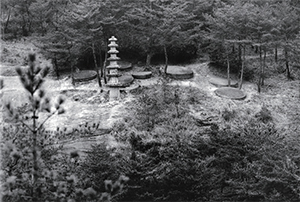
In addition, seven stone discs of 2–4 meters in diameter are arranged mirroring
the form of the Big Dipper. The seven stones are rendered in different thicknesses
according to the brightness of the corresponding star in the constellation. Made in the
12th or 13th century, this stone arrangement at Unjusa Temple is estimated to be the
world’s oldest evidence of a representation of the magnitude of stars.
The Unjusa property on the Tentative List testifies to the long-standing practice of
Buddhist worship in a single place that dates back to the 10th century.
The component pagodas and Buddha images provide broad evidence of the sculptural
and architectural techniques of the past. The entire site is registered at the national
level as Historic Site No. 312, and includes three nationally designated Treasures, ten
Tangible Heritage items and two Heritage Materials inscribed on the provincial list of
Jeollanam-do.
A thriving center of Buddhism from the late 10th until the late 16th century, Unjusa
Temple is an exceptional example of the expression of religious beliefs and scientific
knowledge. It is additionally distinguished by the unique stylistic characteristics and
spatial arrangements of the Buddhist images and pagodas.