Feature
The Woldae, a Platform for Communication, Restored at Gwanghwamun Gate
By Kim Moon-sik, Professor in History at Dankook University Photography by Korea Heritage Service, National Folk Museum of
The Woldae,a Platform for Communication, Restored at Gwanghwamun Gate
Traditional Korean royal architecture often included a raised platform known as a woldae in an effort to elevate the magnificence and dignity of the building. Positioned in front of major palace buildings, woldae were installed at a lower level than the structures they were intended to dignify. A woldae platform could be narrower or wider than the building, and was often paved with bakseok (flat stone slabs). Woldae were mostly used as a space for royal ceremonies. Guests and musicians would be seated together on these raised platforms running along the front side of important palace buildings.
Royal Encounters with Court Officials
Seoul is home to five royal palaces dating to the Joseon Dynasty (1392–1910): Gyeongbokgung, Changdeokgung, Changgyeonggung, Gyeonghuigung, and Deoksugung. A woldae was erected at the front gate for each of them, and at some of the major halls as well. One prominent example is the woldae for Gwanghwamun, the front gate of Gyeongbokgung Palace. As the first royal residence built for the Joseon kings, Gyeongbokgung was the main palace of the dynasty. The woldae at its front gate was the only one with railings along its sides. Joseonera protocols dictated that government officials should come in and out of Gyeongbokgung through the west gate (Yeongchumun), while members of the royal family, court ladies, and other service personnel used the east gate (Geonchunmun). The front gate was reserved for the king during royal processions. Those who had been selected to become queen or crown princess also entered the palace through the front gate on the day of their weddings. Foreign emissaries could be welcomed into the palace through the front gate as well. During these significant state events, the area in and around Gwanghwamun, including its woldae, was lavishly decorated with flowers and enlivened with exuberant music and dance.
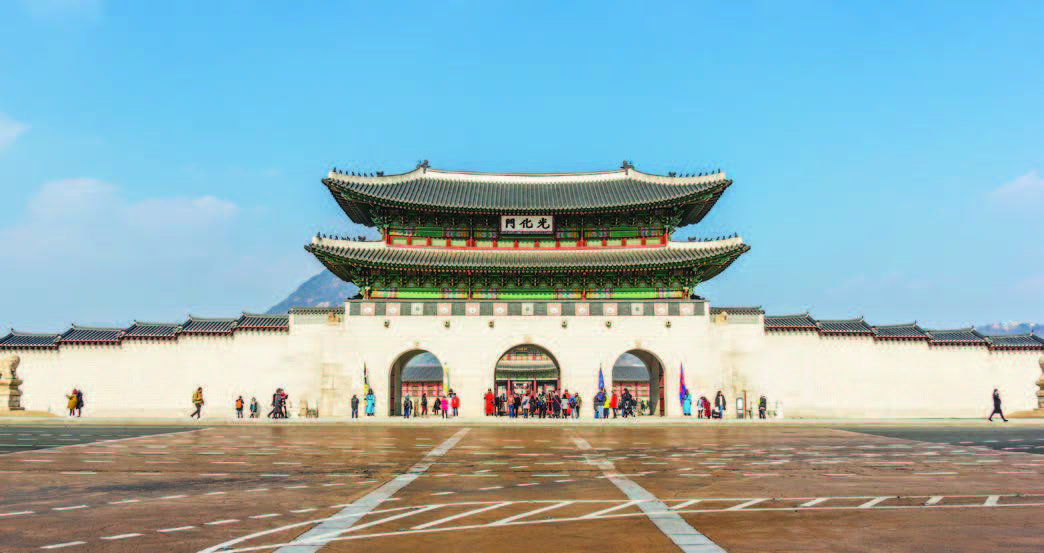
Before the restoration of the woldae
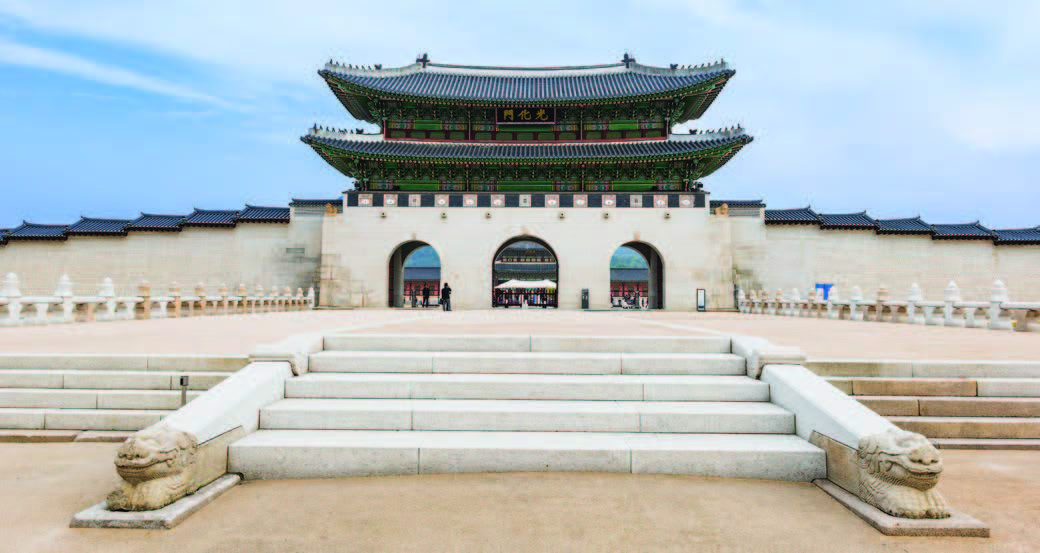
After the restoration of the woldae
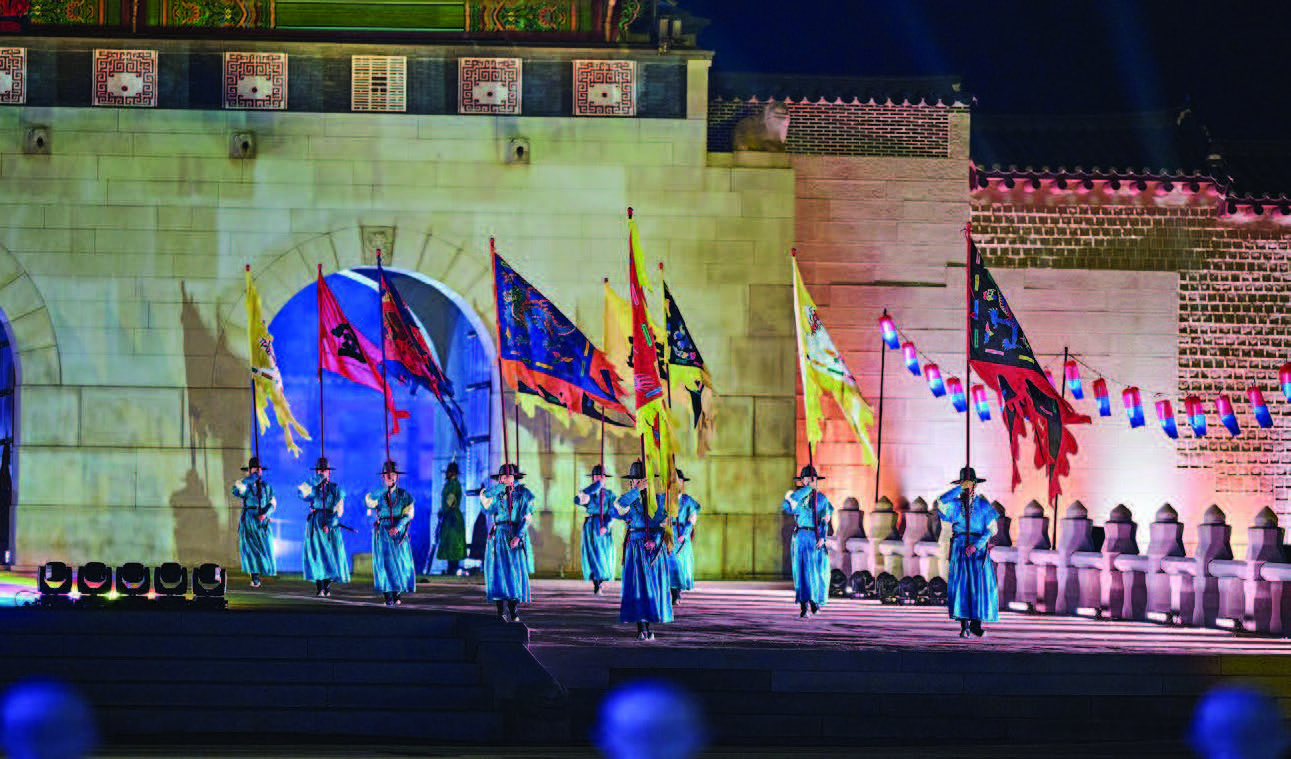
A reenactment of the Royal Guard Changing Ceremony at the celebration for the completion of the woldae reconstruction
Besides serving as the main royal passageway, the woldae of Gwanghwamun Gate provided a space for the king to meet with court officials. The gwageo examinations, held to select government officials, were among those occasions. The final stage of these gwageo examinations took place at the palace. While candidates for literary positions sat their tests in front of the throne hall (Geunjeongjeon), aspiring military officers needed an area spacious enough to fully show off their archery and equestrian skills. The area around Gyeonghoeru Pavilion was considered suitable, as was Six Ministries Street (Yukjo geori), a thoroughfare running straight from Gwanghwamun Gate that derived its name from the offices of the ministries flanking it. According to records in Joseon wangjo sillok (The Annals of the Joseon Dynasty), there were five occasions when gwageo examinations for military officers were held in front of Gwanghwamun Gate. Each time, the king came out onto the Gwanghwamun woldae to supervise the military tests with flocks of commoners crowding the site to catch a glimpse of the event.
The king would also appear on the Gwanghwamun woldae to watch archery contests between members of the government and test firings of newly developed artillery, events that were often held on Yukjo geori. King Sejo (r. 1455–68) and King Myeongjong (r. 1545–67) are recorded to have observed archery competitions between officials from the vantage point of Gwanghwamun’s woldae. King Sejo also took to this raised platform to witness the power of a newly invented cannon. Yukjo geori, the most spacious open area in Seoul, hosted a wide range of state events attended by the king, and no commoners wished to miss the rare opportunity to see such a spectacle.
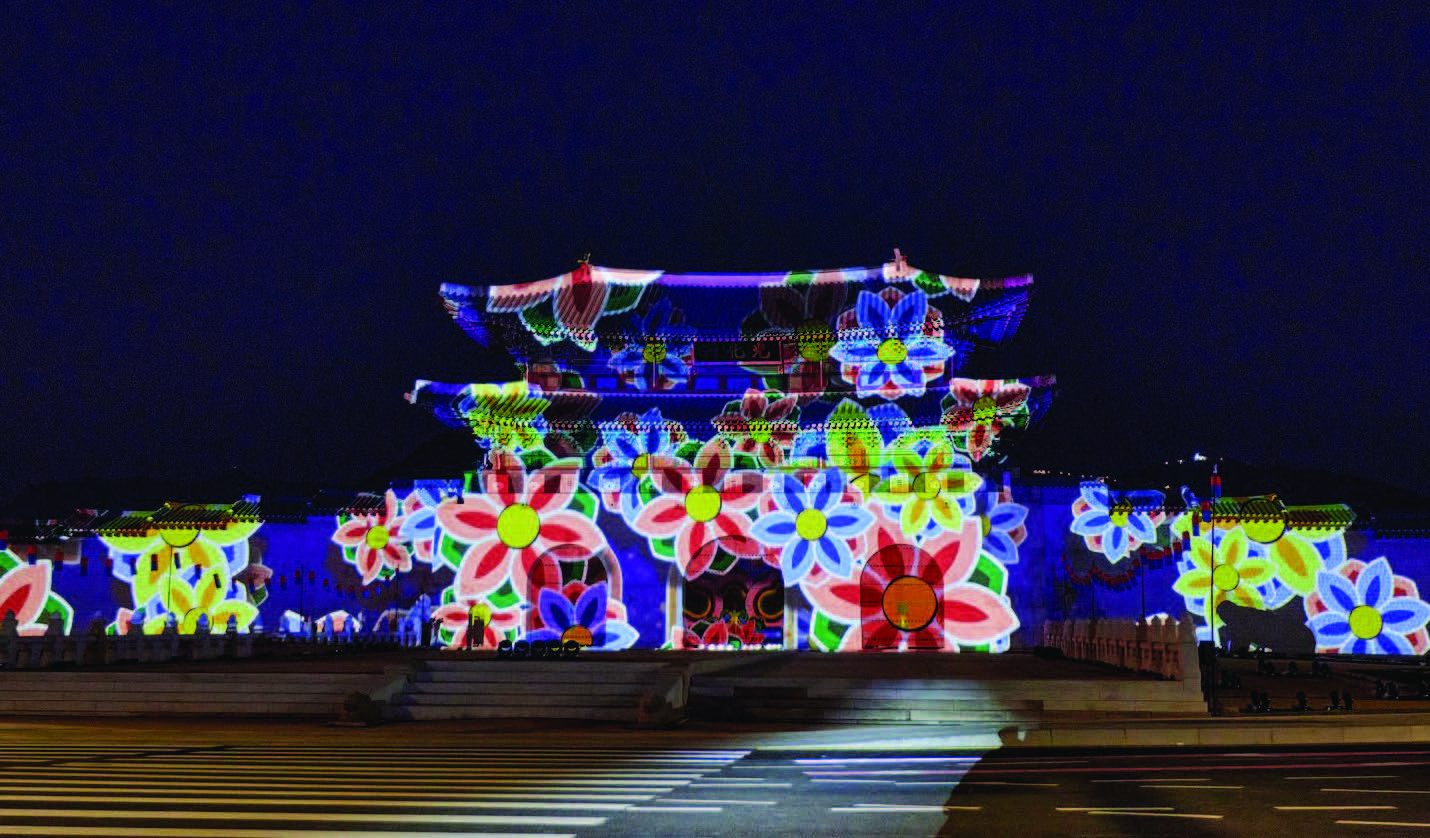
A media-façade show celebrating the reconstruction of the woldae
Interactions be between the King and Commoners
The woldae at Gwanghwamun Gate also offered a means for the king to communicate with his people. During the reign of King Sejong (r. 1418–50), an individual who had been unable to have his complaint heard by other means came to Gwanghwamun Gate and spread out sheets of paper detailing his complaint. The complaint and his suggestions for its redress were so extensive that the papers spread all the way from Gwanghwamun Gate to the Jungchuwon Office (where the southern boundary of the Seoul Government Complex is located today). The complaint was mostly composed of accusations of illegal behavior among local and central government officials. Another complaint was posted on the walls of Gwanghwamun Gate during the reign of King Jungjong (r. 1506–44). It detailed the wrongdoings of four highranking officials from the reign of Jungjong’s immediate predecessor, Yeonsangun.
King Sejo made an active use of the woldae to collect public grievances. Feeling compassion for the frustrations of his people when they failed to have their voices heard, King Sejo sent close aids to the raised platform at Gwanghwamun to receive public complaints. When the volume of complaints grew unmanageable, those wishing an audience were made to draw lots to have their opinions recorded by officials and reported to the king. Following the spirit of this 15th-century practice of communication on the woldae, King Yeongjo (r. 1724–76) and King Jeongjo (r. 1776–1800) embraced a policy of actively listening to the opinions and suggestions of people who submitted their complaints in writing (Sangeon) or verbally (Gyeokjaeng) along the route of a royal procession.
Suffering and Rehabilitation
Gyeongbokgung’s status as the main Joseon palace was transferred to Changdeokgung Palace in the late 16th century when most of its wooden structures were destroyed during the Japanese invasions of 1592–98. The woldae at Gwanghwamun Gate consequently lost its function of connecting the monarch with his subjects. The ruins of Gyeongbokgung had been restored in 1868 in the fifth year of the reign of King Gojong. At the time, the woldae at the front gate was reconstructed as a platform 29.7 meters wide and 48.7 meters long with a seven-meter royal passage in its median.
The story of the Gwanghwamun woldae faced further twists, however. One of the streetcar lines established by Imperial Japan after its annexation of Korea in 1910 split to the east and west at Gwanghwamun, severely damaging the gate’s raised platform. The remains of the woldae were buried entirely in the 1960s when an east-west road for motorized traffic was constructed over the colonial-era rail route in front of the gate. This long-buried platform has recently been reconstructed. Launched in September 2022 under the leadership of the Korea Heritage Service, the reconstruction project was completed in October 2023. Original stone elements excavated from the site were reused for the reconstruction to the greatest possible extent.
Second, ssirem has long been practiced as community activity. Wrestling was established in Korea as a seasonal custom related to the annual agricultural cycle. Grappling competitions were organized as a means to help predict the abundance of the harvest in the first lunar month or to call for rain in dry seasons. Wrestling also served to strengthen solidarity among community members in the farming seasons. When the time drew near for the transplanting of rice seedlings, two neighboring villages would challenge each other to wrestling matches to decide which community would get priority for irrigation water from a shared channel. The wrestling practiced on these occasions was considered a matter for the entire community. Ssireum has mainly been practiced as a collective festival enhancing communication and solidarity among community members.
The woldae project was a capstone for the Gwanghwamun reconstruction project that began in 2006, completing the restoration of the central axis of the palace. With the reconstruction of the woldae, the excavated sites of two Joseon-era offices, the State Council (Uijeongbu) and the Three Military Offices (Samgunbu) located to either side of the platform, have now been made accessible to each other on foot.
To the north of the woldae is the name plaque of the gate, bearing the characters gwanghwa- mun, with gwanghwa (光化) meaning “illuminating the nation with the king’s virtue.” Beyond it can be seen successive layers of traditional Korean royal buildings. When looking toward the south of the woldae, Gwanghwamun Square and the modern thoroughfare known as Sejong-daero are bracketed by high-rise buildings. This neighborhood in central Seoul where tradition coexists alongside modernity was long a space for communication between the king and his subjects during the Joseon Dynasty. The reconstruction of its woldae will hopefully bring back the spirit of dialogue and unity to today’s Korean politics, illuminating Korean society through greater virtue.