Feature
A Buddhist Temple Shrouded in Mystery
By Text by Cheon Deuk-youm, Chonnam National University Photography by Korea Heritage Service, Clipartkorea
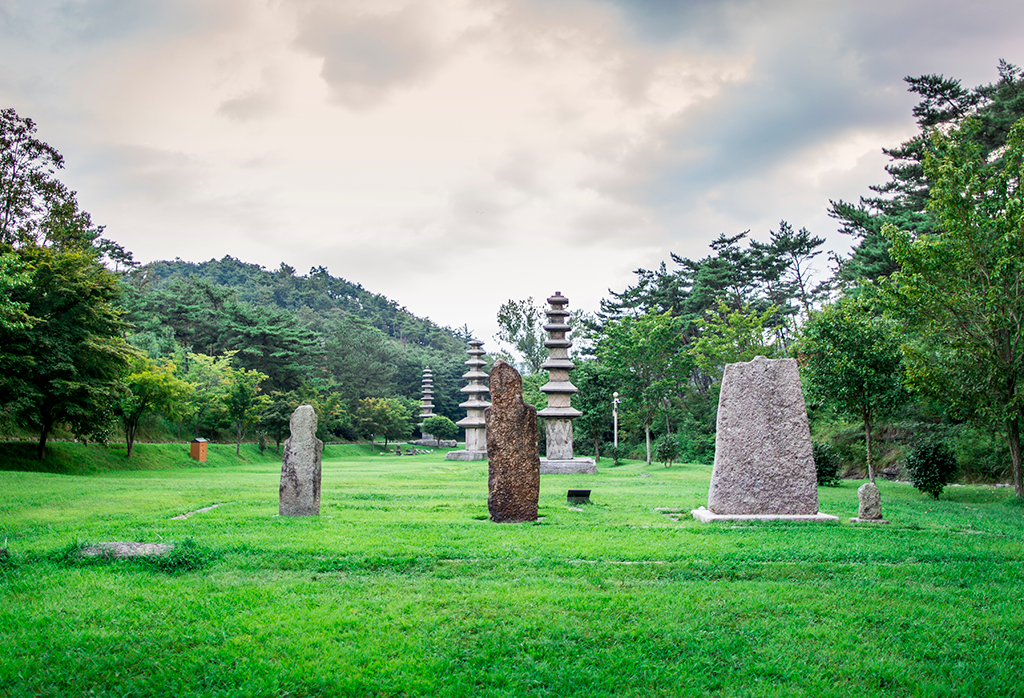
Stone pagodas at Unjusa Temple
A Thousand Buddhas and a Thousand Pagodas
Located in Hwasun, Jeollanam-do Province, Unjusa Temple is known for its “thousand Buddhas and a thousand pagodas.” More than 100 Buddha sculptures and 30 pagodas are found scattered here across two gentle hills and in the valley running north-south between them. There are also other stone artifacts, including a rock arrangement in the shape of the Big Dipper. These stone Buddhas and other artifacts can be described as witty, playful, and folkloric. The concept of a thousand Buddhas was introduced to Korea from China toward the end of the Three Kingdoms period (57 BC–668 AD). The earliest local historical reference to this Buddhist concept can be found in documents from the reign of King Gyeongdeok (r. 742–765), a monarch of Unified Silla (668– 937). Sculptural manifestations of the thousand-Buddhas idea can be found at Hwaeomsa Temple in Gurye and Daeheungsa Temple in Haenam, both of which are in the vicinity of Unjusa. The thousand-pagodas tradition has been theorized to be a product of pagoda worship, a belief developed in close association with the Avatamsaka Sutra of Mahayana Buddhism. It should be noted that in Buddhism “thousand” is not literally thought to mean the number one thousand, but symbolically as a “full number that cannot be added to.” Unjusa Temple is the only Korean materialization of the “thousand pagodas” concept. Outside of Korea, the pagodas in Bagan, Myanmar is another example. Unjusa Temple and the surrounding cluster of Buddhas and pagodas have a unique arrangement. Information is scarce on who built the temple and the numerous Buddhas and pagodas in this part of Korea, when they were built, and why. This mysterious Buddhist complex has stimulated many people’s imagination, and there have been several arguments put forward seeking a systematic understanding of the temple and the stone artifacts seemingly randomly arranged around it.
Mythical Foundation Stories
The most repeated story about the construction of Unjusa Temple and its Buddhas and pagodas concerns Monk Doseon from the late Unified Silla period. Monk Doseon equated the Korean Peninsula with a ship in accordance with the geomantic philosophy of pungsu and worried that this ship might drift away toward Japan. He compensated for this possibility by creating a thousand Buddhas and a thousand pagodas in a single night. Another story attributes the work to low-caste people and slaves who sought the arrival of Maitreya and built the temple, Buddhas, and pagodas in an effort to create a community ruled by Maitreyan ideology. There are others who contend that Unjusa Temple does not actually pertain to local Buddhism, but to Taoism or perhaps Esoteric Buddhism, or may have been a place for local shamanistic beliefs. Based on the traditional worship of the Big Dipper—which is supported by the seven stones arranged in the shape of the Big Dipper at Unjusa Temple—some argue that the pagodas were positioned to represent the constellations in the sky. Others say that the abbot of nearby Ssangbongsa Temple had them constructed during the Goryeo Dynasty (918–1392) with a view to repelling the invading Mongols.
Art Historical Perspective
Art historians believe that the stone Buddhas and pagodas at Unjusa Temple were created no earlier than the mid-Goryeo period. The stone artifacts show stylistic diversity but little artistic sophistication. They are technically rather rough and random, and the iconography is mostly playful. It is a far cry from the dignity and balance that define the aesthetic in the stone remains and artifacts from the Unified Silla period. The dating of the Unjusa Buddhas and pagodas to the mid-Goryeo period or later is also in line with their characteristics typical of 13th century Korean Buddhist art. Korean Buddhism at the time was characterized by a fierce rivalry among different schools, the revival of mystical trends, and the flourishing of people-centered beliefs.
Pagodas and Immense Diversity
The pagodas at Unjusa Temple come in diverse forms and shapes. There are seven- and nine-story stone pagodas with rectangular roof slabs and a brick-style stone pagoda that is more in agreement with conventional styles. There are also pagodas there with no parallel in Korea. Examples include: a pagoda with disk-shaped roof stones; a pagoda made of globular stones more reminiscent of Chinese stone pagodas; a pagoda built by piling undressed stones,
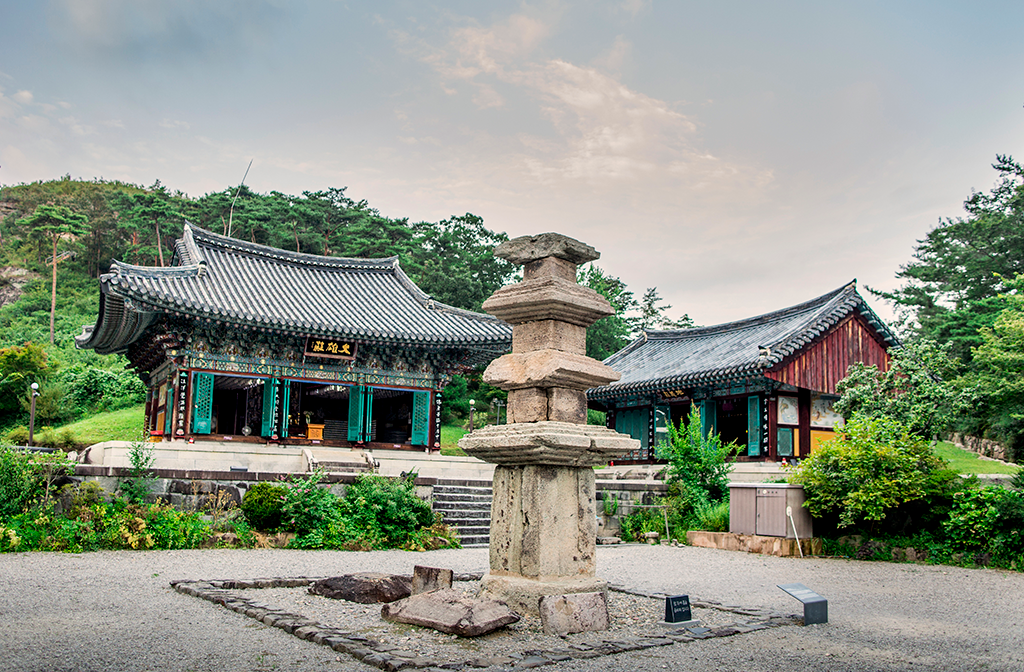
A stone pagoda near the main hall (Daeungjeon) of Unjusa Temple
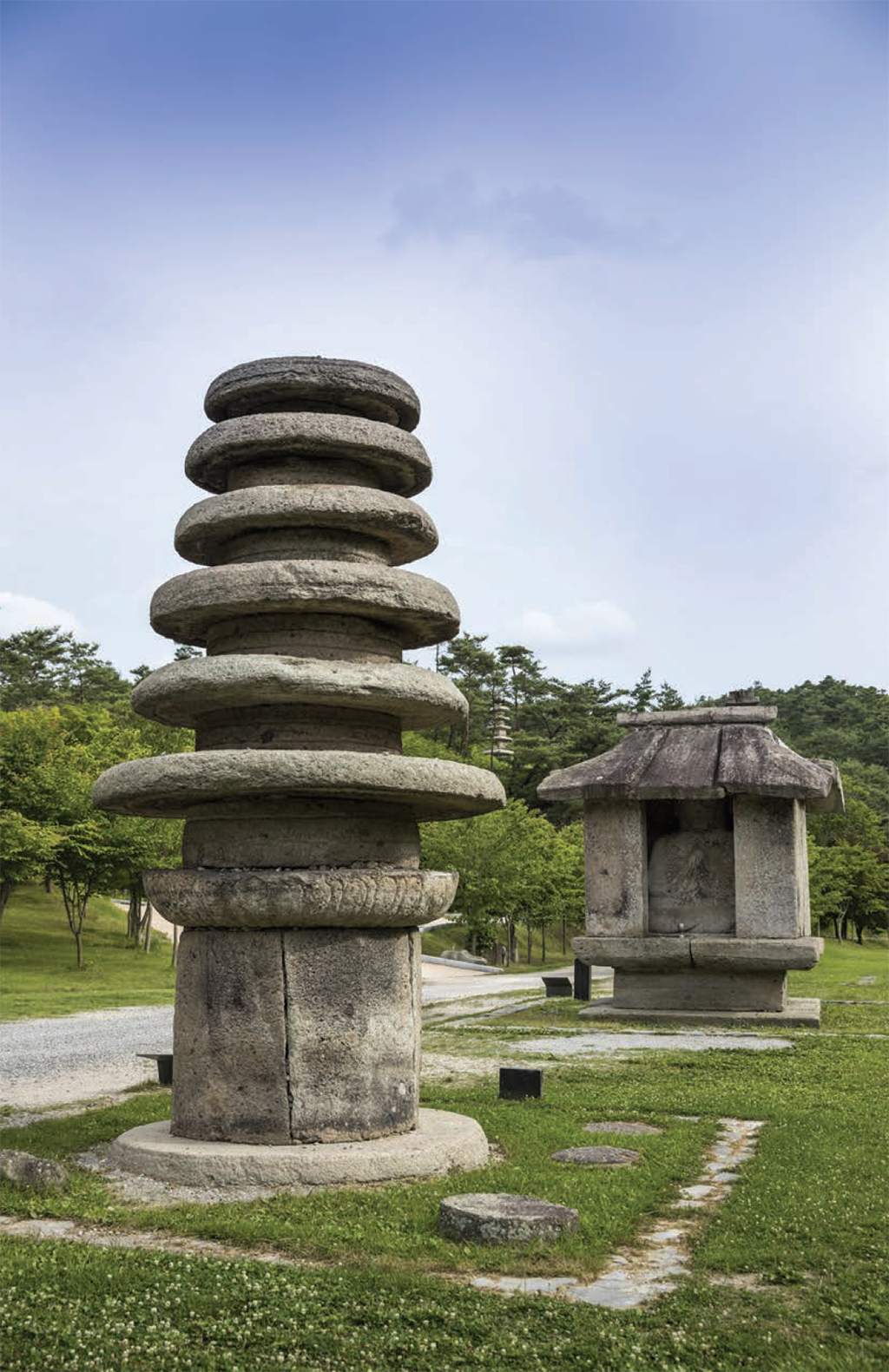
A pagoda with disk-shaped roof stones with no parallel in Korea
known as the “beggar pagoda”; and one rendered in the shape of a spool that manifests a superb sense of creativity. The body stones of the Unjusa pagodas are carved with diverse motifs, the meanings of which are hard to decipher. Materials, layouts, and stylistic features are the conventional reference points used by Korean scholars to classify stone pagodas, but the creative and unconventional designs expressed in the stone pagodas at Unjusa make it difficult to apply any conventional typology.
Folkloric Buddhas
Art historians date the Buddha statues at Unjusa to the Goryeo Dynasty. These statues mostly have a slender face with a sharp nose and plunging ears. A halo is absent from most of them. Their eyes and lips are generally expressed in fine lines. It is hard to determine their facial expressions. Most of the Buddhas have a crown protuberance, as seen in other Korean Buddha statues, but lack any expression of curled knots of hair. The Buddhas generally make the gesture of teaching with their hands. In most cases, their Buddhist robe exposes the right shoulder and covers the left. The folds formed on the left shoulder narrow at regular intervals and run downward. The legs are generally not expressed in detail. The Unjusa Buddha statues lack realism and seem rather two-dimensional, distinguishing them from other Buddha statues in Korea.
Two Buddhas Back-to-back in a Stone Shrine
One of the notable stone artifacts found at Unjusa Temple is a Buddhist shrine housing two Buddhas shown back-to-back. The rectangular shrine mimicking a wooden building with a hip-and-gable roof is enclosed on the sides with stone slabs, but the front and back remain open. Refined sculptural techniques were not applied to these Buddhas, but they do manifest local characteristics of such statues from the Goryeo period. A stone Buddhist shrine of this size is unprecedented in Korea, and the two Buddhas with their backs to each other have no parallel as well, making it an invaluable material for cultural and historical research.
Dream of the Rise of the ‘Reclining Buddhas’
Another noteworthy feature is the “reclining Buddhas” at the top of the west hill. It is so known since they are extending along the ground rather than standing. It is actually a pair of Buddhas, one standing and the other seated, carved out of a single large rock. The tuff stone carved with this Buddha pair is 12 meters long and 10 meters wide. Legend has it that Monk Doseon’s plan to finish all the work overnight failed because the celestial masons he relied on returned prematurely to the heavens when his exhausted apprentice wished to stop and faked the sound of a rooster crowing. There is a folkloric belief that Maitreya will arrive and build a new world when these Buddhas are raised upright. It is a dream that remains unfulfilled, but one that still lives in the minds of many.