Feature
An Earthly Reincarnation of Paradise in Gwanghalluwon Garden
By the Cultural Heritage Administration
A traditional garden in Namwon, Jeollabuk-do Province created during the Joseon era, Gwanghalluwon incorporates a variety of aesthetic elements including Gwanghallu Pavilion, which provides the garden with its name, a pond in front of the pavilion, the Bridge of Crows and Magpies, and the Three Divine Mountains. There are also a number of interesting stories associated with the garden.
Construction of the Garden
Gwanghalluwon is celebrated as one of the definitive traditional gardens of Korea alongside Soswaewon Garden in Damyang and the area surrounding Gyeonghoeru Pavilion in Gyeongbokgung Palace in Seoul. Gwanghallu Pavilion enjoyed an unrivalled reputation among Joseon poets for its aesthetic environment compared to
other famous pavilions such as Bubyeoknu in Pyongyang, Chokseoknu in Jinju, and Yeongnamnu in Miryang.
Today’s Gwanghalluwon started with Gwangtongnu Pavilion, which was established by the early Joseon official Hwang Hui after he was banished to Namwon in 1419. The current name Gwanghan-nu was derived from an analogy made in 1444 by Jeong In-ji, the governor of Jeolla-do Province, between Gwangtongnu and Gwanghancheongheobu,
the mythical lunar palace housing the Chinese goddess Chang’e. The pond at Gwanghallu was added in 1461 when Jang Ui-guk, the magistrate of Namwon, drew water from the nearby Yocheon Stream to create a pond symbolizing the Milky Way while carrying out repairs on the pavilion. In 1582 the Three Divine Mountains were rendered in the pond under the leadership of Jeong Cheol, the governor of Jeollado Province at the time.
A Divine Space on Earth
Koreans of the past strived to express an idealized world or divine space in the architecture of houses or gardens while respecting the given topography and pursuing harmony with nature. Gwanghalluwon is a fine example of this. The garden embodies a diverse range of traditional Korean philosophies and beliefs, such as yin and yang, wu xing (the five elements), geomancy, and Confucian ethics.
The topography of the garden was not refined artificially, but has been maintained as it was originally found with the hilly areas remaining intact. On the hills in the garden
have been spontaneously placed large stones. The plants and flowers of the garden grow naturally to impart a sense of being in the wild.
Gwanghalluwon delivers historical Koreans’ conceptions of an ideal world and their attitudes toward nature. This explains the heritage value of the garden as an important
source of information on social, cultural, and architectural attributes of the society at the time.
Aesthetic Beauty of the Garden
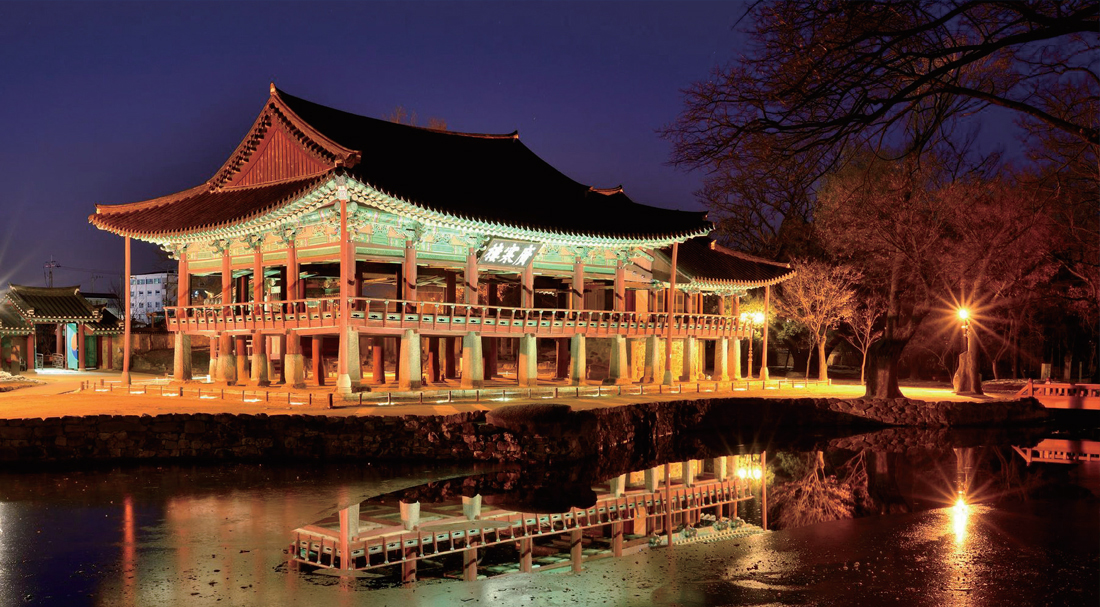
Gwanghalluwon Garden at night
In Gwanghalluwon Garden, the large man-made pond, the bridge lying across it, and its three islands all conspire to create a beautiful scene. The pond is rendered in a rectangular form with a ratio of 1:2 for the sides. Situated at the western edge of the pond, the bridge known as Ojakgyo (Bridge of Crows and Magpies) stands on arch-shaped legs which lend a sensation of rhythm to what would otherwise have been a monotonous flat structure. Three islands known as Samsinsan (Three Devine Mountains) are afloat in the pond at nearly equal east-west intervals; they were constructed as a symbol of the three legendary Chinese mountains resided upon by deities, Mt. Penglai, Mt. Fangzhang, and Mt. Yingzhou, which respectively correspond with Mt. Geumgangsan, Mt. Jirisan, and Mt. Hallasan in Korea. There is a stone turtle in front of Gwanghallu Pavilion that serves as a guardian of the Three Divine Mountains.
Famed Love Stories

A portrait of Chunhyang at the Chunhyang Shrine
Another love story is associated with Ojakgyo, the Bridge of Crows and Magpies. The name of the bridge derives from the July 7 legend. A couple, Gyeonu and Jiknyeo, passionately loved each other but were separated on either side of the Milky Way and could not meet. Feeling sympathy for their tragic destiny, on the seventh day of the seventh lunar month crows and magpies flew up to form a bridge with their bodies to allow Gyeonu and Jiknyeo to be united at least once a year. The bridge formed by crows and magpies is called Ojakgyo.
These two love stories are so deeply rooted in the minds of the Korean people that Gwanghalluwon Garden remains popular among contemporary couples.
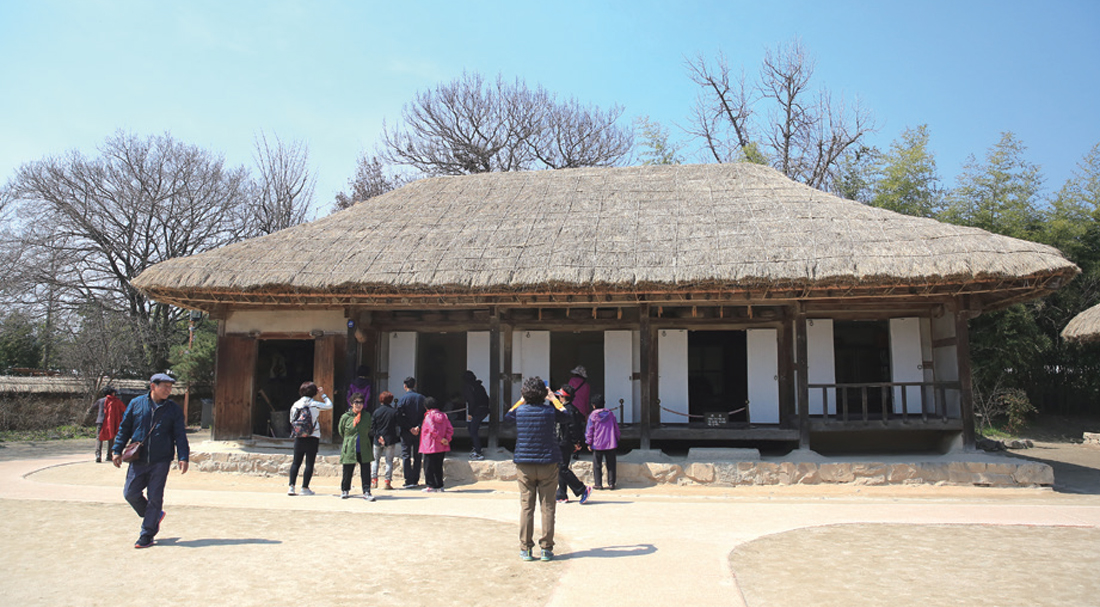
The house of Chunhyang’s mother, where Chunhyang and Yi Mong-ryong made their life-long vow to each other