Feature
Namhansanseong Fortress and the City of Luxembourg
By Semina
Due to both their similarities and differences, Namhansanseong Fortress in Gyeonggi-do Province, Korea can be compared with the City of Luxembourg found in the southern portion of the country of the same name.
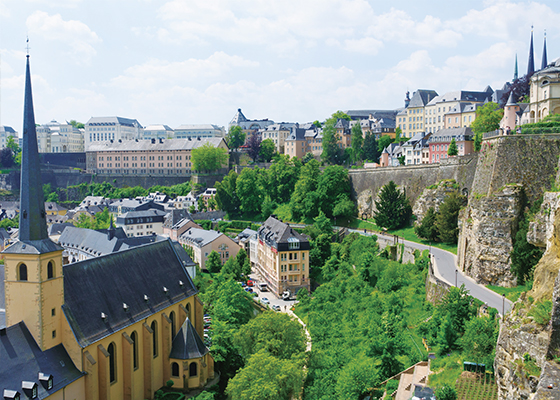
Namhansanseong Fortress
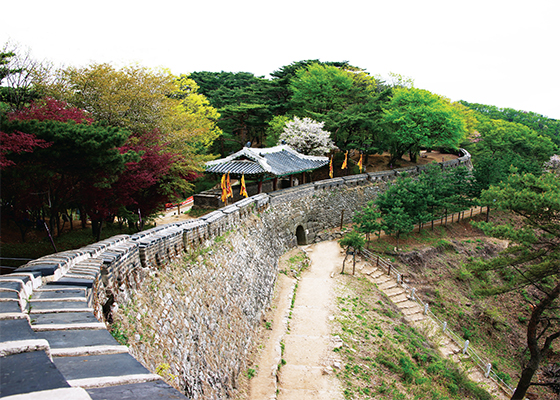
Fortifications in the City of Luxembourg
Namhansanseong Fortress Inscribed on the World Heritage List
At the annual meeting of the UNESCO World Heritage Committee held in Doha, Qatar, in June 2014, Namhansanseong Fortress became the 11th Korean site to join the ranks of heritage sites of global significance collectively known as World Heritage. With mountainous terrain comprising about 70 percent of its landmass, Korea abounds with mountain fortresses constructed to take advantage of local geographic conditions. In fact, it has been historically addressed as “a country of mountain fortresses.” What sets Namhansanseong apart from the throng of other fortresses and led it to merit World Heritage status?
The outstanding significance of Namhansanseong can be confirmed in the existing historical records and archaeological remains. The history of Namhansanseong stretches far back to the Unified Silla period (668–935). In the seventh century, the fortified wall that stood at the current site of Namhansanseong, then known as Jujangseong Fortress, was a place of great strategic importance to Silla’s military relations with Tang China (618–907). A recent excavation of Haenggung Palace in Namhansanseong uncovered a military warehouse site with walls about two meters thick and a cluster of roof tiles weighing more than 20 kilograms each, all from the Unified Silla era. These testify eloquently to the strategic significance of the fortress at the time.
Namhansanseong was constructed in its current form in 1624 during the Joseon Dynasty (1392–1910), utilizing the surviving base and stone blocks from Silla’s Jujangseong. People were assigned to live inside the walled enclosure so that they could perform daily maintenance tasks and ensure the protection of the fortress.
The fortified space of Namhansanseong was equipped not only with a settlement, but also with a range of government institutions. Among them is Haenggung Palace, a temporary residence for the king. Haenggung Palace at Namhansanseong is distinguished from other temporary royal residences of Joseon in that it accommodated a royal ancestral shrine (Jongmyo) and an altar for gods of earth and grain (Sajikdan), the ritual spaces of key national importance during Joseon since they represented the sovereignty and legitimacy of the dynasty. The presence of a Jongmyo and Sajikdan in Namhansanseong allowed the king to retreat here and designate it a temporary capital in case of national emergency.
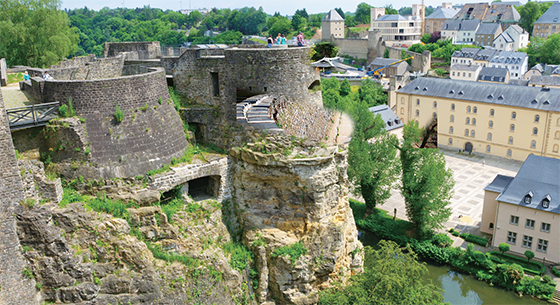
The Bock casemates in the City of Luxembourg
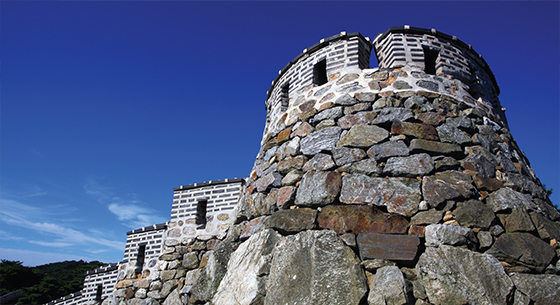
An outwork at Yeonjubong Peak in Namhansanseong Fortress
Luxembourg, One of Europe’s Most Fortified Cities from the Middle Ages
Similar to Joseon, caught geographically between China and Japan and subject to attack from the outside, the City of Luxembourg occupied a strategically important position between northern and southern Europe and was successively conquered by European powers including the Holy Roman Empire, the House of Burgundy, the Habsburgs, French and Spanish kings, and finally the Prussians.
As it passed from the hands of one European power to the next, the City of Luxemburg gradually added to its surrounding defenses. The name Luxembourg, or L.tzebuerg in Luxembourgish, actually means a “small fortress.” As such, fortifications lie at the heart of its identity. The remains of the fortifications in the City of Luxembourg were inscribed on the World Heritage List in 1994 as the City of Luxembourg: Its Old Quarters and Fortifications.
After Luxembourg Castle was erected in the 10th century, a settlement developed around the castle and was protected by a stone wall in the 12th century. This was later extended in the 14th and 15th centuries. In the 16th century the site emerged as a formidable fortress, and in the 17th century S.bastien Le Prestre de Vauban (1633–1707), the foremost French military engineer of his time, further expanded and reinforced the fortifications. During the 17th–18th centuries, large-scale underground forts equipped with casements were constructed, enhancing the military capacity of the site. As late as the latter part of the 19th century, new structures were added to the site by the Prussians.
Geography Used for Defense
Namhansanseong is a grand mountain fortress constructed to take advantage of rugged geography rising as high as 500 meters above sea level. The City of Luxembourg is similar in that it utilized the local topography as part of its fortifications. Formed on a rocky hill reaching 300 meters high, Luxembourg was renowned as an impregnable fort city. The site was constructed as a Vauban-style fortress, making the most of the given landscape in order to ensure the greatest possible military effectiveness. A vast underground system of passages was created to intensify the defensive power of the site.
Sited south of the Hangang River, Namhansanseong did not require an artificial moat and instead used the river as a natural deterrence to attacks from the north. Similarly, the Alzette River runs around the fortifications in the City of Luxembourg.
External Exchanges Transformed into Structural Changes
The special exhibition hall at the museum is dedicated to the display of traditional crafts. Genre paintings, bronze and wooden utensils, and artifacts with silver or mother-of-pearl inlay have been presented to public view in this space, and a special exhibition has even been organized in cooperation with the Italian luxury brand Gucci to showcase the harmony between Gucci accessories and Korean traditional furnishings. Currently, traditional Korean clothing, including royal ceremonial robes, is on exhibit in the hall, demonstrating to the public the dignified and elegant beauty of traditional Korean attire.
In the case of Namhansanseong, upon the completion of its construction people were encouraged to settle within the walled enclosure to eventually form a town of more than 1,000 households. Namhansanseong served as an administrative center in peacetime, and in times of war the walled city could function as a center of national defense where the king and people living around the fortress could gather and fight against the enemy alongside the fortress residents. Meanwhile, for the City of Luxembourg a castle was first constructed and then subjects began to settle around the residence of the lord. Walls were gradually added to protect the settlements, and the boundary of the city enlarged to its current size. While the noble residence was the first structure for the City of Luxembourg, at Namhansanseong the formation of people’s settlements was considered the foremost priority.
A Thought on the World Heritage System
The inscription of Korean heritage sites onto the World Heritage List is definitely an event for national celebration. However, it should be remembered that inscription as World Heritage does not indicate some kind of recognition of the cultural superiority of the inscribed property. In fact, the World Heritage system does its due service when we perceive World Heritage Sites as the heritage of not just a single country, but of all humanity and as a reservoir of ancestral knowledge and wisdom that we are obliged to transmit to future generations.
In this sense, it is worth exploring a World Heritage Site in one country from the perspective of other similar examples from other parts of the world as we did in this article. It is an interesting way to not only improve the appreciation of other countries’ World Heritage, but also to gain a novel perspective on our own.
Text & Photos by Semina, Researcher, Namhansanseong World Heritage Center of Gyeonggi-do
Photos by Namhansanseong World Heritage Center of Gyeonggi-do and Shutterstock