Feature
Western Buildings in the Korean Palace of Deoksugung
By Kim Jae-eun
Deoksugung Palace as an Incubator of Modernity
Deoksugung Palace served as imperial seat for the Korean Empire (1897–1910). King Gojong (r. 1863–1907), the 26th ruler of Joseon, declared the birth of the Korean Empire in 1897 at Deoksugung Palace under the motto Gubon sincham, meaning “respecting the old and accepting the new.” He used the palace as a test bed for modern transformation. Telling evidence of this modernization drive is provided by the Western buildings remaining within the Deoksugung Palace compound today. In the late 1890s–early 1900s, a series of Western buildings were erected there as a place to receive foreign diplomats and hold royal banquets. Among them are Seokjojeon Hall, Jeonggwanheon Pavilion, and Jungmyeongjeon Hall.

Seokjojeon Hall
The Joseon court employed selected foreigners within the government, and it was McLeavy Brown from Ireland serving as an advisor to the Ministry of Financial Affairs and as Chief Commissioner of Customs who first suggested the construction of Seokjojeon. He recommended the Welsh architect J. R. Harding, a member of the Imperial Maritime Customs Service in China, as its architect. An elevation made by Harding survives to the present inscribed with the date February 25, 1898, indicating that the design of Seokjojeon had been carried out by that time. Before ground was broken for the construction of Seokjojeon, a one-tenth scale model was constructed, a new architectural method never before attempted in Korea. A structure with one floor underground and two aboveground was completed by 1906, and in 1907 interior construction began under the direction of a British architect and with the British firm Maple & Co. hired as an operator.
As the name Seokjojeon, literally meaning a “hall made of stone” signifies, the surface of the building is finished in granite. The structure is in the Neo-Classicist style, with a triangular pediment and an orderly array of columns recalling the image of a Greek temple. The interior is also adorned in a Neo-Classicist style, as manifested by molding decorated with acanthus leaves and wall ornamentation in the shape of flowering fruit trees, all rendered in rigorous bilateral symmetry. Meanwhile, the pediment of the building’s fa.ade and the reception room feature plum flowers that represent the imperial family of the Korean Empire, emphasizing its identity as a component of the imperial palace of Korea.
In 1910, however, the same year Seokjojeon was completed, the Korea-Japan Annexation Treaty was signed and the Korean Empire faded into history. Throughout the colonial era (1910–1945) Deoksugung experienced a steady process of erosion. For example, a project to convert the palace area into a public park was pushed head in the 1930s and Seokjojeon was adapted into an art center. After national liberation in 1945, Deoksugung was left deformed on the inside and was used as an art gallery or museum until the Cultural Heritage Administration undertook a restoration project in 2009. For the next five years, efforts were made to collect relevant historic records and restore Seokjojeon to its original appearance. The restoration was completed in 2014 and Seokjojeon was opened to the public as the Korean Empire History Museum.
The Korean Empire History Museum offers daily guided tours at designated times (eight sessions on weekdays and eleven on weekends), through which visitors can experience the everyday life of the imperial family. Based on a historic record indicating that Seokjojeon hosted concerts for Emperor Gojong, classic music performances are held in the central hall at 19:00 on each Culture Day, the last Wednesday of every month. Those who wish to attend these concerts can make a reservation online through the webpage of the Deoksugung Palace Management Office. Ten seats are set aside for on-site applications from people from abroad and Koreans aged 65 and over.
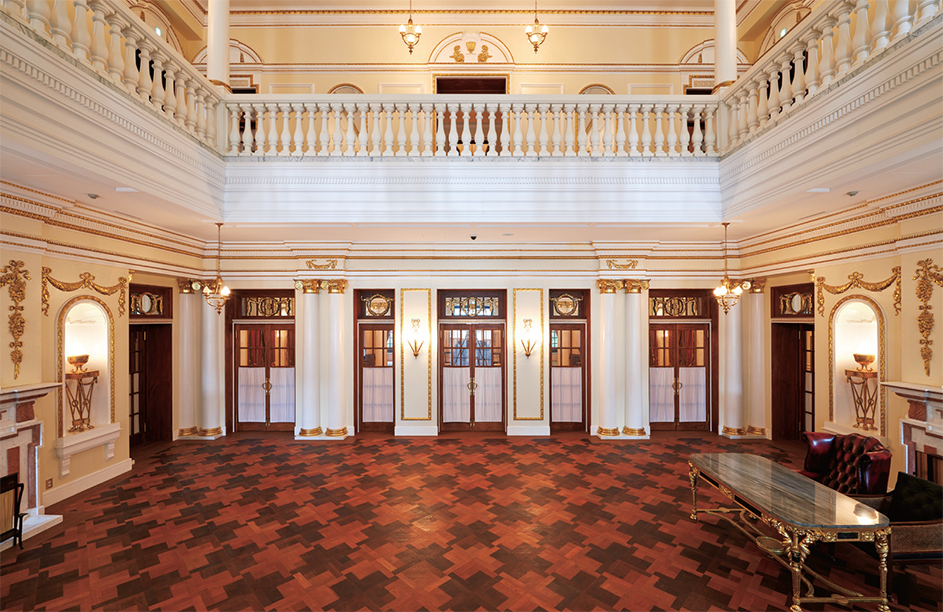
The central hall of Seokjojeon
Jeonggwanheon Pavilion, Gojong’s Coffee Chamber
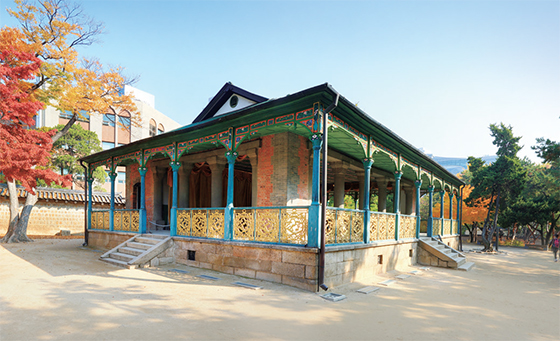
Jeonggwanheon Pavilion
This special exhibition of woolly mammoth fossils would not have been possible without the passion and affection for the public display of rare exhibits in Korea demonstrated by the Korean-Japanese paleontologist Park Hui-won. After donating relics from prehistoric mammals that he had excavated himself, Park delivered a message to visitors: “I hope that these rare mammoth specimens will provide inspiration to children in my homeland so that they can have bigger dreams and broader imaginations.”
Park Hui-won dedicated more than 20 years to excavating prehistoric animals, including three years from 1994 to 1996 that he spent along the frozen sea at Yakutsk in Russian Siberia. Park donated the collection of about 1,300 relics to the Cultural Heritage Administration in late 2016 and in recognition of his contribution to the public appreciation of prehistoric mammals the Cultural Heritage Administration awarded him the Silver Cultural Medal, a national recognition provided to those who have made distinguished accomplishments toward the development of culture and arts.
The National Research Institute of Cultural Heritage is planning to draw on the results of this special exhibition to implement diverse experience programs using the woolly mammoth specimens.
Jungmyeongjeon Hall, a Repository of Modern History
Jungmyeongjeon Hall, known as Suokheon during the era of the Korean Empire, is also one of the definitive Western buildings of Deoksugung. Although somewhat detached from the palace complex, Jungmyeongjeon was built in 1899 as an imperial library. Standing today as a two-story red brick building, Jungmyeongjeon was originally constructed as a single-story structure in 1899. It was reconstructed in its current form following a fire in 1902. It is presumed that the reconstruction was designed by a son of William McEntyre Dye, an American serving as a military advisor to the Korean Empire at the time. When a major fire in 1904 reduced most of the buildings in Deoksugung to ashes, including Junghwajeon, Jungmyeongjeon assumed the status of throne hall. In the following year, Jungmyeongjeon took on a tragic historical role when the Korea-Japan Protectorate Treaty was signed under duress here in 1905.
Throughout the tumultuous modern history of Korea, Jungmyeongjeon changed hands several times for use as a foreigners’ club or office building, losing its original appearance to a great extent. Purchased by the Cultural Heritage Administration in 2004, Jungmyeongjeon was included as part of the Deoksugung heritage site in 2007 and was restored and opened as an exhibition space in 2010 to display the history of Korea from the 1905 Korea-Japan treaty to the fall of the Korean Empire. Temporarily off limits to the public due to landscape construction at the front of the building, public visitation will be resumed in April of this year. The opening hours will be from 10:00 to 17:00.
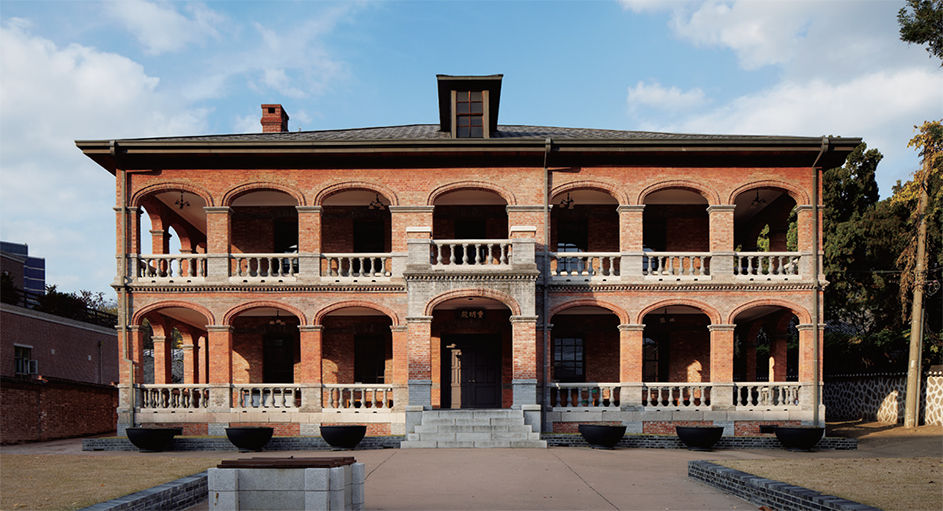
Jungmyeongjeon Hall
Text & photos by Kim Jae-eun, Curator, Deoksugung Palace Management Office