
Inside
Stone Comes Alive at the Korean Stone Art Museum
By the Korean Stone Art Museum
Stones may seem lifeless. They neither speak nor move. However, they do visibly age and bear the traces of the passage of time. They also change their appearance—more crystalline after a rain and more brilliant at sunrise. The many charms of stone can be explored at the Korean Stone Art Museum in Seoul.
The Story of the Museum’s Foundation
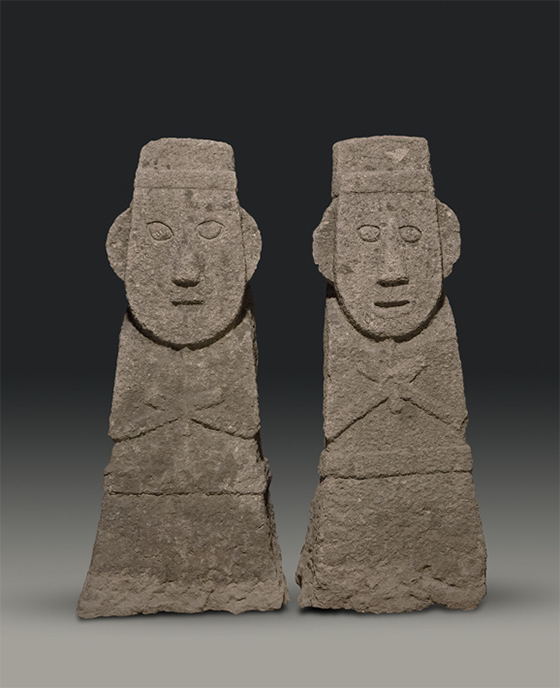
Beoksu is an original Korean word referring to
a stone version of jangseung, or guardian pillars,
which are commonly made from wood.
The history of the Korean Stone Art Museum goes back to the late 1970s in the Insa-dong neighborhood of Seoul. A man in his 30s named Cheon Sin-il who already possessed an avid interest in old books and paintings stood in one of the neighborhood’s antiquities shops. Currently the Chair of the Korean Stone Art Museum, Mr. Cheon still vividly remembers the moment. “On that day I was browsing at an antique store I frequented. A Japanese dealer entered and started haggling over the price of a stone-art collection with the shop’s owner.” Strongly believing this precious heritage deserved to remain in the country of its creation, Mr. Cheon returned home with all 27 of the pieces of stone art included in the collection. He recounts the pleasantly mysterious sensation he derived from the stone objects: “They shine clearer after rain, and they present a different face under direct sunshine. The seemingly lifeless stone pieces offer up different images under raindrops or rays of sun.” This is how he first became mesmerized by stone art. His passion culminated in the establishment of a stone art museum in July 2000 in Yongin, an area neighboring the capital Seoul. In November 2015, he transferred the museum to central Seoul to allow easy access to the stone artifacts by a wider public. It is currently known as the Korean Stone Art Museum and located in Seongbuk-dong.
An Exhibition Space for Stone Artifacts in Seoul
The stone artifacts on public view at the Korean Stone Art Museum are mostly from the Joseon Dynasty. Housed within a four-story building, the museum features five galleries. The first gallery displays muninseok, or stone figures representing Joseon literary officials. During the Joseon era, a pair of stone officials was placed in front of a royal burial mound to serve as guardians of the king’s tomb. There are 47 officials on display out of 70 that Mr. Cheon repatriated from Japan in 2001. They had been part of the Korean heritage illicitly exported during the 1910–45 colonial period. The second gallery houses diverse stone representations of dongja, or child attendants, which were placed at the tomb of a person of exalted social class. As dongja are believed to serve as messengers for the gods, there is a section in the gallery where visitors can write down their wishes and pray for their realization in front of the statues. The third gallery is for beoksu, which refers to a stone version of the community guardian pillars known as jangseung. Stone guardian pillars were placed at the entrance of a village as a guardian to prevent evil spirits from penetrating the community.
Besides the three exhibition halls for stone objects, there are two more galleries respectively displaying dexterous and imaginative embroidery artifacts and for modern artworks that showcase their creators’ artistic consciousness.
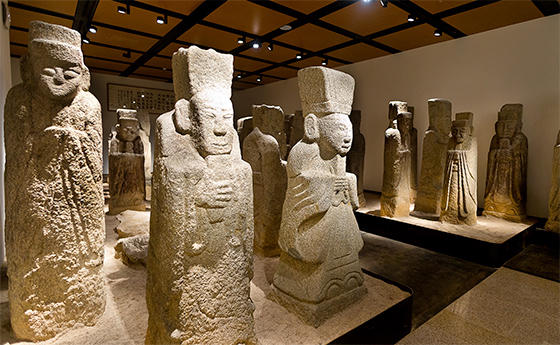
One of the exhibition halls at the museum is dedicated
to 47 stone officials that were repatriated from Japan,
along with other stone artifacts.
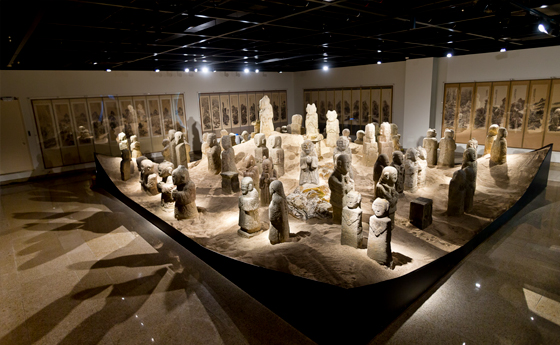
Dongjasang, or stone child attendants, were grave guardians placed at
tombs for royal family members or high-ranking officials
from the 16th–18th centuries.
The visitation route at the museum naturally flows from the interior galleries to the exterior of the building. The open-air area outside, known as the Garden of Stones, is an extension of the exhibition space and features various thematic spaces for relaxation and recreation. The Garden of Stones creates a magnificent landscape by combining the background of Mt. Baegaksan and a vista of central Seoul with the stone sculptures scattered around. The stone objects in the garden take on additional artistic value when set against a colorful array of wildflowers. As many as 12,000 wildflowers were planted last spring, striking a stunning aesthetic harmony with the stone artifacts. Small waterways and poetic phrases carved in stone add to the recreational ambience of the garden.
Among the several thematic spaces within the garden is the Space for the Five Senses, located at the highest point of the museum and providing a bird’s eye view of Seoul. Visitors are encouraged to touch the stone sculptures there and enjoy sensory experiences. At the Road of Nonstop Victories, participants can make wishes while walking up a staircase. There is also an entertainment area especially recommended for those with children. Stone dongja assistant children are positioned there holding traditional instruments and kitchen utensils or playing traditional games. These stone figures performing diverse actions stimulate the imagination of visiting children.
Unchanging Passion for Stone
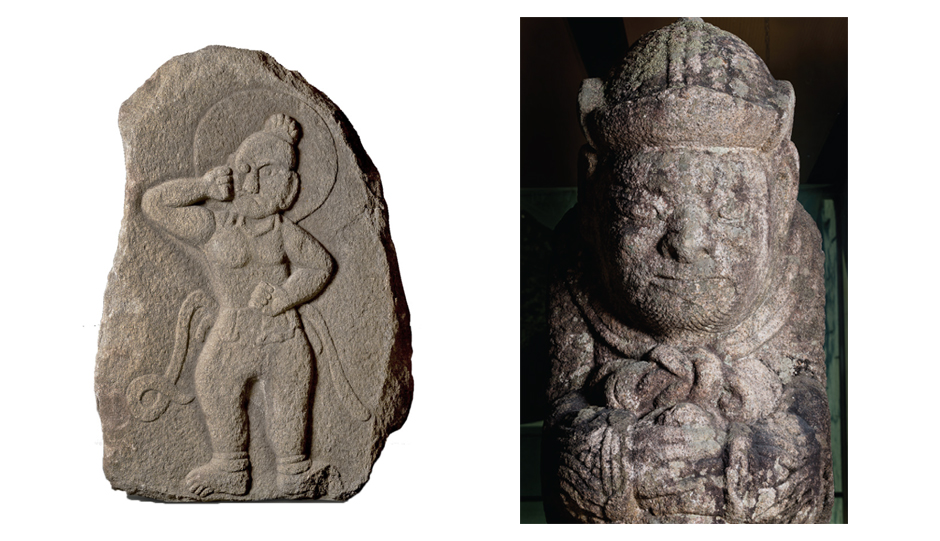
(left)One of the exhibition halls at the museum is dedicated to 47 stone officials that were repatriated from Japan, along with other stone artifacts.
(right)Dongjasang, or stone child attendants, were grave guardians placed at tombs for royal family members or high-ranking officials from the 16th–18th centuries.
The founder of the museum, Mr. Cheon, has a wish of his own. “I hope that by contemplating the stone artifacts delivering our ancestors’ wishes at the museum, contemporary Koreans can take a much-needed pause from their hectic lives and reflect on their own desires and purposes in life. I hope that it can provide a healing experience for them.” He also emphasizes the museum’s strong commitment to the effort to repatriate Korean artifacts, as well as to accelerating its work to develop experience programs, support academic research, and offer exhibition opportunities to young artists.
Text by Visitor Information
Hours: Daily (except on Mondays) from 10:00 a.m.–6:00 p.m.
* From December–February, open from 10:00 a.m.–5:00 p.m.
* When a national holiday falls on a Monday, closed on Tuesday
Guided tours: Three times per day at 11:00 a.m., 2:00 p.m., and 3:00 p.m.
* From December–February, two times per day at 11:00 a.m. and 2:00 p.m.
Address: 66, 13 gil, Daesagwan-ro, Seongbuk-gu, Seoul
Inquires: +82 2 986 1001 (tel), +82 2 986 3600 (fax)
Webpage: www.koreanstoneartmuseum.com
Text by the Korea Cultural Heritage Foundation
Photos bythe Korea Cultural Heritage Foundation