Inside
Toward Better Risk Preparedness for Cultural Heritage
By Sang-sun, Safety
The devastation of the two World Wars of the early 20th century awakened people everywhere to the need for protecting buildings, monuments, and other sites of cultural, historical, and artistic significance. This heightened awareness was followed by practical efforts to enhance cultural heritage risk preparedness at the national and international levels. Korea is no exception to this worldwide trend. Endeavors have been actively underway here to protect cultural assets from a wide range of disasters, both natural and human-made, under the coordinated supervision of the Cultural Heritage Security Policy Division of the Cultural Heritage Administration and the Safety and
Disaster Prevention Division of the National Research Institute of Cultural Heritage.
Disaster Management in Korea
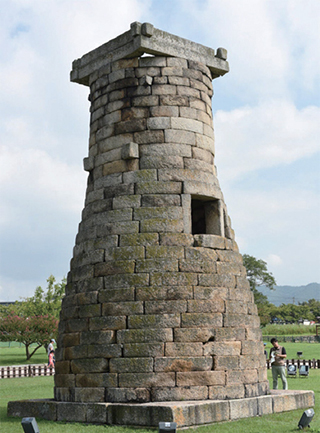
Cheomseongdae, the oldest observatory on Earth,
survived the 2016 earthquake in Gyeongju with no major harm.
Disasters can be natural, like floods, lightening, or landslides, or artificial, as in the case of fire, attacks, or armed conflict. They can also be social, for example an outbreak of contagious disease. Any effort or activity geared toward preventing such disasters or alleviating their damage can be considered part of improving cultural heritage risk preparedness. In Korea, such activities take place at two levels: daily management and emergency preparedness. Regular efforts are made to mitigatethe adverse impact of disasters and to reduce the vulnerability of a heritage building or site to their effects. When a disaster does occur, an emergency response such as heritage recovery efforts is carried out.
Recently, a natural disaster damaged cultural heritage in Korea. An earthquake took place in the historic city of Gyeongju on September 12, 2016, the first day of Chuseok, the main seasonal holiday in Korea. It measured 5.8 on the Richter scale, the strongest in Korea since modern measurement began in 1978. The natural disaster inflicted damage on the Cheomseongdae, built during the reign of Queen Seondeok (r. 632–647) and believed to be the oldest observatory in East Asia. The upper structure of Cheomseongdae was partly deformed and its central axis was tilted by 0.1 degree. In addition, approximately 100 other heritage buildings and monuments in Gyeongju sustained damage from the earthquake.
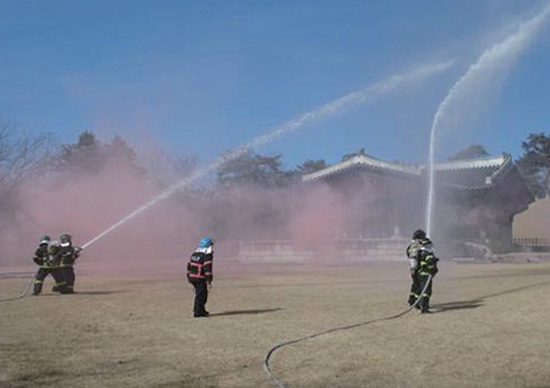
There are other examples of heritage damaged by natural and artificial catastrophes. The traditional house Seongyojang in Gangneung (National Folklore Cultural Heritage No. 5) suffered under heavy snows in February 2014. Three years earlier, in July 2011 Ihwajang (Historic Site No. 497), the private residence of former president Syngman Rhee, was impacted by flood-related landslides. Arguably the most significant event in the country’s cultural heritage disasterresponse history came on February 10, 2008 when a middle-aged man angered by a seemingly unfair land reparation process set fire to National Treasure No. 1, Sungnyemun Gate. The extreme damage that resulted to this foremost National Treasure caused shock across the entire nation and put a spotlight on the country’s risk preparedness. The date of this tragedy, February 10, was designated Heritage Disaster Prevention Day, and intensive safety checks and fire drills are now carried out in commemoration.
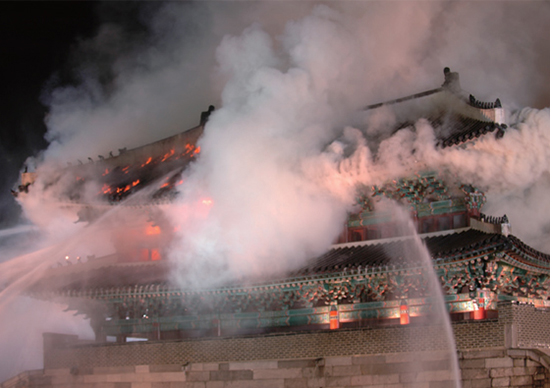
(left)Sungnyemun Gate, severely damaged by fire in 2008, has been restored and was reopened to the public in 2013.
(right)A joint fire-fighting drill at the World Heritage Royal Tombs of the Joseon Dynasty
Planning and Research Efforts
To improve risk preparedness for cultural heritage, the Cultural Heritage Administration in cooperation with its research organ, the National Research Institute of Cultural Heritage, is currently making all-out efforts.
The Cultural Heritage Security Policy Division of the Cultural Heritage Administration prepares risk management plans and establishes an integrated system for disasterprevention data. They maintain a disaster-prevention map based on the analysis of the hazards facing cultural heritage, and prepare disaster-specific manuals to ensure an effective response depending on the type of risk. Training of personnel, replacement of worn-out electrical infrastructure, and installing the necessary equipment also fall
under their responsibility. Other activities include efforts to combat illicit trafficking in cultural heritage, administrative support for refining related laws and regulations, and operating a heritage situation room for the daily monitoring of important cultural heritage and to ensure a proper response to an emergency event.
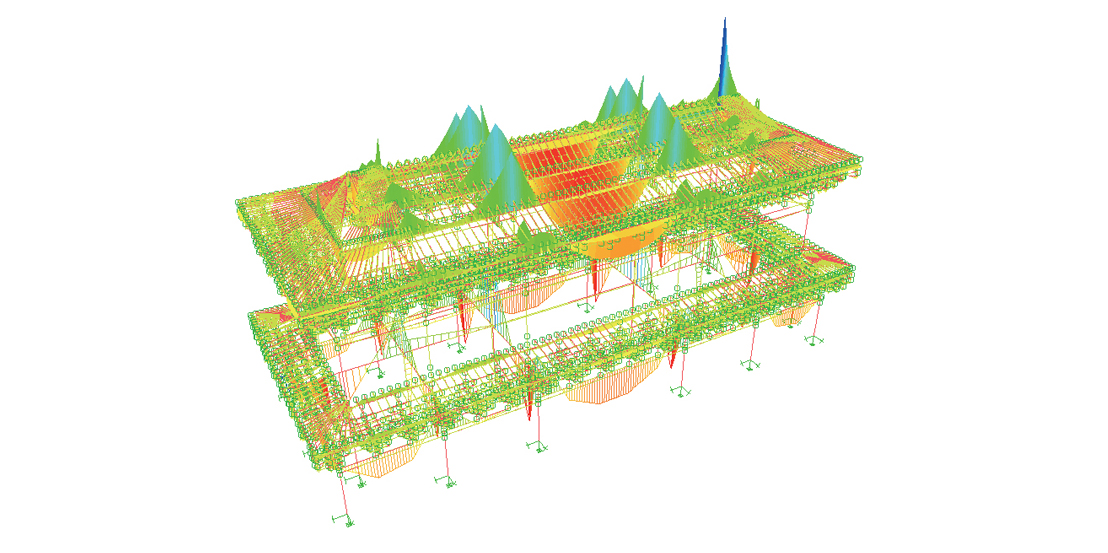
An analysis of the structural security of Heunginjimun Gate, a 19th-century wooden structure
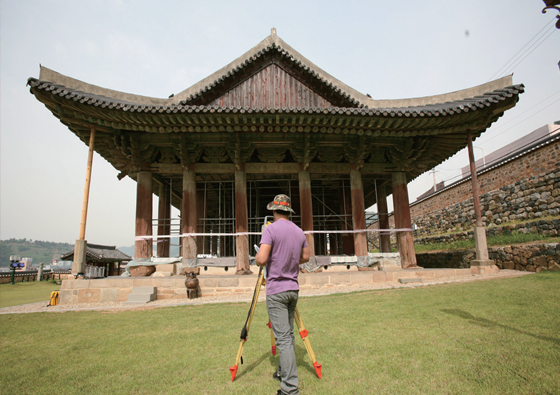
Measuring of the inclination and deformation of Jinnamgwan Hall in Yeosu
Meanwhile, the Safety and Disaster Prevention Division at the National Research Institute of Cultural Heritage conducts research on the structural integrity of built heritage and on how such heritage responds to particular types of disaster in order to devise measures to improve responses to and resistance against disasters.
Regular safety check-ups are carried out on the 753 nationally designated built heritage elements, and for the 50 in need of intensive care a more thorough inspection is implemented. The information obtained through these regular assessments provides baseline data for analyzing the vulnerability of cultural heritage and hazard factors. Long-term research plans covering the next five and ten years have been put in place for studies on wear to construction materials and changes in the conservation environment resulting from climate change, as well as on improved earthquake preparedness. Emergency field research and disaster recovery efforts are also their responsibility. Diverse joint research projects with national and international institutes are being planned as well.
Principal Rules for Risk Preparedness
Admittedly, expecting total prevention of disaster-induced damage to cultural heritage is unrealistic. The only practical measure is to improve risk preparedness through continuous efforts at mitigating risk factors and strengthening the capacity of cultural heritage to resist the impacts of disasters.
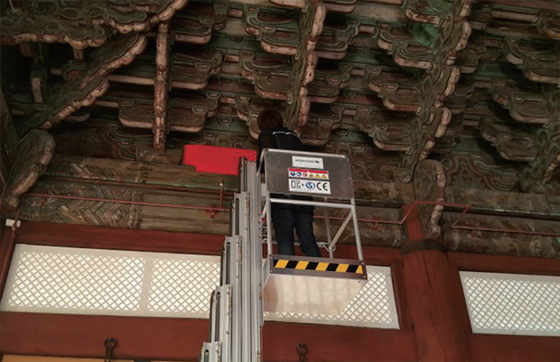
An annual check of the electric and fire-fighting facilities at heritage sites
Towards a Better Disaster Prevention Strategy
A recent study of earthquakes on the Korean Peninsula drawing on historical documents suggests that there have been a total of 2,161 earthquakes from A.D. 2–A.D. 1904. Among these, 440 were earthquakes of magnitude 5 or higher on the Richter scale, and 35 were of 8 or greater. The Gyeongju earthquake of 2016, the most formidable since modern measurement equipment was introduced about 40 years ago, forced the recognition of earthquakes as one of the foremost risks in the country, along with previously identified risks such as fire and flooding.
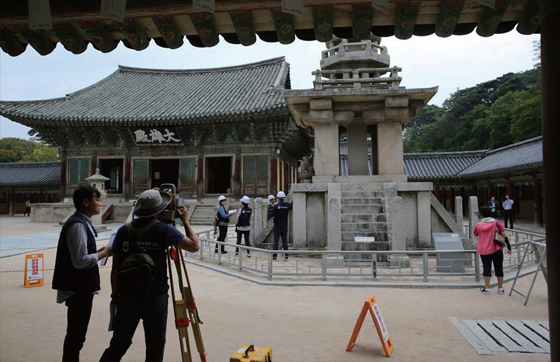
Measuring of the inclination and deformation of Dabotap
Pagoda at Bulguksa Temple
While efforts are being made worldwide to conserve buildings, monuments, and sites of great importance and ensure their transmission to future generations, destructive events continue to take place that damage or destroy heritage of national and global significance. Glaring examples including the destruction of the Buddhas of Bamiyan in Afghanistan in 2001, the 2008 fire at Sungnyemun Gate in Korea, and the recent bombing of the Great Mosque of al-Nuri in Mosul, Iraq.
Although damage to cultural heritage from natural disasters can never be absolutely prevented, concerted efforts can minimize the impact of human risks such as fire and conflict. This is why efforts at analyzing risks and increasing heritage resilience in the face of disasters should be accompanied by increasing awareness of the social significance of cultural heritage among the general public.