Inside
Hanji Becomes International Restoration Material
By Ahn Ji-yoon
“Paper lasts 1,000 years and silk lasts 500.” This old saying emphasizes the quality of traditional Korean paper, or hanji, which is known for its durability and strength. Made with hanji, the oldest known woodblock print in the world, Mugujeonggwang daedaranigyeong (Great Dharani Sutra of Immaculate and Pure Light), has withstood the rigors of time for more than 1,200 years and remains in good condition. Eight of the thirteen Korean entries on the UNESCO Memory of the World Register are books or documents crafted using hanji.
Hanji Qualifies as a Material for Heritage Restoration
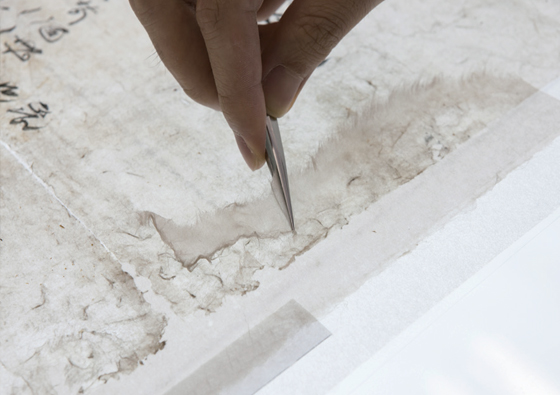
Hanji is applied as a reinforcement treatment for Nanjung ilgi
(The War Diaries of Admiral Yi Sun-sin), one of Korea’s Memory
of the World entries
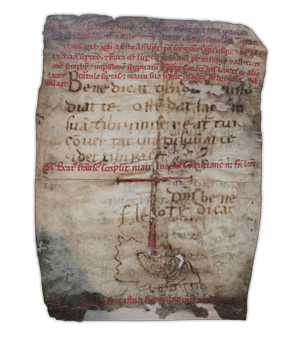
The restored Chartula of St. Francis of Assisi
This is the first certification of hanji as a restoration material by an overseas organization. The recognition is especially meaningful when considering that the ICRCPAL is a leading research institute in Italy and a globally recognized authority in the field of paper heritage conservation. During the process of testing the qualities of hanji, the ICRCPAL discovered its superb attributes and has already adopted it for the restoration of five important Italian documents, including the Chartula of St. Francis of Assisi and the Rossano Gospels.
Globalization Endeavors
In Europe, Japanese washi has long been considered the definitive Asian paper and
is widely used in the restoration of documentary heritage. The lofty reputation enjoyed
by washi in Europe can be explained, at least partly if not totally, by Japan’s proactive
awareness-raising efforts in the generous provision of washi to Italy for document
restoration after the 1966 Flood of the Arno in Florence. Compared to Japanese
traditional paper, Korean hanji possesses a low level of recognition and usage overseas,
despite its excellent qualities. The domestic market for traditional Korean paper has
also been contracting in the wake of a series of challenges, such as the aging of hanjimaking
practitioners, a lack of future craftsmen, and declining demand and public
interest. There exist only a few hanji workshops in Korea that still practice traditional
methods.
To imbue a new dose of vitality into the hanji market and to make its qualities
better known overseas, the Hanji in Europe project was launched in 2014. As a shared
Korean-Italian research undertaking implemented by Korea’s National Research
Institute of Cultural Heritage, the Korean Embassy in Italy, and the ICRCPAL, it was
intended to promote hanji in Europe as a heritage restoration material. The first fruit of
this cooperative enterprise was reaped in the form of the ICRCPAL’s recognition of hanji
as appropriate for the restoration of European documents and books in December
of last year. In the lead-up to the certification of hanji, an academic symposium on
the paper was held in Korea in July 2016. The presentations on the use of hanji for
the restoration of a drawing from the Vatican Museums and of a globe housed at a
museum dedicated to Pope John XXIII drew particular attention.
Notable Attributes of Hanji
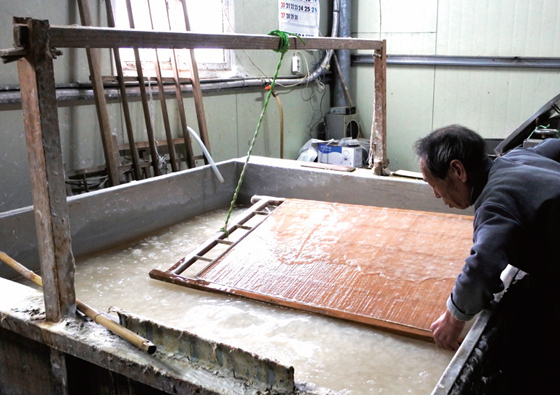
Master Sin Hyeon-se making hanji
These attributes make hanji an ideal material for heritage conservation and restoration. It makes an excellent reinforcement or backing paper for books, documents, and paintings and can be employed not only for the restoration of archaic documentary heritage, but also for modern works. Hanji shows far greater durability and strength than modern pulp-based papers.
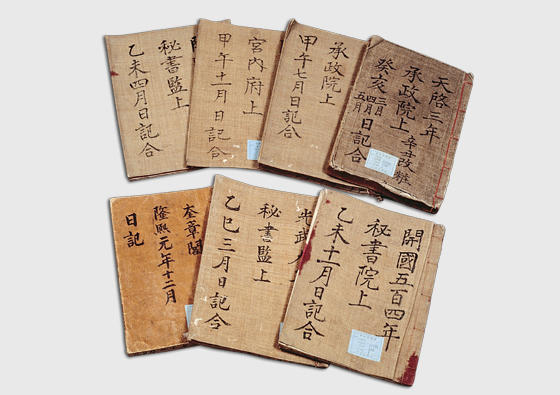
Seungjeongwon ilgi (The Diaries of the Royal Secretariat),
one of Korea’s Memory of the World entries made of hanji