Inside
Historical Meaning of the Korean Provisional
Government
By Kim Yong-dal
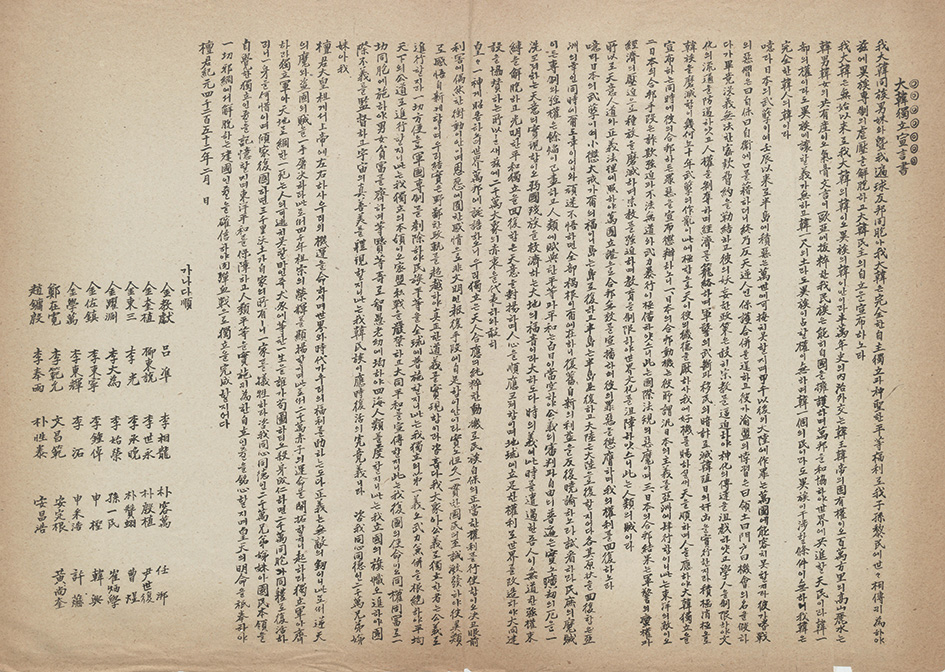
A declaration of independence announced in February 1919 in Jilin, China,
under the name of 39 independence activists including Kim Gyo-heon and Yeo Jun
The early-modern history of Korea cannot be understood without an awareness of the unyielding struggle for independence. The drive toward democracy in particular is intricately connected with the movement for independence from Japanese colonial rule (1910–45). On April 11, 1919, the long-standing desire for national indepvendence and popular sovereignty was given a voice with the foundation of the Provisional Government of the Republic of Korea in Shanghai, China. It was a seed of hope for achieving an independent nation, planted at a time when the Korean people were enslaved, national sovereignty had been usurped, and the nation’s territory had fallen under the harsh colonial rule of Imperial Japan. Encompassing both Koreans at home and abroad under its authority, the Provisional Government carried out diplomatic appeals, military operations, educational programs, and even assassination and bombing, all for the purpose of winning the recognition of Korea’s independence in the international community.
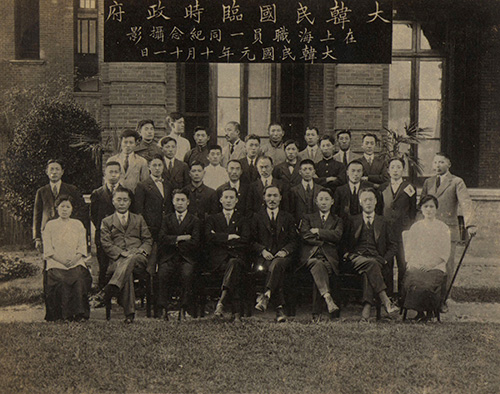
A photo of the staff of the Provisional Government taken on October 11, 1919
showing An Chang-ho fourth from the right in the first row
and Kim Gu at the right end of the second row
The Provisional Government of the Republic of Korea was born out of the March First Movement, a nationwide public demonstration in support of independence that began on March 1, 1919. The March First Movement in turn came to take on a greater historical meaning thanks to the establishment of the Provisional Government. In the lead-up to or during the protests, a declaration of independence was proclaimed in four disparate locations—Jilin in China (the Korean Declaration of Independence), Tokyo (February Eighth Declaration of Independence), Vladivostok (Declaration of Independence by the Korean National Congress), and Seoul (March First Declaration of Independence). The overriding agenda commonly voiced in these four declarations was the independence of Korea and the autonomy of the Korean people.
These declarations made it clear that Koreans would not waver in their struggle for independence and autonomy until the end, by including such language as “life-long bloody war” (from Jilin), “bloody war for perpetuity” (Tokyo), “bloody war forever” (Vladivostok), and “the determination of the nation should be willingly expressed until the last citizen and until the last moment” (Seoul).
Millions of Koreans acted out their commitment to national independence through the March First Movement. More than 2 million out of the total population of 20 million voluntarily took part in the street demonstrations. With their collective resolution to restore independence expressed and confirmed, they now needed a government established by Koreans that could convert this commitment to nationhood into a reality.
The March First Movement was not a form of begging or a plea to the world, but a show of self-determination regarding Korea’s independence and autonomy on the part of Koreans. In the light of the spirit of the March First Movement, it was only natural that creating a government was considered a sovereign task for Koreans. In response to this historical demand, a series of provisional governments were formed at various locations at home and abroad.
Provisional governments were constituted in both Vladivostok and Seoul. On April 11, 1919 the Provisional Government of the Republic of Korea (Daehan Minguk Imsi Jeongbu) was set up in Shanghai, China. It was a temporary means of governance established by independence activists in exile on behalf of a state they named “Daehan” (derived from the Daehan Empire or “Korean Empire”). They chose a democratic republican political system as its base.
As a government in exile with no enforceable authority over a territory or people, the Provisional Government of the Republic of Korea never slackened in its commitment to govern. Under the guidance of Interior Minister An Chang-ho, a Liaison Office (Yeontongbu) and a Communications Bureau (Gyotongguk) were established in order to take control of internal administration and facilitate contacts between people inside Korea and the Provisional Government.
The Liaison Office and the Communications Bureau were also a critical pipeline supplying human and financial resources to the Provisional Government. To support the government in exile, a series of clandestine associations and groups were formed inside Korea, such as the Association of Korean Female Patriots, the Korean Young Diplomats Corps, Jubidan, and Uiyongdan.

Representatives of the Allied Powers at the Cairo Conference in November 1943
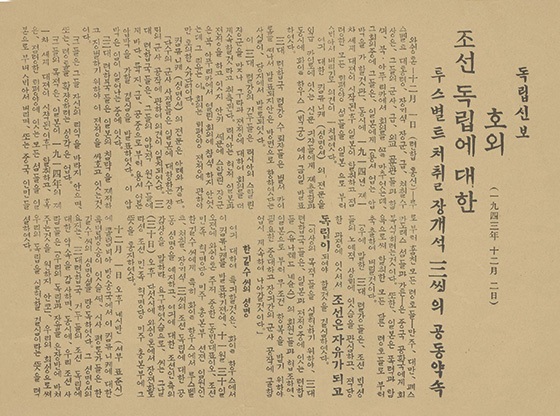
An extra edition of Dongnip (Korean Independence) issued on December 2, 1943
reporting on the Cairo Conference
From Diplomatic Maneuvers to Armed Struggle
The Provisional Government emphasized diplomatic efforts as a means to restore Korean independence. In 1919, Kim Gyu-sik was dispatched as a representative to the Paris Peace Conference. Serving as envoy plenipotentiary, Kim pursued diplomatic activities promoting the cause of independence.
China was the key country in the Provisional Government’s efforts to secure support and cooperation. When Chinese revolutionaries established the Military Government in Guangzhou in 1921, Foreign Minister of the Korean Provisional Government Sin Gyu-sik paid a visit to its leader Sun Yat-sen. Kim was treated cordially in Guangzhou and gained official recognition for the Provisional Government from Sun. However, the volatile political conditions in China at the time did not allow this recognition to remain in force.
Expectations were high for diplomacy with the United States, and a diplomatic office was installed in Washington, D.C. Independence activists under the direction of Syngman Rhee carried out active diplomatic efforts to woo U.S. politicians, but with few meaningful achievements. In Russia, a funding request by Prime Minister Yi Dong-hwi was accepted, and Vladimir Lenin provided 2 million RUB to the Provisional Government.
Their greatest diplomatic victory came at the Cairo Conference in November 1943. A sentence was included in the subsequent Cairo Declaration that guaranteed the independence of Korea after the surrender of Japan. This was a product of the diplomatic efforts of Jo So-ang and Kim Gu, the last president of the Provisional Government. Korean independence was strongly supported by the Chinese leader Chiang Kai-shek and conceded by U.S. President Franklin Roosevelt and British Prime Minister Winston Churchill as well. It was not an unconditional promise of independence, however, but simply a pledge that it would arrive “in due course.” Korea was the only colony to earn such an international guarantee of independence during the course of World War II.
Diplomacy was not the sole area of focus as the Provisional Government worked toward its ultimate goal of independence. From the end of 1919 onward, military plans were implemented as well. A military training center was established in Shanghai at the end of 1919 with a view to producing officers for a Korean military. In the United States, a pilot training center was opened at Winslow, California in February 1920 under the leadership of Military Minister No Baek-rin and supported by a local Korean named Kim Jong-rim. It was hoped that aviators could be nurtured for an official air force under the Provisional Government.

Immediately after the bombing by Yun Bong-gil at Hongkou Park on April 29, 1932
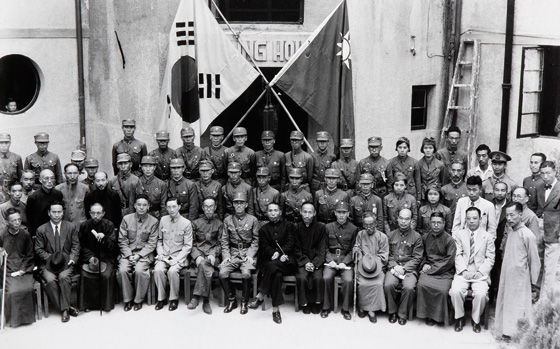
A photo taken on September 17, 1940 in celebration of the establishment of the Restoration Army as the official armed branch of the Provisional Government
In 1920, efforts were made to link up with Korean freedom fighters operating in Manchuria. As a result, groups of armed independence activists respectively headquartered in West Gando (Jiandao) and North Gando were incorporated into the Military Ministry of the Provisional Government. In 1924, a pro-independence fighting force called Chamuibu was installed in southern Manchuria under the direct command of the Provisional Government.
In 1940, the Provisional Government finally established a formal army. Settled in Chongqing after a long process of shifting its headquarters from place to place within China, the Provisional Government launched its Restoration Army on September 17, 1940. Issuing a declaration of war on Japan, the Provisional Government took part in joint operations with the Allied Powers. The Restoration Army of the Provisional Government supported Chinese forces in their campaign against Japan and carried out military operations in the India-Burma theatre in concert with the British army. The Provisional Government also cooperated with the Office of Strategic Services, the predecessor of the United States Central Intelligence Agency (CIA), in an attempt to penetrate the Korean Peninsula. In an effort code-named Project Eagle, Korean soldiers were trained for a planned infiltration aboard an airplane or submarine.
The “justice and blood struggle,” or uiyeol tujaeng, is another activity of the Provisional Government that relied on violent tactics. It can be described as a selfless resistance against colonization and a complete dedication by an individual to the goal of eventual peace and justice. To this end, the Provisional Government organized a special group called the Korean Patriots Corps (Hanin Aegukdan). This group made notable achievements on behalf of Korea’s independence movement, including Yi Bong-chang’s attempt to assassinate the Japanese emperor in Tokyo in 1932 and Yun Bong-gil’s bombing in Hongkou Park (present-day Lu Xun Park) in Shanghai during a celebration organized by the Japanese Imperial Army.
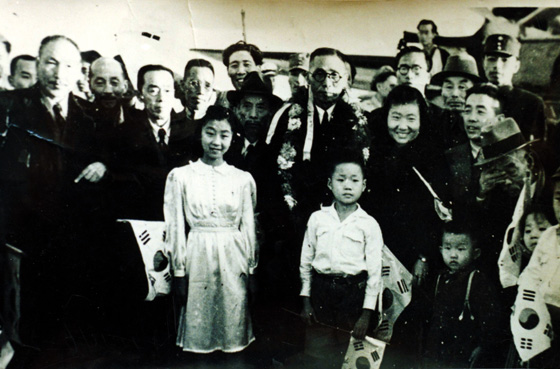
Kim Gu and other members of the Provisional Government arriving
in Shanghai from hongqing on November 5, 1945 prior to their return to Korea.
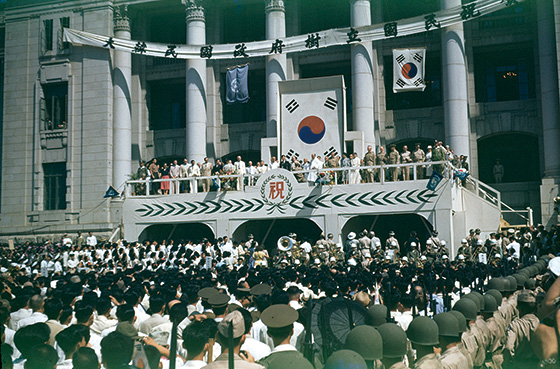
The formal establishment of the government of the Republic of Korea on August 15, 1948
A Critical Force for National Liberation
The Provisional Government of the Republic of Korea has a lofty place in the country’s history. First of all, it was a government for the Korean nation that was established by Koreans on their own as a clear signal of resistance against Imperial Japan and its colonial program.
The Provisional Government ushered in the era of democracy. Article 1 of the Provisional Charter of the Republic of Korea, adopted and proclaimed by the Provisional Government on April 10, 1919, states, “The Republic of Korea is a democratic republic.” This meant an end to the longstanding monarchy and the installation of a democratic political system, replacing the dynasty with a nation-state and royal subjects with sovereign citizens.
The Provisional Government served as the final bastion of hope for independence among the Korean people. Although trapped under the harsh realities of colonialism, Koreans could manage to hold a sliver of hope for the future thanks to the existence of the Provisional Government. This was manifested in the comments made by the renowned independence activist Kim Maria at a meeting of the Provisional Government in Shanghai: “Even those who do not support the Shanghai Provisional Government overseas sell its name when they want to raise funds in Korea. This shows how much trust the Provisional Government has garnered among the Korean people. If you do not mention the Provisional Government, it is hard to gain support from people in Korea, not even a single meal!” Korean students conscripted into the Japanese Imperial Army risked their lives to escape and make the long voyage to seek out the Provisional Government and enlist in its forces.
The Provisional Government was the kernel of the present-day Republic of Korea. Officially established on August 15, 1948, it inherited its name, year-numbering system, and constitutional principles from the Provisional Government. This spirit of successor to the Provisional Government is illustrated in the preamble of the Constitution of the Republic of Korea, “We, the people of Korea … upholding the cause of the Provisional Government of the Republic of Korea born of the March First Movement of 1919.”
The liberation and independence of Korea was neither a simple byproduct of the victory by the Allies nor an unexpected act of fortune. It was an achievement earned by the exertions of the Korean people, at the center of which was positioned the Provisional Government of the Republic of Korea.
Text by Kim Yong-dal, Director, Korean Independence Movement Research Institute
Photos by the Independence Hall of Korea

대한민국 임시정부 100년의 의미
한국 근대사는 독립운동사와 같이 시작하여 발전해왔다고 해도 과언이 아니다. 특히 한국 민주주의의 역사는 독립운동사와 그 궤를 같이한다. 독립운동시기였던 1919년 4월 11일, 한국인은 자주독립의 꿈과 국민주권의 이상을 담아 중국 상하이에 대한민국 임시정부를 만들었다. 일본제국주의의 침략으로 국민은 노예 상태에 빠져 있고, 주권은 빼앗겼으며 영토는 강점 당한, 그야 말로 척박한 땅 위에 ‘국민국가’의 희망을 심은 것이다. 이렇게 출범한 대한민국 임시정부는 국내외 한국인을 아우르며 국제사회에서 독립을 보장받기 위한 외교활동, 항일 무장투쟁, 민족교육, 의열투쟁 등을 전개하였다.
한국인의 뜻을 결집한 임시정부의 수립
대한민국 임시정부는 3.1독립운동으로 성립하였고, 3.1독립운동은 대한민국 임시정부의 수립으로 빛을 발하였다. 3.1독립운동 시기 4개 지역에서 독립선언이 발표되었다. 만주 길림에서 대한독립선언, 일본 도쿄에서 2.8독립선언, 서울에서 3.1독립선언, 그리고 러시아 블라디보스토크에서 대한국민의회 독립선언이다. 4개 독립선언의 공통 이슈는 “대한의 자주독립과 대한 국민의 자주” 또는 “조선의 독립과 조선인의 자주”이다.
중요한 사실은 이들 독립선언에서 볼 수 있는 “육탄 혈전(대한독립선언)” 또는 “영원 혈전(2.8독립선언)”, “영구의 혈전(대한국민의회 독립선언)”, “최후의 일인까지 최후의 일각까지 민족의 정당한 의사를 쾌히 발표하라(3.1독립선언)”는 말이다. 자주독립을 달성할 때까지 한국인은 마지막 한 사람까지 마지막 한 순간이라도 영원히 ‘피의 투쟁’을 멈추지 않겠다는 뜻이다.
한국인은 독립과 자주를 몸소 행동으로 표출했다. 독립 만세운동에는 당시 2천만 한국인 가운데 2백만이 넘는 인원이 자발적으로 동참했다. 한국인 다수가 조국 독립과 민족 자주를 원했으니, 그 뜻을 결집한 국가와 정부가 필요했다. 일본제국주의 식민지 국가와 정부가 아닌, 한국인이 스스로 세운 나라와 정부가 절실했던 것이다.
더욱이 3.1독립운동은 세계만방에 한국의 독립을 구걸하거나 청원한 것이 아니다. 스스로 한국의 독립과 한국인의 자주를 선언한 것이다. 그러니 국가와 정부를 세우는 일도 한국인 스스로 해야 했다. 한국의 독립을 위해 ‘영원 혈전’을 벌이는 것과 그를 위해 한국인의 대표기관이자 지도기관을 만드는 일이 시급했다. 그래서 3.1독립운동 시기 각지에서 한국인의 임시정부가 탄생하게 되었다.
먼저, 러시아 연해주에서 대한국민의회 독립선언과 함께 임시정부안이 발표되었다. 이어 국내에서 한성 임시정부안이 성립하였고, 4월 11일 중국 상해에서 대한민국 임시정부가 수립되었다. 나라의 이름을 ‘대한’으로 하고, 정치체제를 민주공화제, 곧 ‘민국’으로 하며 한국 영토가 아닌 중국 땅에서 일부 독립운동가들이 세운 정부이기에 ‘임시정부’라는 이름으로 수립된 것이다.
영토도 없고 국민도 없이 타국 땅 중국 상해에 세운 국가와 정부였지만, 대한민국 임시정부는 한국인에 대한 통치 의지를 포기하지 않았다. 대한민국 임시정부는 수립 직후부터 국내 행정을 장악하기 위해 노력했다. 이런 계획은 초대 내무총장 겸 국무총리 대리 안창호에 의해 이루어졌다. 안창호는 연통부와 교통국을 설치하여 국내 행정을 확보하고, 교통 통신체계를 마련하고자 힘썼다.
국내 행정권 장악과 연락망 확보를 목적으로 삼은 연통부와 교통국은 대한민국 임시정부의 인력과 재정에 중요한 공급선이었다. 국내에서도 대한민국 임시정부를 지원하기 위해 많은 비밀단체가 조직되기도 했는데, 대한민국애국부인회와 대한민국청년외교단, 주비단이나 의용단 등이 대표적이다.
외교활동부터 군사활동까지, 성과를 얻다
대한민국 임시정부가 역점을 두었던 대외정책은 외교활동이었다. 제1차 세계대전이 끝나고, 그것을 마무리 짓기 위해 프랑스 파리에서 개최된 강화회의를 이용하려는 의도였다. 김규식은 대한민국 임시정부의 대표로 강화회의가 열린 파리에 외교공관인 대표부를 설치하고, 전권대사로 활약하였다.
무엇보다 중국 정부가 대한민국 임시정부의 외교대상으로는 가장 중요했다. 중국 정부의 양해와 협조를 얻지 않고는 활동할 수 없었기 때문이다. 손문이 광동에서 호법정부를 수립하자 1921년 대한민국 임시정부의 외무총장 겸 국무총리 대리 신규식이 광동을 방문했다. 여기서 신규식은 국빈 예우를 받으며 손문으로부터 대한민국 임시정부의 승인을 얻어냈으나, 중국이 국민혁명 중에 있었던 지라 그 성과를 지속시켜 나갈 수 없었다.
미국에 대해서는 상당한 기대를 가지고 외교적 노력을 기울였다. 워싱턴에 대한민국 임시정부 구미위원부를 설치하여 임시 대통령 이승만을 중심으로 미국 의회와 정계에 활발한 외교활동을 벌였지만, 큰 성과를 거두지 못했다. 러시아에 대한 외교는 국무총리 이동휘가 레닌(Lenin)에게 요청하여 200만 루불의 자금을 지원받기도 했다.
가장 큰 외교 업적은 1943년 11월 카이로회담에서 일제 패망 이후 한국인의 독립을 보장받은 것이었다. 대한민국 임시정부 주석 김구와 외교부장 조소앙의 노력으로, 중국 대표 장개석 총통이 열성적으로 지원하여 미국 대표 루스벨트 대통령과 영국 대표 처칠 수상의 양해 아래 얻어진 성과였다. 비록 ‘적절한 절차(in due course)'라는 경과 조치를 두었지만, 2차 세계대전 중 식민지 국가 가운데 유일하게 독립을 보장받는 외교적 성과였다.
대한민국 임시정부가 외교활동에만 치중한 것은 아니다. 1919년 말부터 군사활동 계획을 수립해 추진해 나갔다. 1919년 말 상해에 육군무관학교를 설립하여 군사 간부 양성에 들어간 것이다. 미주에서는 군무총장 노백린이 재미 한인 김종림의 지원으로 1920년 2월 캘리포니아주 윌로우스에 비행사양성소를 설립하였다. 비행사를 양성하여 공군을 창설하려는 시도였다.
1920년은 ‘독립전쟁의 해’로 삼아 만주지역에서 활동하던 독립군 부대들과 연계하여 독립전쟁을 전개하고자 힘썼다. 그 결과 서간도의 서로군정서와 북간도의 북로군정서가 대한민국 임시정부 군무부 산하 군정 기관으로 편제되었다. 1924년 초에는 직할 독립군 부대로 참의부를 남만주에 창설하기도 하였다.
1940년 9월 대한민국 임시정부는 국군을 창설하였다. 대장정 끝에 중경에 안착한 직후인 9월 17일, 한국광복군을 창설한 것이다. 제2차 세계대전 중 대한민국 임시정부는 대일 선전포고를 발표하고 연합국의 일원으로 공동작전을 수행하였다. 한국광복군은 중국군의 대일 항전을 지원하고, 인도와 미얀마 전선에서 공작대를 파견하여 영국군과 공동작전을 펼쳤다. 또 미국 전략첩보국(O.S.S)과 합작하여 국내 진입작전을 전개하기 위한 군사훈련을 실시하였다. 한국광복군을 잠수함이나 항공기로 한반도에 투입하여 공작거점을 확보하기 위한 독수리작전(Eagle Project)을 계획한 것이다.
대한민국 임시정부의 활동 가운데 특이한 점은 의열투쟁을 전개했다는 것이다. 의열투쟁은 살신성인의 정신으로 침략에 대항하고 인류의 정의와 평화를 지키기 위해 헌신하는 것이다. 대한민국 임시정부는 특무조직으로 한인애국단을 결성하여 의열투쟁 역사상 가장 빛나는 쾌거를 이룩하였다. 1932년 일본 도쿄에서 일왕 처단을 기도한 이봉창 의거와 홍커우 공원에서 상해를 침공한 일본군사령관을 처단한 윤봉길 의거가 바로 그것이다.
해방의 중심에 있었던 대한민국 임시정부
이러한 대한민국 임시정부의 역사적 의의는 다음과 같다. 첫째는 일본제국주의 식민지 국가와 정부를 거부하고 한국인 스스로 ‘대한민국’이라는 나라와 ‘임시정부’를 세웠다는 사실이다.
둘째는 민주주의의 역사를 처음으로 열었다는 점이다. “대한민국은 민주공화제로 함”. 이는 「대한민국 임시헌장」 제1조에 명시된 대한민국의 정체이자 국체이다. 대한민국 임시헌장은 1919년 4월 10일 열린 제1회 대한민국 임시의정원 회의에서 제정 선포되었다. 여기에서 대한민국 임시정부가 ‘민주공화제’를 채택함으로써 반만년 지속된 군주전제 국가가 사라지고, 민주공화제 국가가 새롭게 성립되었다. 이로써 ‘제국’에서 ‘민국’으로, 봉건국가의 ‘신민(臣民)’에서 근대국가의 ‘국민’으로, 무권리의 ‘백성’에서 주권을 가진 ‘시민’으로 거듭나는 민주의 시대가 열린 것이다.
셋째는 한국인에게 독립의 꿈과 희망을 주었다는 점이다. 한국인이 꿈과 희망조차 잃어버린 고난의 시기가 일제강점기였다. 그런 엄혹한 시기에 한국인에게 위안이 되고 등불이 되어 민족독립의 꿈과 희망을 잃지 않게 했던 것이 대한민국 임시정부라는 존재였다. 그래서 유명한 여성독립운동가 김마리아도 상해 국민대표회의 석상에서 목청 높여 이야기한 것이다. “설혹 외지에서 임시정부를 반대하던 자라도 국내에 들어와서 금전을 모집할 때에는 다 임시정부의 이름을 파는 것을 보아도 국내 동포가 임시정부를 믿는 증거이다. 국내에 들어가 대한민국 임시정부를 팔지 않으면 밥 한 끼도 얻어먹지 못한다.”고. 일제 말기 학병으로 끌려간 수많은 한국인 청년들이 죽기 살기로 탈출해 찾아간 곳이 바로 대한민국 임시정부라는 사실이 그 존재가치를 잘 말해준다.
넷째는 오늘 대한민국의 뿌리이자 연원이라는 점이다. 1948년 8월 15일, 정식으로 수립된 대한민국 정부는 대한민국 임시정부의 국호, 연호, 헌법을 계승하여 재건되었다. 뿐만 아니라 임시정부와 광복군 지도자들은 정부와 국군 성립에 주요한 역할을 맡았다. 대한민국 임시정부가 대한민국의 뿌리이자 기원이 된 것이다. 헌법 전문에 새겨진 “우리 대한국민은 3·1운동으로 건립된 대한민국 임시정부의 법통”을 계승한다고 하는 생생한 이유도 바로 여기에 있다.
결국, 한국인의 해방은 연합국 승전의 부산물도, 하늘에서 떨어진 떡도, 어느 날 갑자기 찾아온 손님도 아니다. 한국인이 피땀으로 이룬 성취이자 결과이고 그 중심에 대한민국 임시정부가 자리 잡고 있는 것이다.
Text by 김용달 한국독립운동사연구소장
Photos by 독립기념관