Interview
Master Park Breathes New Life into Wood
By Korea Cultural Heritage Foundation
Sculpting wood holds a prominent place among Korea’s traditional crafts. Solid wood with beautiful grain patterns are usually adopted, such as princess tree, pine, fir, ginkgo, and pagoda tree. Wooden sculpture has been designated on the national heritage list as National Intangible Cultural Heritage No. 108, and Park Chan-su is the recognized master of the craft.
Wood Carving, the Epitome of Traditional Craft
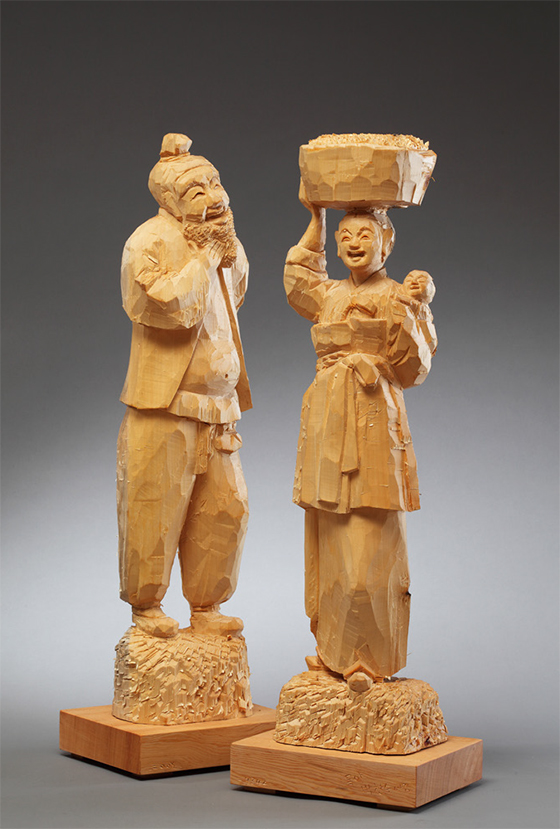
Korean Lady and Grandfather;
20 × 16 × 88 cm and 21 × 15 × 85 cm
From prehistoric times, wood has been used to produce both two- and three-dimensional objects. Due to its perishable nature, prehistoric woodwork has not survived well to the present, but its existence can be deduced from pictorial images on prehistoric legacies made of stone or bronze. Many ancient artifacts such as the petroglyphs of the Bangudae terrace (National Treasure No. 285), a bronze ritual object carved with a farming scene (Treasure No. 1823), and a bronze mirror decorated with fine lines (National Treasure No. 141) bear images of wooden sculptures. The earliest examples of a wooden sculpture from Korea surviving today are the early Three Kingdoms period lacquered sheaths and other woodwork and some pieces of a musical instrument, respectively excavated from the Daho-ri tomb cluster and the Sinchang-dong site. With the introduction of Buddhism onto the Korean Peninsula during the Three Kingdoms era, Buddhist images and objects began to be carved in wood. Into the Joseon Dynasty, wooden sculpture was applied in the rendering of diverse objects, both large and small, intended for commoners and nobles alike. This is evidenced by the inclusion of wood sculptors on the list of craftspeople supplying the Joseon court in Joseon’s constitution Gyeongguk daejeon (Grand Code of State Administration).
Among other items, Master Park Chan-su specializes in Buddhist images. Buddhism served as one of the foremost religious and governing ideologies on the Korean Peninsula, wielding great influence over the development of arts and crafts. The skilled creation of Buddhist ritual decorations and Buddha statues provide eloquent testimony to the quality of Korean traditional crafts.
A Life Dedicated to Wooden Sculpture
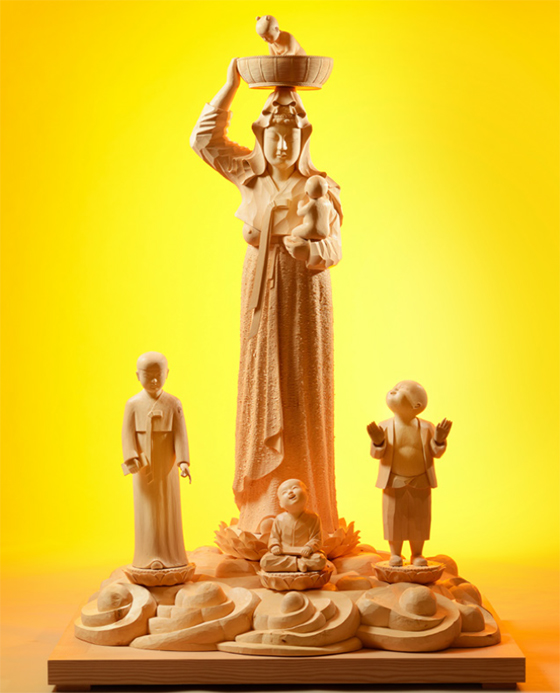
In the Bosom of the Mother
Park Chan-su was born in 1948 to a poor family in Sancheong, Gyeongsangnam-do Province, but moved to the capital Seoul in the sixth grade. There he was admitted to the workshop of the wood sculptor Kim Seong-su, and for one and a half years he learned wood carving skills there while doing chores. In middle school, Park’s talent caught the attention of the art teacher Lee Un-sik, and he came to experience a wider world of sculpture—working not only in wood but also in stone and bronze. In 1974 Park left for Japan to study Buddhist art. While there he came to take interest in traditional artworks, and naturally developed an eye for sculpture through comparative analyses between Korea and Japan. Back in Korea, Park participated in repair and restoration efforts on traditional heritage, and in 1985 acquired national recognition as a heritage repair engineer (No. 722 in the area of sculpture).
Park Chan-su made desperate efforts to sustain and transmit the traditional craft of wood sculpture. He visited numerous Buddhist temples, interviewed countless Buddhist monks, and referred to vast volumes of relevant documents. After all these endeavors, in 1989 he finally succeeded in rendering an accurate wooden Goryeo beopsang, or preaching pulpit. This beopsang was submitted to the 1989 National Craft Championship and took home the top prize. Three full years and a great volume of documentary references and verbal testimonies were required for Park to complete this Buddhist item modeled on the octagonal seat enshrined at the main hall of Tongdosa Temple from the Joseon Dynasty. It was the first physical recreation of a Goryeo-era beopsang seat, which survive only in records. In 1993 Park established the Mok-A Museum (after his nickname Mok-a) in Yeoju, Gyeonggi-do Province, as part of the efforts to raise public awareness of carved woodworks and Buddhist sculpture. When the crafting of wooden sculpture was entered onto the national heritage list as National Intangible Cultural Heritage No. 108 in 1996, Park Chan-su was recognized the first master of this heritage.
Traditional Preservation and Creative Recreation
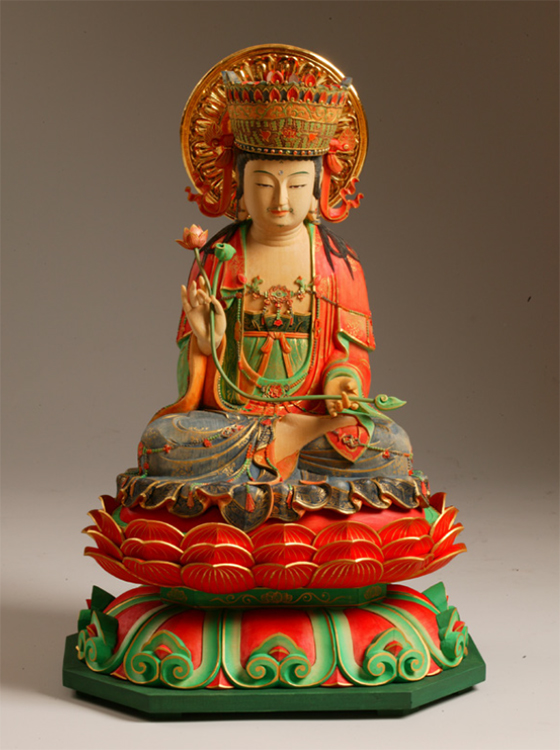
Avalokitesvara Bodhisattva; 56 cm high
His life dedicated to wood sculpture can be explained in several stages. The 1960s was his entry and training phase. During this period, he honed his fundamental skills as a sculptor while experimenting with diverse materials such as wood, stone, bronze, and plaster. In the 1970–80s, Park enhanced his understanding of wooden artifacts and buildings both in terms of breadth and depth, and solidified his position as a professional sculptor. While actively involved in creative activities, he did not ignore academic pursuits for acquiring a theological basis for his profession. It was during this period that Park learned from the Buddhist scholar Lee Gi-yeong about theories on Buddhist art, and established his own creative vision and area of professional specialization. Since the 1990s, Master Park has been devoted to developing and disseminating creative interpretations of traditional art forms. His works representing a Buddhist boy attendant (dongjasang) and shamanistic guardian pillar (jangseung) are good examples in this regard. In these artworks he offers a modern interpretation of traditional forms, demonstrating a positive case for the creative transmission of tradition.
Master Park carries out his work based on a profound understanding of the intrinsic qualities of wood. His exceptional knowledge of wood is evidenced through his unique and careful application of different species of wood and parts of the tree. Master Park makes a careful selection of the species of wood depending on the object to be carved. Furthermore, he adopts, for example, the root for the head of a Buddhist statue and pursues wood of different thicknesses for the various body parts. In this way he can reduce the chance that the finished wood sculpture will suffer from splitting, and also refine the aesthetic effect of a Buddhist sculpture as an object of veneration.
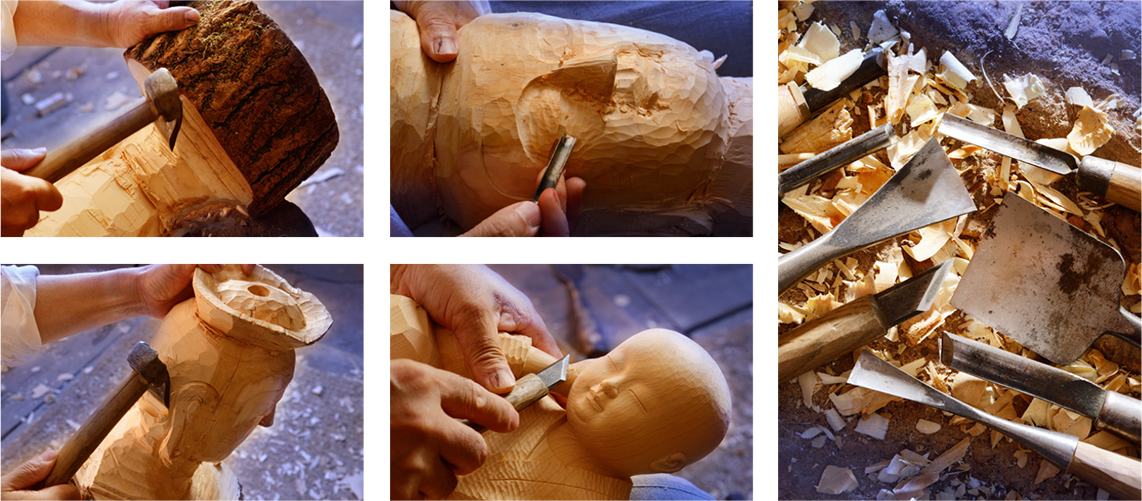
Crafting process for wooden sculptures/Diverse woodworking implements
1) Selection of a wood
Once dried, wood from old trees becomes too hard to be planed; but from young trees it remains viable even after being dried.
2) Drying and refinement
The greatest disadvantage of wood as a material for sculpture is its tendency to split. To prevent such splits, wood is left to dry for two to three years after felling the tree, and only then refined into the desired forms.
3) Sketching
The outline of a Buddhist image is drawn on the processed wood in a way that avoids the knots and aligns the wood grain with the intended sections of the statue.
4) Preliminary carving
A wooden frame is created by joining wood pieces and then roughly cut into the overall structure of the intended image.
5) Carving
Carving is performed on the wooden framework. The carving step can be subdivided into rough and detailed carving.
6) Surface rendering
Cloth pieces are draped on the sculpture to provide a suitable surface for the subsequent lacquering process. The cloth pieces should be fixed with glue.
7) Lacquering and gilding
Lacquer, the refined sap of the lacquer tree, not only enhances the durability of the sculpted Buddhist image but also serves as an adhesive to affix gold leaf or powder to a surface.
8) Painting
The carved Buddhist image may be painted by applying a mixture of pigments and glue. Camellia or castor oil is applied to the painted Buddhist statue to enhance color expression and prevent discoloration.
9) Waxing
Rather than painting or gilding, the carved Buddhist image may be immersed in boiled wax to bring the grain of the wood to life.
Text by the Korea Cultural Heritage Foundation
Photos bythe Korea Cultural Heritage Foundation