
Visit
Jeong-dong, a Newly Rediscovered Center of Early-modern Korea
By Ahn Chang-mo
In 1897, the 26th king of the Joseon Dynasty, Gojong, proclaimed the autonomous rule of Korea by inaugurating the Korean Empire. The primary seat of the new empire was installed at Deoksugung Palace, a Joseon compound that had not previous served as the primary royal residence. Around the time of the declaration of the Korean Empire, the neighborhood surrounding the imperial palace of Deoksugung, known as Chong Dong at the time and as Jeong-dong today, emerged as a new center in Seoul when a series of Western institutions were installed there. The American legation was the first to settle in Jeong-dong, followed by diplomatic bodies from other countries and religious and educational institutes. The history of early-modern Korea, from its initial encounters with the West and the historical development of its international relations, is clearly manifested in Deoksugung and the wider Jeong-dong neighborhood.
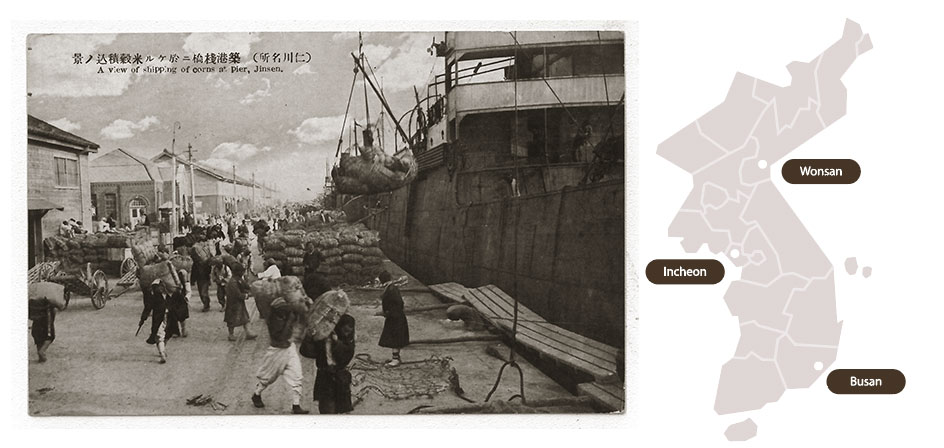
Incheon Port after its opening in 1882. Photo courtesy of the Incheon Open Port Museum
Reemerging History of Early-modern Korea
Seoul is a historic city with an ages-old legacy of more than 600 years as the capital of Korea. It might be expected that such an old city would already have undergone sufficient change and would remain static. This is not the case for Seoul, however. The capital of Korea was and still is passing through phenomenal changes, not only in terms of the physical landscape, but in terms its memory-scape as well.
After the celebrations marking the 600th anniversary of Seoul as the capital of Korea in 1994, the areas around Gyeongbokgung and Changdeokgung Palaces, such as the Bukchon and Insa-dong districts, saw a meteoric rise as iconic neighborhoods in the capital. Likewise, Deoksugung Palace and the Jeong-dong area entered the spotlight on the occasion of the 120th anniversary of the proclamation of the Korean Empire in 2017. They are considered to provide hard evidence for correcting errors in the history of early-modern Korea that has been somewhat distorted following decades of Japanese colonial control.
Port Opening as an Active Choice for the Future
Joseon signed its Treaty of Amity and Commerce with the United States in 1882 and soon thereafter opened Incheon Port (known as Jemulpo at the time) to international trade and allowed the installation of the American legation in Jeong-dong within the walled core of the capital. The 1882 treaty with the United States was not the first international trade agreement with the outside. This had come in 1876 when Joseon entered the era of international commerce and open ports through the signing of the Treaty of Ganghwa with Japan. However, it was not until 1880 that Japan established diplomatic representation in Korea, and its representation was located outside the walled capital.
Was Joseon passively giving in to Japanese coercion when it opened its ports? If so, why did Japan fail to gain entrance to the walled capital? On the other hand, how did the United States peacefully establish a diplomatic presence in the center of Seoul? Answers to all these historical questions can be found in the fact that the early-modern history of Korea has been distorted by a colonialist viewpoint that reflects Japan’s perspective.
A simple look at the order for the opening of ports reveals a different story than the conventional understanding of the early-modern history of Korea. As a condition of the Treaty of Ganghwa, Joseon promised to open the three ports of Busan, Wonsan, and Incheon, respectively on the southern, eastern, and western coasts of the Korean Peninsula. The highest priority on the Japanese side was Incheon, since it served as a gateway to Seoul. However, Joseon opened Busan first in 1876 and then Wonsan in 1880 and Incheon only in 1882, six years after the formation of the commerce treaty with Japan. The story unfolded quite differently with the bilateral agreement with the United States. Upon the signing of the Treaty of Amity and Commerce in 1882, Incheon Port was promptly opened and the American legation was allowed into the center of the capital the next year. Through these historical events, it can be inferred that the opening of Incheon Port was not simply the fulfillment of a forced treaty with Japan, but more of a proactive decision made on the part of Joseon out of its commitment to commercial exchanges with the United States.
For Joseon, international trade and engagement with the outside—in the true sense of the words—was effected through the 1882 treaty with the United States and the installation of the American legation in 1883. After the United States positioned its diplomatic delegation in Jeong-dong, other countries forging relations more gradually with Joseon followed suit: England and Germany in 1883, Russia and Italy in 1884, France in 1886, and Belgium in 1900 all installed legations within the same area. Jeong-dong quickly emerged as a diplomatic center in Korea and bore witness to some of the most important events of the country’s early-modern history.
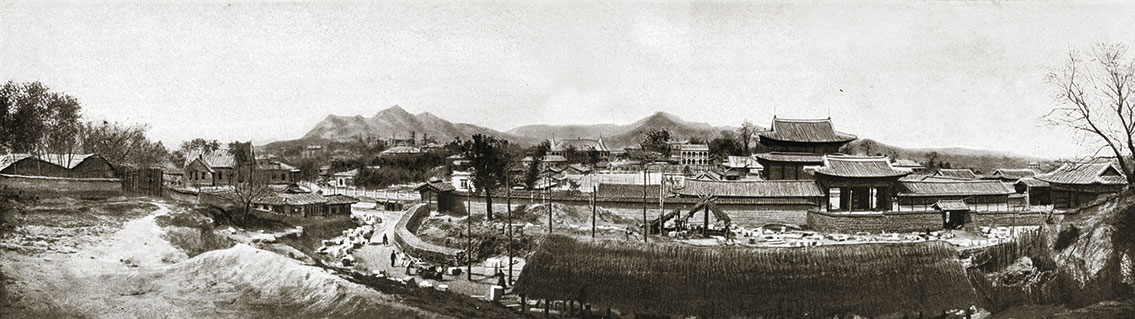
The Jeong-dong area with Deoksugung Palace shown in the center. Photo courtesy of Corea e Coreani by Carlo Rossetti
Jeong-dong as Historical Testimony
The history of Korea’s early-modern period was distorted during the Japanese colonial era of 1910–45. Emperor Gojong became known as an incapable coward who was busy securing his personal safety while the sovereignty of his country was being encroached upon by outside forces. The historical significance of the Korean Empire was wiped from national history. Seokjojeon, a modern masonry building in Deoksugung Palace that was constructed as the governing hall for the Korean Empire, obtained an unjustified reputation as a symbol of the reckless infiltration of Western culture.
When Japan intensified its pressure on Joseon by assassinating Queen Min in 1895, Gojong partnered with Russia to counterbalance the Japanese aggression. Shifting his residence to the Russian legation in February 1896, Gojong implemented a series of undertakings to safeguard an independent future for Joseon, such as purging Japanese collaborators, having Deoksugung reconstructed, ordering the construction of the Independence Gate, and spearheading the publication of a daily newspaper in both Korean (Dongnip Sinmun) and in English (The Independent). Soon after his return to Deoksugung Palace in February 1897, Gojong declared the birth of the Korean Empire with himself its first emperor. He then designated Deoksugung Palace as the main imperial seat.
The road leading from Deoksugung to the site of the Russian legation building, closely associated with memories of the lead-up to the proclamation of the Korean Empire, has been recently refurbished and will soon open to the public.
Jeong-dong Alive with Memories of Early-modern Korea
It is fortunate that the past decade has seen renewed public and academic interest in Gojong and the Korean Empire, and accordingly the discovery of new historical facts and interpretations.
Rendered in the Neoclassic style, Seokjojeon stands as the manifestation of Korea’s firm aspiration to develop into a modern state and of its capacity to materialize this dream. The site of the current Canadian embassy in Jeong-dong once housed the diplomatic representatives of Belgium, with whom Joseon formed a special relationship in order to demonstrate Korea’s neutrality toward imperial rivalries. The Sontag Hotel, perceived once as simply a clubhouse for Westerners, and Dondeokjeong Hall, where Sunjong assumed the throne after his father Gojong, are both places associated with the fortieth anniversary of Gojong’s reign. They respectively served as the banquet hall for the 1903 celebration and as accommodation for distinguished guests. There remain other buildings in Jeong-dong that carry the history of early-modern Korea into the present: the American and British legation buildings that maintain their original appearance; Chungdong First Methodist Church, the oldest Protestant place of worship in Korea; and the structures that housed the Ewha Girls’ School and Pai Chai Academy. Diverse bodies reflecting Christian beliefs, including the Catholic Church, Anglican Church, Russian Orthodox Church, Methodist Church, and the Salvation Army, also established a presence in the Jeong-dong neighborhood. The previous Korean legation building in Washington, D.C., which has recently been restored and opened to the public, demonstrates that the extent of Gojong’s efforts at national autonomy was not confined within the limits of Korean territory.
The Korean Empire should be understood as the starting point of the current Republic of Korea. This can be explained through the evidence from the existing historical spaces and surviving architecture—the Jeong-dong area and Deoksugung Palace. The Jeong-dong neighborhood encompassing the Deoksugung complex is and will be in the future changing its historical meaning. Each discovery of their hidden history renews our understanding of the area and contributes to correcting the distorted perceptions of early-modern Korea. As part of this grand historical project, restoration will soon begin on Seonwonjeon, the hall where the portraits of preceding kings were maintained during the Joseon era. The restoration of Seonwonjeon is expected to strengthen the understanding of the position of Deoksugung Palace as the seat of the Korean Empire. Once at risk of being converted into the American embassy, the site of Seonwonjeon was reclaimed by Korea by means of passionate civil support. The task of correcting historical distortions can—and should—be pursued not only through the concerted efforts of the government and academics, but also with strong civic participation.
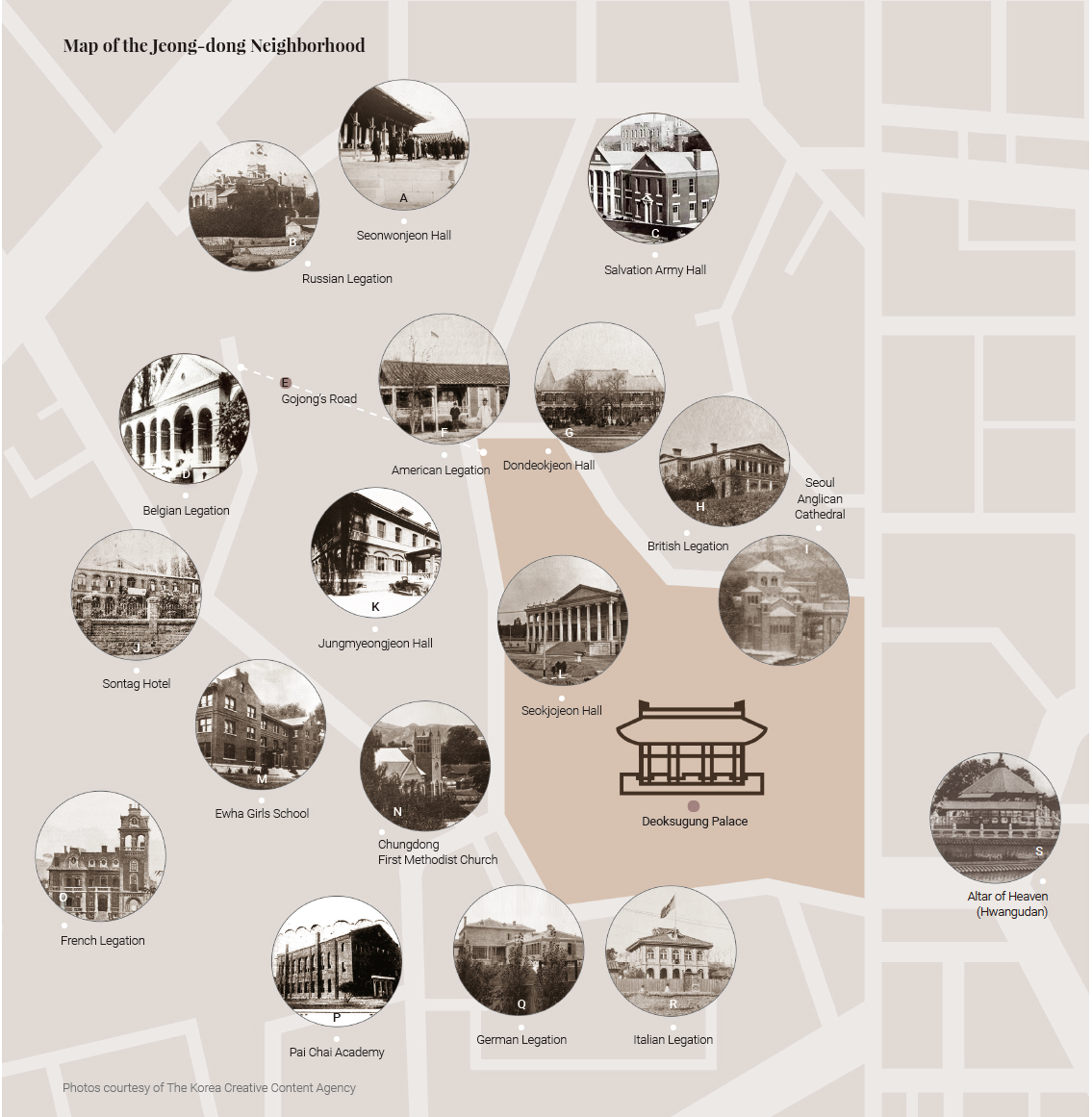
Map of the Jeong-dong Neighborhood
A. Seonwonjeon Hall
Seonwonjeon, a hall within the Deoksugung Palace compound that enshrined the portraits of preceding kings, was demolished by the Japanese colonial authorities in 1920. Its restoration is currently underway and is scheduled for completion in 2039.
B. Russian Legation
Five years after the signing of a commercial treaty with Joseon in 1885, this building was erected to house Russia’s diplomatic representatives. It was here that Gojong made preparations for the proclamation of the Korean Empire in 1896. The building was destroyed in the Korean War (1950-3); only the observatory tower remains today.
C. Salvation Army Hall
This building was constructed in 1928 as a two-story red brick structure. Despite an extension at the rear of the building, it has generally maintained its original form. It is currently used as the Salvation Army Museum of History. Photo courtesy of Ahn Chang-mo.
D. Belgian Legation
Gojong pushed ahead with an agreement with the neutral state of Belgium in 1901. The Belgian legation was originally sited across from the Russian legation, but soon moved southeast to the Hoehyeon-dong area. At the site where the Belgian legation was once located is now the Canadian embassy. Photo courtesy of Ahn Chang-mo
E. Gojong’s Road
This is the roughly 120-meter route walked by Gojong when he transferred his residence from Deoksugung Palace to the Russian legation in 1896. The historic path has been restored and is scheduled for a public opening in October this year.
F. American Legation
This traditional Korean building housed the initial American legation to Korea. It was the first Korean property every sold to a Westerner. The building is presently used as the U.S. ambassador’s residence.
G. Dondeokjeon Hall
Dondeokjeon, one of the now-demolished halls within the Deoksugung Palace compound, was the site of diplomatic receptions during Gojong’s reign. The enthronement ceremony for Emperor Sunjong was held here as well.
H. British Legation
The United Kingdom formed a diplomatic relationship with Joseon in 1883 and established this building as its seat in 1884.
I. Seoul Anglican Cathedral
This building housing the Seoul Anglican Cathedral was constructed in 1926. It has been designated as Tangible Heritage no. 35 on the heritage list of the Seoul Metropolitan Government. Photo courtesy of the Seoul Museum of History.
J. Sontag Hotel
Founded in 1902 by Antoinette Sontag, the sister-in-law of the Russian consul Karl Weber, the Sontag Hotel was the first Western-style hotel in Korea. Today the site is home to the Centennial Memorial Hall of Ewha Girls School.
K. Jungmyeongjeon Hall
Jungmyeongjeon was constructed in 1899 as the official library of the Korean Empire. After a fire at Deoksugung Palace in 1904, it was temporarily used as the residence of Emperor Gojong. Transferred to private ownership after independence, the building was later purchased by the government and has since been restored and opened to the public as a museum.
L. Seokjojeon Hall
Seokjojeon, completed in 1910, is a European-style masonry building within Deoksugung Place. It features carvings of plum flowers, a symbol of the Joseon royal family, on the front and Western-style decorations inside.
M. Ewha Girls School
This building housed Ewha Girls School, the first modern educational institution for girls in Korea. It was founded by the American missionary Mary F. Scranton in 1886. The building currently serves Ewha Girls High School.
N. Chungdong First Methodist Church
The Chungdong First Methodist Church building has survived at its original location since its construction in 1887 by the American missionary Henry Gerhard Appenzeller.
O. French Legation
This building was constructed in 1896 to accommodate the French legation. It was the tallest structure in Korea at the time. The French legation moved out in 1910 and the building was dismantled in 1939. Currently, Changdeok Girls High School stands on the site.
P. Pai Chai Academy
This building housed the Pai Chai Academy, the first secondary educational institute in Korea. It was founded by Henry Gerhard Appenzeller, starting with a two-student class. The building currently houses the Pai Chai Academy Museum of History.
Q. German Legation
The German legation was established in Jeong-dong in 1891. Afterwards, the building was used by the highest court of the Korean Empire. Following independence in 1945, it served the Supreme Court of Korea. It is currently the seat of the Seoul Museum of Art. This photo shows the German legation after it moved to Namchang-dong in 1902.
R. Italian Legation
After signing a commercial treaty with Joseon in 1884, Italy constructed this building in 1901 to house its legation.
S. Altar of Heaven (Hwangudan)
Here at the Altar of Heaven Gojong was invested as the head of the Korean Empire and reported his imperial status to the heavens. The structure was demolished in 1913 by Japanese colonialists. The Westin Chosun Seoul currently stands on site and no remnants of the heavenly altar survive. Photo courtesy of Ahn Chang-mo.
Text by Ahn Chang-mo, Professor of Architecture, Kyonggi University

정동 다시 만나는 근대 한국의 중심
고종은 1897년 ‘조선은 홀로 설 수 있는 자주국’임을 만천하에 공포하며 덕수궁을 황궁으로 하는 대한제국을 선포했다. 덕수궁과 가까운 정동에는 미국공사관을 비롯한 서구의 공사관이 들어섰고, 신식 교육을 선도하는 교육기관, 외래 종교의 건물들이 등장했다. 정동은 대한제국의 정치1번가였고, 대한문 앞은 서울의 새로운 중심이었다. 조선이 서구와 어떻게 만났고 오늘에 이르렀는지, 그 역사가 정동에 고스란히 담겨 있다.
다시 돌아가는 역사의 시계
서울은 600년이 넘는 시간을 수도로서 역할해온, 창덕궁, 종묘 등 세계유산을 품은 ‘역사도시’이다. 역사도시는 오랜 시간의 풍파를 견뎌왔기 때문에 변화의 폭이 크지 않은 것이 일반적이나 서울에는 적용되지 않는다.
서울 성곽 안의 변화는 놀랍다. 1994년 ‘정도 600년 행사’ 이후, 북촌과 인사동은 역사도시 서울의 아이콘이 됐다. 그리고 대한제국 출범 2주갑(周甲, 1주갑이 60년)이었던 2017년을 기점으로 정동과 덕수궁이 근대 한국의 원점으로서 새롭게 조명되고 있다. 일본이 심었던 식민사관으로 오염된 ‘개항’과 ‘대한제국’으로 이어지는 한국 근대사의 오해를 바로잡을 역사의 현장이기 때문이다.
개항, 조선 정부의 능동적인 선택
조선은 미국과 수교한 1882년 이후, 인천을 개항하고 도성 문을 열었다. 이어서 정동에 미국공사관을 설치했다. 헌데 그보다 앞선 1876년, 일본과의 강화도조약이 먼저 맺어졌고, 세 곳의 항구를 열어 외국과 통상을 이미 시작했는데 일본공사관은 1880년이 되어서야, 그것도 서대문 밖에 설치되었다.
1876년 일본에 의해 강제로 개항 당한 것이 사실이라면, 왜 일본은 도성의 문을 열지 못했을까. 반면 미국은 어떻게 서울 한복판인 정동에 공사관을 설치할 수 있었을까. 이 모든 것에서 왜곡된 한국 근대사의 실체를 발견할 수 있다.
개항장이 열리는 순서를 살펴보자. 조선은 1876년 일본과 강화도조약을 맺으면서 20개월 이내에 부산, 원산, 인천 세 곳의 항구를 열겠다고 약속했다. 일본이 정말 원했던 곳은 서울로 들어오는 관문인 인천이었지만, 조선은 1876년 부산을 가장 먼저 개항하고, 1880년 원산, 1882년 인천을 가장 마지막에 개항했다. 1876년 강화도조약 체결 이후 무려 6년 만의 일이다. 그런데 미국에게는 1882년 수교 후 인천을 바로 개항하고, 이듬해 정동에 미국 공사관 설치를 허락하기에 이른다. 즉, 인천 개항은 일본을 향한 게 아니라, 미국과의 교역을 목적으로 진행된 것이다. 결국 개항은 조선 정부의 능동적인 선택이었다는 점에 주목해야 한다.
조선의 입장에서는 1882년 인천 개항과 1883년 미국 공사관 설치가 실질적인 개항이자 문호개방이었다. 이를 시작으로 1883년 영국과 독일, 1884년 러시아와 이탈리아, 1886년 프랑스, 1900년 벨기에 공사관이 들어서며 정동은 외교타운으로 부상했고, 근대 한국의 역사가 농축된 현장이 됐다.
정동은 알고 있다
일본이 한국을 강제로 점령한 ‘일제강점기(1910.8.29~1945.8.15)’에 한국의 근대 역사는 왜곡됐다. 고종은 나라를 빼앗기고 자신의 안위를 지키는데 급급했던 비겁한 왕이 되었고, 대한제국은 지워져 있었다. 그리고 대한제국 황궁의 정전으로 지어졌던 석조전은 외세침탈의 상징으로 잘못 알려졌다.
1895년 을미사변 당시, 일본은 명성왕후를 살해하고, 조선을 압박했다. 고종은 일본에 대항하기 위해 러시아와 손을 잡았고, 1896년 2월 정동의 러시아공사관으로 거처를 옮겼다. 그곳에서 친일파를 숙청하고 덕수궁(당시 경운궁)을 중건토록 명했으며, 독립문을 세웠다. ‘조선은 홀로 설 수 있는 자주국’이라는 사실을 천하에 공포했으며 한글과 영어로 된 독립신문을 발행해 국민, 그리고 서양 국가들과 소통하고자 했다. 1897년 2월 덕수궁으로 돌아온 고종은 1897년 10월 13일 대한제국을 선포하고 황제에 즉위했으며, 경복궁이 아닌 덕수궁을 황궁으로 삼았다.
이러한 역사가 담긴 곳이 바로, 덕수궁에서 러시아 공사관으로 연결되는 ‘고종의 길’이다. 최근 대한제국 출범 직전의 역사 현장이자, 덕수궁과 러시아공사관 터를 연결하는 ‘고종의 길’이 단장 되어 대중들에게 선보일 날을 기다리고 있다.
긴 역사를 품에 안고, 정동은 살아있다
다행히 지난 10여 년 동안 대한제국과 고종이 새롭게 조명되면서, 왜곡된 역사가 바로잡혀가고 있다.
서양의 신고전주의 건축양식으로 지어진 덕수궁의 석조전은 대한제국의 서구식 근대국가를 지향하였으며 그러한 능력이 있음을 선언한 것과 다름없음을 증명한다. 현재 캐나다 대사관이 위치한 장소는 대한제국이 중립국화를 위해 벨기에와 수교한 현장이고, 서양인의 클럽하우스로 인식됐던 손탁호텔과 순종의 즉위 장소로 알려졌던 돈덕전은 고종황제 즉위 40년을 위한 행사장과 국빈이 머물던 숙소였다. 신축 당시의 모습을 유지한 미국대사관과 영국대사관, 개신교 교회로는 가장 오래된 정동제일교회, 이화학당과 배재학당의 존재를 알려주는 옛 건물들이 여전히 정동에 살아있다. 천주교와 성공회를 비롯하여 러시아정교, 감리교, 구세군 등의 외래 종교의 출발점도 정동이다. 또한 고종의 행보가 한국에만 국한되지 않았다는 사실이 최근 재개관된 워싱턴 D.C.의 주미대한제국공사관을 통해서도 밝혀졌다.
이와 같이 ‘대한제국이 대한민국의 출발점’이었다는 사실은 문헌이 아닌, 역사 현장과 건축을 통해서 실체적으로 밝혀질 수 있었다. 정동과 덕수궁이 바로 그 증거이다. 정동의 변화는 현재에 멈추지 않는다. 왜곡된 역사 속에 숨겨진 진실이 밝혀질 때마다 정동의 장소와 건축의 가치는 새롭게 조명되고 새로운 모습으로 우리에게 다가올 것이다. 곧 덕수궁이 대한제국의 황궁이었다는 것을 증명하는 덕수궁 선원전(조선시대 궁궐 내에서 역대 왕들의 어진을 봉안하고 제사 지내던 곳)의 모습을 되찾는 작업이 시작될 것이다. 선원전은 자칫 미국대사관 부지로 전락할 위기를 시민의 힘으로 되찾은 역사의 현장이다. 이처럼 역사의 실체를 밝히고 역사와 함께하는 것은 몇몇 학자의 역할이 아니라 우리 모두의 몫이다.
글 안창모 (경기대 건축학과 교수)
사진 한국콘텐츠진흥원, 서울역사박물관, 인천개항박물관, 안창모