
Visit
Historical Lessons from Goryeo:
Integration, Coexistence, and Reconciliation
By Park Jong-ki
This year marks the 1,100th anniversary of the foundation of the Goryeo Dynasty. Given that its millennial commemoration in 1918 fell during the Japanese colonial era, the year 2018 takes on even greater importance as a special occasion to celebrate the anniversary of Goryeo’s foundation and reflect on its historical significance. As the second unified dynasty in Korean history, Goryeo achieved national cohesion by pursuing such virtues as diversity, openness, and dynamism in the social and cultural fields. Casting a reflective light on the history of Goryeo can be a meaningful exercise for people living in South Korea in the present who are experiencing a strong need for social integration, both internal and intra-Korean. The numerous commemorative art exhibitions that have already been held or are scheduled for this year across the country offer an invaluable opportunity to more fully appreciate the history and culture of Goryeo.
History of United Rule in Korea
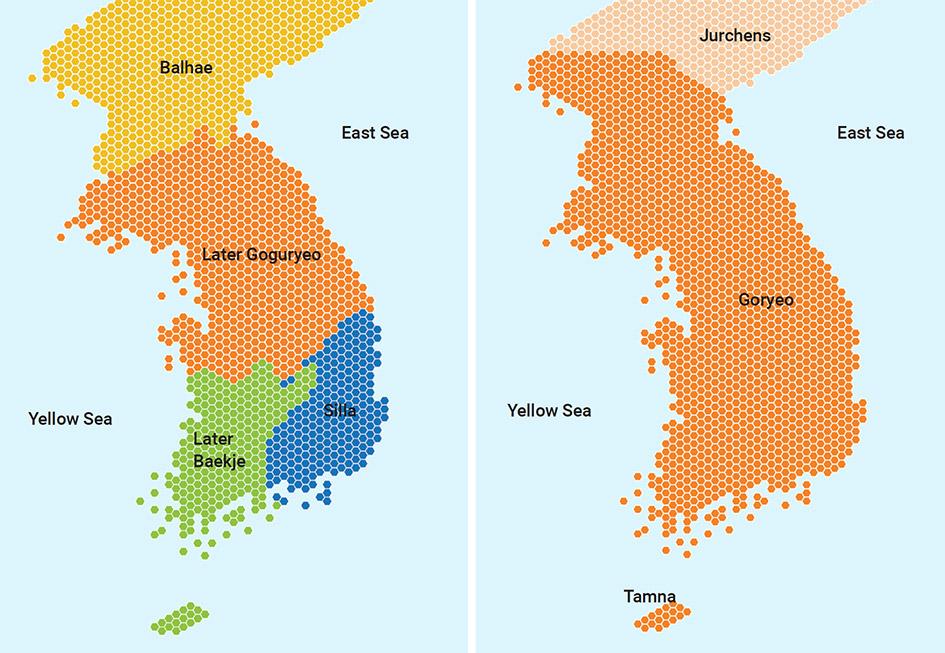
After laying the foundation of Goryeo in 918, Wanggeon, the founder of Goryeo, successively defeated Silla and Later Baekje in 935 and 936 to reestablish united rule on the Korean Peninsula.
The first dynasty to bring the Korean Peninsula under a single government was Unified Silla. After absorbing the two other ancient kingdoms of Goguryeo and Baekje in 668, Unified Silla continued on for roughly 270 years until 935. However, it failed to establish a unified nation in the true sense of the word, not least because the “true-bone,” or jingol, social class system that had ruled the kingdom before unification maintained a monopoly over politics and the economy after the integration. This prevented people of talent from the two absorbed kingdoms from taking part in important government affairs. Around the year 900, the political order on the Korean Peninsula showed signs of disintegration, finally splintering once again into three divided rules with the establishment of Later Goguryeo and Later Baekje in roughly their original regions. As a result, the Korean Peninsula suffered from decades of civil war at the end of the Unified Silla period.
Founded during this tragic period in 918, the Goryeo Dynasty established the second united nation on the Korean Peninsula in 936. This process required years of strenuous efforts at resolving the inter-regional and inter-class conflicts that arose during the unification process. From Goryeo’s foundation to the division of Korea into north and south in 1948, the Korean Peninsula was under uninterrupted unified rule for over 1,000 years.
Dynastic Foundation Based on Inclusiveness
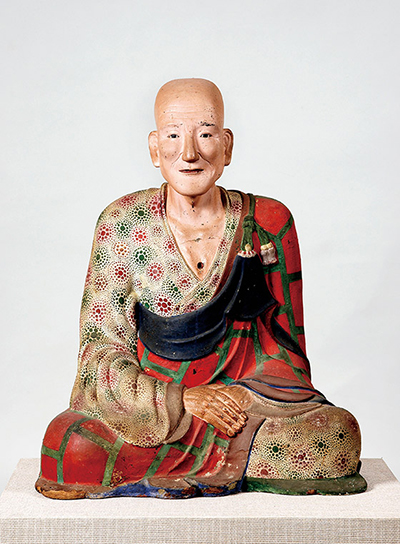
Dry-lacquered seated statue of Buddhist Monk Huirang at Haeinsa
Temple, Hapcheon;c. 930; Treasure No. 999 (photo courtesy of the Haeinsa Museum)
Goryeo accomplished national integration and social cohesion by embracing the diverse cultural and ideological legacies transmitted from the respective polities that had dominated the different parts of the Korean Peninsula, namely the Later Three Kingdoms. This spirit of inclusion and integration underlay the continuity of the dynasty for nearly 500 years.
Wanggeon, the Goryeo founder also known as King Taejo, recognized the authority and autonomy of local warlords in exchange for their support for the central government. His inclusive policy toward different groups based on the principles of compromise and coexistence united the peninsula in a remarkably short period of time with little blowback. This is a sharp turn away from—and must have reflected a serious consideration of—the unsuccessful unification policy of Silla that upheld the dominance of the established elite and denied any inflow of human resources from the newly integrated polities into its political and economic system. As we experience ever-deepening internal conflicts among different regions and classes and face the reality of a Korea split between north and south, contemporary Koreans could learn from this policy of social cohesion and national integration established by the Goryeo Dynasty a whopping 1,100 years ago.
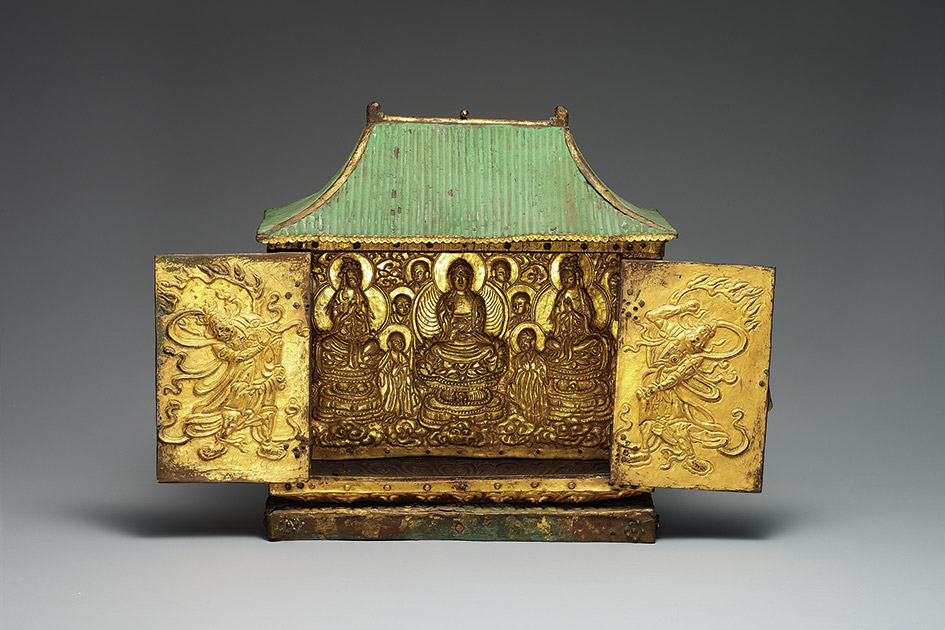
Gilt-bronze portable shrine; 14th century (photo courtesy of the National Museum of Korea)
An Open and Diverse Society
During the Goryeo era, diverse ideologies did not clash, but coexisted peacefully instead: Buddhism, Confucianism, Daoism, and pungsu (geomantic principles) all received their due regard. The refined cultural tradition of the center, represented by the creation of celadon and metal type, flowered side by side with the cultural dynamism of the periphery. The latter gave birth to the production of Buddha images in iron or stone. Values, ideas, and cultures of all stripes were equally appreciated with no preference given to particulars. This must certainly have contributed to the remarkable endurance of the dynasty.
A proactive policy of openness was also practiced in social and political matters. Robust foreign trade contributed to eventually making the country known in the international community by the name of Korea. A complete meritocracy was pursued as talented individuals were recruited as civil servants regardless of nationality or ethnicity. A foreign citizen was employed and promoted as high as a ministerial position during this era. Goryeo was a dynamic society in which people from the lower social classes rose in status and entered politics with great frequency. All this was made possible by the Goryeo belief in the power of social openness.
The Past for the Present
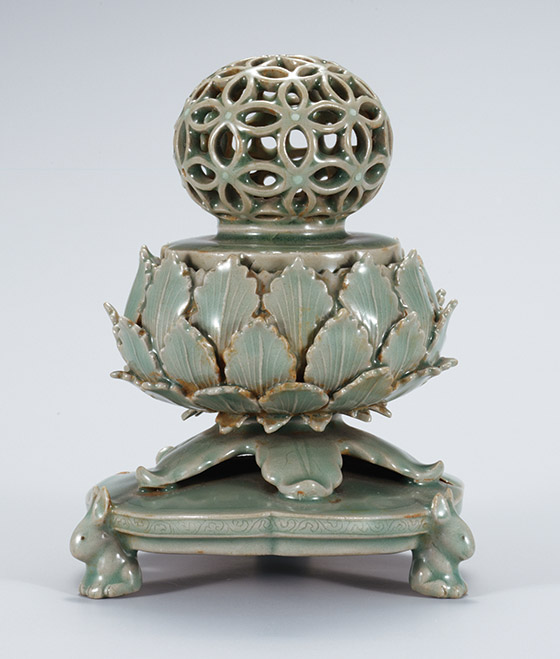
Celadon ewer in the shape of a fish dragon; 12th century; National Treasure No. 61
(photo courtesy of the National Museum of Korea)
History that is not meaningful to the present and future has already died. We reflect on history in order to help find a better path for today and the days to come. History comes alive when it sheds light on the present and future. In this sense, the history of Goryeo is a living textbook and a source of inspiration for contemporary Koreans.
The global community is watching carefully as a new turning point in human civilization unfolds in the 21st century with the advent of the Fourth Industrial Revolution. In Korea, we are seeing signs of social plurality sprouting up in every corner of the country as we place such issues as human rights, environmental protection, and gender equality high on the agenda. At the same time, we are grappling with social conflicts and confrontations that result from income disparity and the growing number of international residents and multicultural families.
Now is an opportune time for the arts exhibitions on Goryeo being hosted by the National Museum of Korea and its branch museums as they commemorate the 1,100-year anniversary of the dynastic foundation. Goryeo: The Glory of Korea at the National Museum is an occasion to explore the astounding artistic achievements of Goryeo and the inherent sprit of challenge and experimentation that they embody. It is hoped that we can discover some clues to resolving the social issues facing us today by engaging with the history of Goryeo at these exhibitions.
We must move beyond the days of a single dominant ideology and values system and the accordant social conflicts and confrontations. We must progress toward a new era of ethnic, national, religious, and cultural diversity and of different ideals and ideologies peacefully coexisting through comprehensive integration. The historical virtues we can find in Goryeo—respect for others, pursuing coexistence, and promoting reconciliation—have significant bearing on today’s Korea and on the wider world. There are a series of exhibitions on the history and culture of Goryeo currently open.
Special Exhibitions Commemorating the 1,100-year anniversary of the foundation of Goryeo
Goryeo: The Glory of Korea
December 4, 2018–March 3, 2019
This exhibition presents a comprehensive overview of the creativity and brilliance of Goryeo. Goryeo achieved the apogee of artistic accomplishment in Korean history by adopting new ideas and techniques from active exchanges with other states and, through this process, carved out a unique Korean cultural identity.
Special exhibition hall, Nation Museum of Korea
www.museum.go.kr
Crafted and Printed in Goryeo: Secrets of Inlaid Celadon and Metal Type
July 20–December 31, 2018
Part of a series focusing on Korean creativity, this exhibition offers an experience space for children where they can discover and appreciate the artistic inventiveness, wisdom, and mastery embodied in Goryeo celadon and metal type.
Children’s Museum of the National Museum of Korea
www.museum.go.kr/site/child/home
Mireuksa Temple during the Goryeo Dynasty
September 11–December 30, 2018
This exhibition showcases the role played by Mireuksa Temple (literally, “Temple of Maitreya”) during Goryeo and the lives of the Buddhist monks who inhabited it. Mireuksa is presented as an embodiment of Maitreya belief through exhibits such as Goryeo celadon, Chinese ceramics, and Buddhist ritual objects excavated from the site.
Permanent exhibition hall, Mireuksaji National Museum
iksan.museum.go.kr
Goryeo in Chungcheongnam-do
November 6, 2018–January 13, 2019
At this exhibition, major cities in Chungcheongnam-do Province during Goryeo are explored in terms of their respective roles as a military stronghold, administrative center, and hub for ocean transport. Characteristics of the religious and material culture of the region during this era are examined through a comparison with other localities, shedding light on the significance of Chungcheongnam-do in the past and present.
Special exhibition hall, Gongju National Museum
gongju.museum.go.kr
Treasures from the Geumgangsa Temple Site in Yeongju
October 23, 2018–February 24, 2019
This exhibition displays Goryeo artifacts excavated from the site of Geumgangsa Temple. A candle stand (Gwangmyeongdae) and incense burner from a pond site, a bronze mirror and other Buddhist ritual objects from near the main Buddha hall site, and many other items illustrate the flourishing of Geumgangsa during the Goryeo era.
Special exhibition hall, Daegu National Museum
daegu.museum.go.kr
Text by Park Jong-ki, Professor of Korean History
Photos by The National Museum of Korea, Haeinsa Museum, Mireuksa National Museum, Gongju National Museum, and Daegu National Musuem

통합, 공존, 화해: 고려 1,100년의 키워드
올해는 고려 건국 1100주년의 해이다. 100년 전인 1918년이 일제 강점기였던 것을 생각하면, 해방 이후 처음으로 고려 건국의 의미를 진지하게 성찰해볼 수 있는 특별한 해가 올해이다. 특히 고려는 한국사에서 두 번째 통일을 이루었으며 문화에서는 다원성과 통합성이, 사회에서는 개방성과 역동성이 공존한 왕조이다. 이러한 고려를 재조명하는 것은 새로운 형태의 통합이 필요한 현재를 사는 우리에게도 뜻깊은 일이 될 것이다. 올해 고려 건국 1100주년을 기념하는 특별전이 한국 곳곳에서 열리고 있다. 고려역사와 문화의 진면목을 살펴볼 수 있는 소중한 자리다.
한국사의 통일왕조
한국사에서 최초의 통일왕조는 신라이다(기원전 57년~기원후 668년). 고구려와 백제를 하나로 통일한 통일신라가 약 270년간(기원후 668~935년) 한반도를 통치했다. 하지만, 옛 신라의 지배층인 진골귀족이 통일 후에도 정치 경제를 독점하고, 옛 고구려와 백제의 풍부한 인적 문화적 자원을 배제하여 진정한 통일국가를 수립하는 데 실패했다. 또한 900년 이후 후백제와 후고구려가 각각 건국되어 후삼국 시대가 시작되면서 한반도는 다시 분열되었다. 그 결과 수십 년간 후삼국 통합 전쟁의 비극적인 내전을 겪었다.
두 번째로 한반도를 통일한 왕조는 고려왕조이다(기원후 918~1392년). 고려는 통합전쟁으로 인한 지역과 계층의 심각한 갈등을 극복해, 기원후 936년 진정한 통일국가를 이룩했다. 고려 건국으로 한반도는 1948년 분단되기까지 약 1000년간 통일국가가 유지되었다.
통합과 포용의 건국 정신
고려는 옛 삼국(고구려, 백제, 신라)의 다양한 사상과 문화를 포용하고 통합해 진정한 민족 통합을 이루었다. 이같이 통합과 포용의 정신은 고려가 500년간 유지될 수 있게 한 훌륭한 전통이다. 무려 1100년 전 건국된 고려에서 이러한 훌륭한 전통이 이루어진 사실은 놀라운 일이다.
고려가 이룩한 이러한 전통의 힘은 어디에서 나온 것일까? 태조 왕건은 지방사회에서 소왕국의 군주와 같은 존재인 호족세력의 권위와 자율성을 인정하는 대신 그들의 협조를 얻어 왕조를 유지할 수 있었다. 타협과 공존의 포용정책을 통해 후삼국 통합전쟁으로 분열된 지역과 민심을 하나로 모으고, 그 후유증도 짧은 시일에 극복할 수 있었다. 이러한 정책은 신라의 지배층이었던 진골귀족이 옛 고구려와 백제의 인적 물적 자원을 배제하고 정치와 경제를 독점해 민족 통합에 실패한 통일신라의 통일정책에 대한 반성에서 비롯됐다. 이러한 고려의 건국정신은 남북이 분단되고, 지역과 계층 간의 갈등이 심화된 지금의 한국이 받아들여야 할 가치 있는 교훈이다.
다원성과 개방성을 존중하는 사회
고려시대에는 불교, 유교, 도교, 풍수지리 등 다양한 사상이 충돌하지 않고 공존했다. 청자, 금속활자 등 세련된 중앙문화와 쇠로 만든 철불, 돌로 만든 석불 등 역동적인 지방문화가 함께 어울려 찬란한 문화의 꽃을 활짝 피웠다. 고려는 다원성과 통합성을 지향하여 이질적이고 다양한 가치와 문화가 모두 존중받는 다원사회였기에, 1000년간 통일 왕조를 유지할 수 있었다.
정치와 사회의 측면에서도 고려는 건국 초기부터 적극적인 개방정책을 추구했다. 대외무역을 장려해 ‘코리아’라는 호칭으로 한반도를 전 세계에 알렸다. 또한 왕조에 필요한 인재는 국적과 종족을 가리지 않고 관료로 등용했다. 외국인이 이품 이상의 벼슬인 재상(宰相)이 된 경우는 고려가 유일하다. 개방의 힘을 믿었던 것이다. 한국사에서 하층민의 신분 상승과 정치 진출이 역시 가장 활발했던 시기 또한 고려 시대였을 정도로 당시 사회 분위기는 매우 역동적이었다.
지금, 왜 고려인가?
현재와 미래의 삶과 무관한 역사는 기억 속에서 쉽게 사라지는 죽은 역사이다. 과거의 역사를 고찰하는 것은 보다 나은 현재와 미래를 위해서다. 과거를 통해 현재와 미래를 전망할 수 있어야 ‘살아있는 역사’가 된다. 그런 점에서 고려의 역사는 우리에게 좋은 교과서이자 역사적 사고와 상상력의 자산이다.
21세기는 4차 산업혁명이라는 새로운 문명의 시대로 진입하는 세계사의 전환기이다. 지금 우리 사회는 민주주의와 시민 의식의 고양으로 인권 환경 양성평등에 관심을 기울이는 등 다양성, 개방성을 특징으로 하는 다원사회의 모습이 여러 방면에서 새롭게 나타나고 있다. 또한 저소득 계층 및 외국인 거류자와 다문화 가정이 급격히 증가하는 추세로, 이에 따른 사회갈등 현상을 해결해야 하는 과제가 있다.
이러한 점에서 고려 건국 1100주년을 맞이하여 국립중앙박물관 및 소속 국립박물관에서 다양한 전시를 여는 것은 반길만한 일이다. 그중 국립중앙박물관의 ‘대고려918·2018 그 찬란한 도전’ 특별전(이하 대고려 특별전)은 고려의 찬란한 미술에 담긴 우수성과 도전에 담긴 새로운 가치를 통해 고려의 성과를 만날 수 있는 전시다. 이를 통해 우리 사회가 품은 과제를 해결하는 데 도움을 줄 고려의 정신을 엿볼 수 있을 것이다.
우리는 이제 하나의 이념과 가치를 강조하거나, 다른 이념과 갈등하고 대립하는 단계를 뛰어넘어야 한다. 인종과 국가, 종교와 문화, 사상과 이념이 공존하면서 통합을 추구해야 한다. 상대의 존재를 인정하고 화해와 공존을 가능하게 하는 다원사회의 힘은 전 세계가 가진 과제들을 해결하는 데에 유용한 자산이 될 것이다. 고려 건국의 의미와 가치를 되새기는 이유는 바로 여기에 있다.
고려 건국 1100주년 기념 특별전
대고려 918·2018 그 찬란한 도전
2018.12.4 ~ 2019.3.3.
개방적이며 독창적인 고려 문화의 우수성을 종합적으로 살펴본다. 동북아시아 국가들과의 교류 속에서 새로운 문화 요소를 수용하여 한국 문화의 정체성을 구축하고 한국 문화 최고의 전성기를 이룬 고려 문화를 볼 수 있다.
서울특별시 용산구 서빙고로 137 국립중앙박물관 기획전시실
www.museum.go.kr
빚고 찍은 고려-상감청자와 금속활자의 비밀
2018.7.20 ~ 2018.12.31
한국인의 창의성 시리즈로 준비된 전시회로서, 고려의 금속활자와 청자에 담긴 지혜와 우수성, 가치를 알리는 어린이 체험 공간을 구현했다.
서울특별시 용산구 서빙고로 137 국립중앙박물관 어린이박물관
www.museum.go.kr/site/child/home
고려시대의 미륵사
2018.9.11 ~ 2018.12.30.
고려시대 미륵사(彌勒寺)의 역할과 이곳에 거주하던 승려들의 생활상을 소개한다. 미륵사 터에서 출토된 고려청자와 중국 도자기, 불교 공양 도구 등을 중심으로, 미륵 신앙을 구현한 사찰인 미륵사를 집중 조명한다.
전라북도 익산시 금마면 미륵사지로362 국립미륵사지유물전시관 상설전시실
iksan.museum.go.kr
충청남도의 고려
2018.11.6 ~ 2019.1.13
충청남도 주요 도시를 전략적 요충지, 행정의 중심지, 조운(漕運)의 중심지로 나누어 살펴본다. 충청남도의 종교 문화와 물질 문화를 다른 지역과 비교해 특징을 찾아보고, 고려시대 충청남도의 가치와 계승 의미를 새롭게 조명한다.
충청남도 공주시 관광단지길 34 국립공주박물관 기획전시실
gongju.museum.go.kr
영주 금강사 터에서 만난 보물
2018.10.23 ~ 2019.2.24.
영주 금강사(金剛寺) 터에서 출토된 고려 시대 불교 미술품을 소개한다. 우물터에서 나온 광명대와 향완, 금당 근처에서 출토된 청동거울과 경상(鏡像), 경자(磬子) 등을 전시하여, 고려시대에 번성한 금강사의 모습을 볼 수 있다.
대구광역시 수성구 청호로 321 국립대구박물관 특별전시실
daegu.museum.go.kr
Text by 박종기 (국민대학교 국사학과 교수)
Photos by 국립중앙박물관, 해인사성보박물관, 국립미륵사지유물전시관, 국립공주박물관, 국립대구박물관