Visit
Blooming Sites for Spring Trips
By Song Il-bong
Sleepy Buddhist temples start to hum with vitality. Flowering trees that have suffered through the swirling freezing winds shake off the last of the cold. All living things start to lower the protective guard, they maintained throughout the winter. Spring has arrived at last. Here, three scenic sites are presented that are perfect for a springtime visit while their charms are on full display.
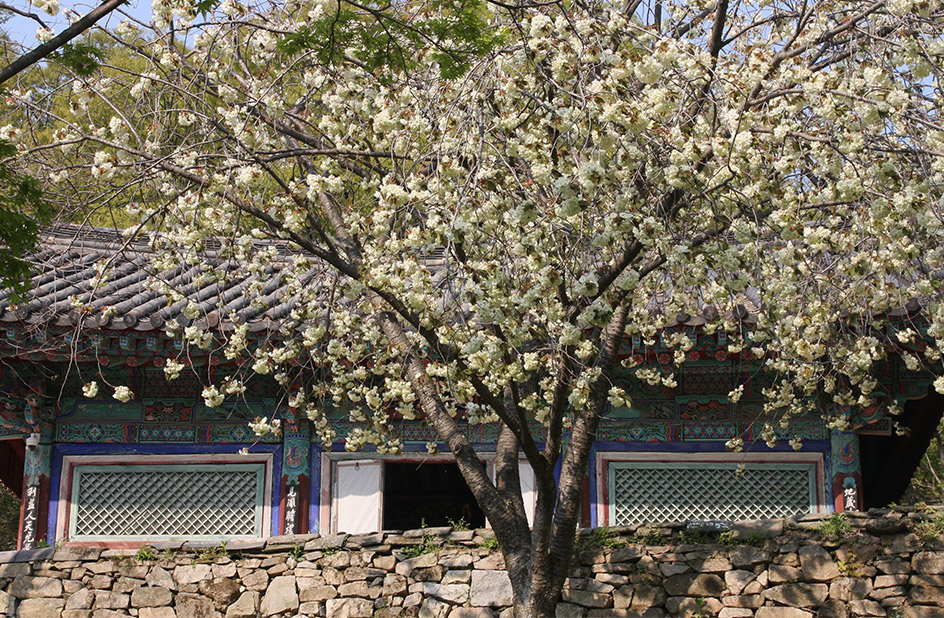
Light-green cherry blossoms in front of Myeongbujeon Hall, Gaesimsa Temple
A Rare Place to Enjoy Green Cherries: Gaesimsa Temple
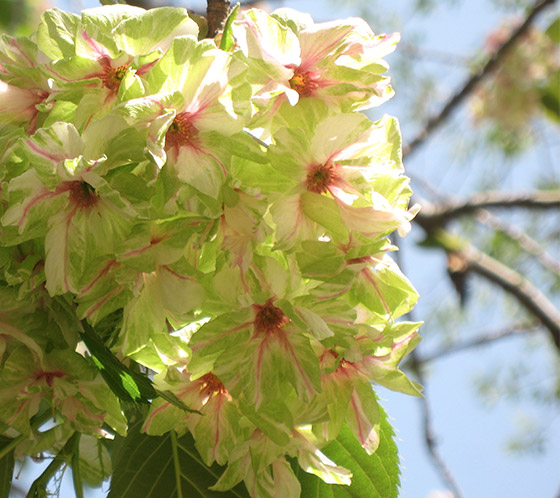
Rare light-green cherry blossoms at Gaesimsa Temple
A visit to Gaesimsa has no season; this Buddhist temple is ideal for a visit round the year. However, Gaesimsa exhibits its best face in early May when it overflows with blooming cherries in diverse colors, including some with distinctive light green blossoms.
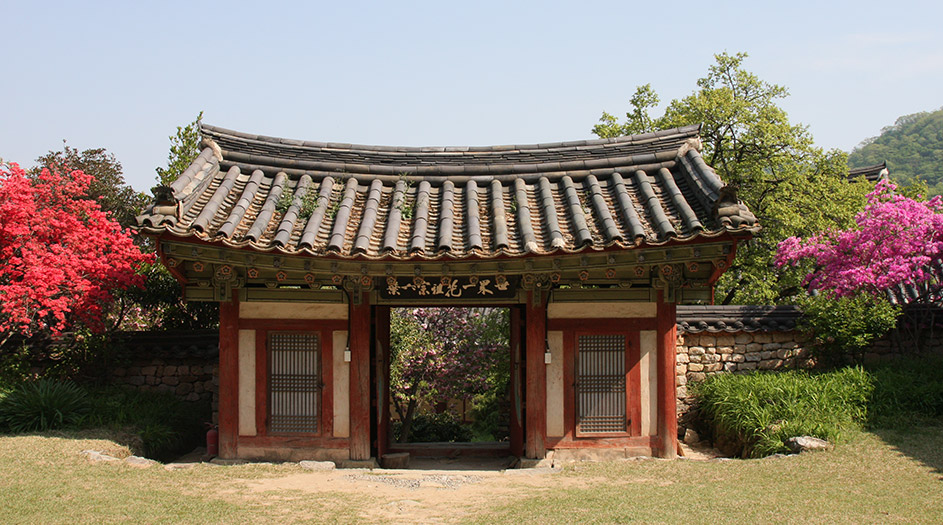
Gaesimsa is situated at the foot of Sangwangsan Mountain in Seosan, Chungcheongnam-do Province. It was founded in 654 under the name Gaewonsa by Monk Hyegam while part of the territory of the Baekje Kingdom. In 1350, during the Goryeo Dynasty, Monk Cheoneung rebuilt the temple and endowed it with the new name of Gaesimsa, meaning “a temple that opens the mind.” Living up to its title, the site offers a purifying experience in the lead-up to the main complex. A short walk past the “one-pillar gate” that serves as the front entry of the temple, visitors can find a stone marker bearing the inscription Sesimdong, meaning “a valley that cleanses the mind.” This inspires visitors to take a moment to arrange their minds before entering the Buddha’s realm.
A five-to-ten-minute walk from the Sesimdong marker leads visitors to a pavilion housing a large Buddhist bell. In front of the bell pavilion is a pond crossed in the middle by a log bridge. This pond was created to suit the mountain at the back of the temple that is considered to resemble an elephant, a water-loving animal.
Following the bell pavilion is a second pavilion known as Anyangnu (“mind-comforting pavilion”). The axis of this structure is slightly tilted toward the east in order to enhance its views of the surrounding temple landscape. Anyangnu provides the best viewpoint within the temple grounds from which to enjoy the stunning scenery of Gaesimsa.
Before entering the main Buddha hall (Treasure No. 143), visitors are attracted to the natural beauty of the building to the left. It is a Simgeomdang (Mind-sharpening Hall), which is characterized by the use of unrefined wooden beams in its architectural elements. The structure is an architectural embodiment of the natural arches and twists of trees, imbuing a strong sense of naturalness and even courage among onlookers. Another charm of the building is the spatial ratio between the height of the vertical columns and the distance between them, which is an attempt at perfection.
The Simgeomdang is also a good place to appreciate cherry blossoms. The double blossoms decorating the front yard of the Simgeomdang exhibit the contrasting but harmonious colors of white and red. Another advantageous point is the Myeongbujeon (Judgment Hall). In May, the Myeongbujeon area is buried under a flowery canopy of cherry blossoms. This is also where visitors can get a chance to appreciate cherry trees with light green flowers. The ceiling of the Myeongbujeon with its exposed rafters adds a cozy feeling for visitors.
Address 321-86 Gaesimsa-ro, Unsan-myeon, Seosan, Chungcheongnam-do
By carSeoul → Expressway No. 15 (Seohaean) → Seosan Interchange → National Route No. 32 → Unsan-myeon → Gaesimsa
A Waterway along Korean Azaleas: Juwanggyegok Valley

Willow trees in Jusanji Reservoir hiding their roots under the water
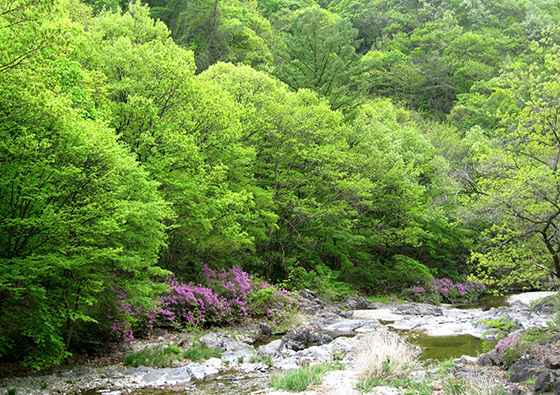
Korean azaleas, one of the must-sees of Juwangsan Mountain
Juwangsan Mountain is located in Cheongsong, Gyeongsangbuk-do Province. It protrudes from the southern tip of the Baekdu mountain range, which runs the length of the Korean Peninsula. While rising only to the modest height of 721 meters, the mountain is renowned for its surrounding nature and the mesmerizing landscape created by an array of attention-grabbing rocks. Designated as national park in 1976, Juwangsan is equipped with safe and visitor-friendly trails, ensuring that people of all ages and levels of physical ability can enjoy trekking here.
Juwanggyegok Valley is a water channel running down the mountain, which comes into bloom with the special flowers of the Korean azalea (su-dallae) in early May. The su-dallae, also
called mul-cheoljjuk, can be easily confused with other rhododendrons such as the Korean rosebay (jin-dallae) or royal azalea (cheoljjuk), but they are a distinct species. The blooming of Korean azaleas on Juwangsan is celebrated with an annual festival. Juwanggyegok and its surroundings have been nationally designated as Scenic Site No. 11.
The most popular trail route starts from the ticket office, passes Daejeonsa Temple and Yongchu falls, and leads to Yongyeon falls. The visitor trail around the Yongchu falls is famed for its chilling walk experience: the path is cut along high-rising rocks that seem as if they could plunge down at any minute, drawing a cold sweat among visitors walking that trail section.
In addition, there are a number of scenic points along the trail route that are associated with interesting stories and legends. Among these are the “stunning rocks” (Giam) abruptly thrusting out from the breast of the mountain; the “crane-residing rock” (Haksodae), which is believed to have housed a flock of blue and white cranes; the “rock for immortals” (Sinseondae), known for the legend that spiritual beings used to descend from above and play there; and the “water-supply rock” (Geupsudae), associated with a story of royal succession in the Silla Kingdom.
Another area to visit is a reservoir situated deeper inside the mountain. This body of water, known as Jusanji, originally served as an agricultural water supply, but today it provides one of the most attractive places to enjoy Juwangsan. Weeping and pussy willows up to 150 years in age enhance its charm. They expose their trunks above the water’s surface, but keep their roots submerged below, creating a mysterious and otherworldly atmosphere.
Address 169-7 Gongwon-gil, Budong-myeon, Cheongsong, Gyeongsangbuk-do
By car Seoul → Expressway No. 30 (Dangjin-Yeongdeok) → Cheongsong Interchange → National Route No. 31 → Local Route No. 914 → Juwangsan
A Mountain Temple Soaked in Spring Flowers: Seonamsa in Suncheon
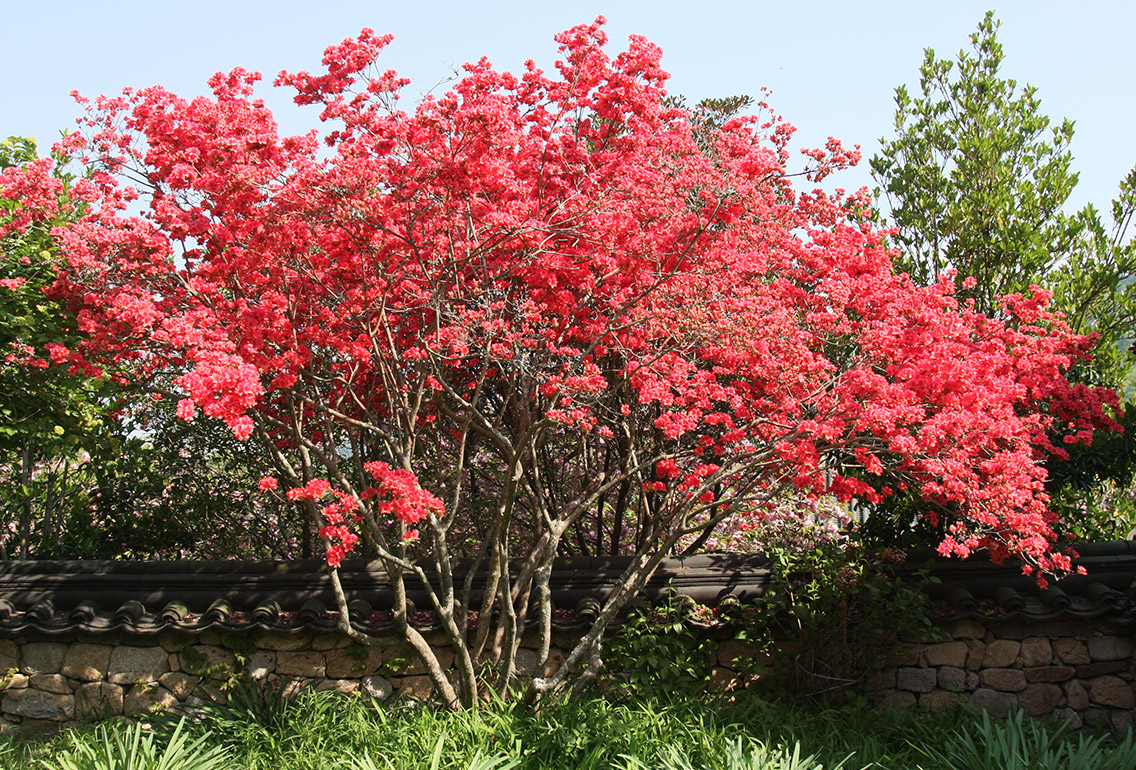
Evergreen azaleas at Seonamsa Temple boast an enchanting color
Situated at the eastern foot of Jogyesan Mountain in Suncheon, Jeollanam-do Province, Seonamsa is the only monastery in Taego Order of Korean Buddhism that is equipped with all of the three monastic training components—a Seon medication center, sutra school, and precept training center. Nationally designated as Historic Site No. 507, the origin of Seonamsa dates back to 529 when Monk Ado laid the foundation for a Buddhist monastery in the territory of the Baekje Kingdom. Toward the later Silla period (57 B.C.–A.D. 935), Monk Doseon officially established a Buddhist temple there and named it Seonamsa, or “an immortals’ rock temple.”
Renowned for the Buddhist dignity emanating from its mountainous location and natural environment, Seonamsa is a great place to visit in spring. Later in April, when the entire temple turns into a flower garden, is ideal. A splendid range of spring flowers, including evergreen azaleas, Korean azaleas, purple magnolias, and common camellias, brings out its best face to catch the eyes of visitors.
Among them are some plants that merit special attention. Visitors should not miss the remarkable beauty of the azalea flowers growing at the entrance of the temple’s Seon meditation center, called Chiljeon Seonwon. Also in the temple complex is a plum tree national designated Natural Monument No. 488 and a horizontally growing pine tree that is about 600 years old. These both deserve a moment of attentive appreciation from visitors.
An extended valley stretches out from the entrance of Seonamsa. According to legend, heavenly beings used to descend here to bathe. The valley features two definitive structures associated with Seonamsa—Seungseongyo Bridge and Gangseonnu Pavilion. The pavilion seen through the frame of the arched bridge is nothing less than a masterpiece. Constructed in 1698 during the Joseon era, the bridge is nationally designated as Treasure No. 400.
The temple’s Seon meditation center, Chiljeon Seonwon, is a place for monastic practice, but also for growing and making tea. Within the Chiljeon Seonwon compound is a uniquely shaped well, called a “four-layered well.” Underground water runs down through a pipe to the first basin, then to the second and third, all the way to the fourth. Water in the four basins is respectively referred to as “high water,”
Evergreen azaleas and royal azaleas blooming at either side of the Seon medication center of Seonamsa Temple
“middle water,” “low water,” and “end water” and is utilized for different purposes. The high water is used for making tea or offerings on a Buddhist altar. The middle water is reserved for cooking rice or drinking, the low water for washing the face, and the end water for doing laundry.
Among the many Buddhist halls within the Seonamsa complex, the Wontongjeon (Avalokitesvara Hall) is particularly notable. One peculiar thing about this building is its T- shaped floor plan unique among Buddhist halls. Another point to note is its association with the birth of King Sunjo, the 23rd monarch of Joseon. Greatly distressed about the lack of an heir to the throne, King Jeongjo, Sunjo’s father, asked Monk Nuram to conduct a 100-day prayer for the birth of a son. Following Nuram’s prayer here in this building, Sunjo was born. After ascending to the throne, King Sunjo endowed the building with a nameplate inscribed with Daebokjeon in his own calligraphy. Visitors can still find this nameplate hanging inside the building.
Address 169-7 Gongwon-gil, Budong-myeon, Cheongsong, Gyeongsangbuk-do
By car Seoul → Expressway No. 30 (Dangjin-Yeongdeok) → Cheongsong Interchange → National Route No. 31 → Local Route No. 914 → Juwangsan
Text by Song Il-bong, travel writer
Photos by Song Il-bong, travel writer

봄꽃이 아름다운 명승지
고즈넉한 절이 소란해지는 시절이 있다. 밤낮없이 매서운 산바람에 휘둘리던 꽃나무가 간지러운 봄볕에 모진 겨울을 털어내는 시간. 어떤 생물체보다 강인한 나무가 잠시 마음을 내려놓는 시간. 봄이다. 봄과 꽃을 함께 즐기기 좋은 명승지 세 곳을 소개한다.
푸른 색의 벚꽃이 피는 곳, 서산 개심사(보물 제143호)
개심사는 언제 찾아도 좋은 절이다. 그러나 연초록빛의 청벚꽃을 비롯해 각양각색의 겹벚꽃들이 꽃동산을 이루는 5월 초를 추천한다. 개심사가 1년 중에서 가장 아름다운 모습을 보여주는 시기이기 때문이다.
충청남도 서산의 상왕산 기슭에 있는 개심사는 백제 의자왕 때인 654년 혜감선사에 의해 창건되었다. 당시의 이름은 개원사였다. 그 후 고려 충정왕 때인 1350년 처능대사가 절을 고쳐 지으면서 개심사로 그 이름이 바뀌었다. ‘마음을 여는 절’이라는 뜻을 가진 개심사(開心寺)는 들어가는 길에서부터 기분이 좋아진다. 사찰 입구의 일주문을 지나면 마음을 깨끗이 씻는 골짜기라는 뜻의 ‘세심동’ 표지석이 세워져 있다. 잠시 발걸음을 멈춰 호흡과 마음을 정리하게 만든다.
세심동 표지석에서 5~10분쯤 걸으면 절의 큰 종을 달아놓은 범종각이 눈에 들어온다. 범종각 앞에는 직사각형의 인공연못이 조성되어 있고 그 한가운데로는 외나무다리가 놓여 있다. 개심사 뒷산이 풍수지리학적으로 코끼리 형상을 하고 있어서 물을 많이 마시는 코끼리를 위해 일부러 만든 연못이다.
개심사 대웅보전으로 들어가기 전에 만나게 되는 건물은 안양루다. 안양루를 유심히 살펴보면 건물 자체가 동쪽으로 조금 비틀어져 있는 것을 알 수 있다. 누각에서 개심사 주변의 절경을 조금이라도 잘 보려고 일부러 살짝 틀어서 지은 것이다. 실제로 안양루는 개심사에서 가장 시원스러운 경치를 감상할 수 있는 조망 포인트이다.
개심사 심검당은 오래된 나무의 자연스러움을 고스란히 건물로 옮겨 놓은 게 가장 큰 특징이다. 제멋대로 뒤틀리고 휘어진 목재들을 다듬지 않고 그대로 건물의 부재로 사용했다. 자연스러움을 넘어 시원시원한 대담함이 느껴진다. 심검당 기둥의 높이와 기둥 사이의 넓이가 거의 ‘황금비’에 가까운 비율을 보이는 점도 눈길을 끈다.
개심사에서 벚꽃을 감상하기 좋은 장소는 심검당과 명부전이다. 심검당 앞마당의 주인공인 흰색과 빨간색의 겹벚꽃은 대비되면서도 조화를 이룬다. 5월의 어느 봄날, 명부전 주변은 말 그대로 꽃동산이다. 흰색과 연분홍색의 겹벚꽃들이 지천이다. 연초록의 희귀한 꽃잎을 가진 청벚꽃나무도 이곳에 있다. 서까래를 자연스럽게 드러낸 명부전 내부의 연등 천장은 여행자의 마음을 더욱 푸근하게 한다.
주소: 충청남도 서산시 운산면 개심사로 321-86 개심사
찾아가는 길: 서해안고속도로 서산나들목 → 32번 국도 → 운산면 → 한우개량사업소 → 개심사
꽃길과 물길을 만드는 수달래, 청송 주왕산 주왕계곡 일원(명승 제11호)
경상북도 청송군에 있는 주왕산은 백두대간의 남쪽 끝자락에 솟아있다. 해발 721m로 높지 않지만, 주변 경관과 함께 기암괴석이 멋진 조화를 이루고 있어 ‘석병산’이라 불리기도 했다. 1976년에 국립공원으로 지정되었다. 주왕산은 한국에 있는 국립공원 탐방로 중에서도 편안하고 안전하게 조성된 탐방로로 꼽힌다. 몸이 불편한 어르신들이나 흙길에 익숙하지 않은 어린아이들도 충분히 걸을 수 있다.
주왕산 한가운데를 흐르는 계곡의 이름은 ‘주방천 계곡’이다. 해마다 5월 초가 되면 이 계곡에서 특별한 꽃을 만날 수 있다. ‘수달래’다. 주왕산의 계곡을 따라 물가에 피어난다. 강원도 정선이나 평창에도 이와 비슷한 꽃을 볼 수 있는데 강원도에는 이 꽃을 ‘물철쭉’이라 부른다. 얼핏 보면 진달래나 철쭉을 닮았지만 가까이 들여다보면 조금 다르다. 그리고 주왕산에서는 수달래가 필 무렵 매년 수달래축제를 개최한다.
주왕산은 매표소에서 대전사와 용추폭포를 지나 용연폭포까지 가는 코스가 일반적이다. 특히 금방이라도 무너져 내릴 듯한 기암괴석 사이로 등산로가 나 있는 용추폭포 근처를 지날 때는 한여름에도 등줄기에 식은땀이 흐를 정도의 전율을 느낄 수 있다.
그밖에 대표적인 명소로는 산 중턱에 솟아오른 거대한 바위 봉인 기암, 청학과 백학이 떼를 지어 살았다는 학소대, 신선들이 내려와 놀았다는 전설이 있는 신선대 등을 꼽을 수 있다. 계곡을 따라 망월대, 급수대, 연화봉 등과 같은 곳도 곳곳에 있다.
내주왕계곡에 있는 주산지도 있다. 농업용수로 활용하기 위해 물을 가두어 놓은 것이 지금은 근사한 ‘호반 여행지’로 탈바꿈했다. 이른 아침의 물안개와 해 질 무렵의 호반의 정취가 압권이다. 게다가 수령 150년 정도로 추정되는 능수버들과 왕버들 10여 그루가 물속에 뿌리를 내린 채 수면 위로 얼굴을 내밀고 있어 신비스러움을 더한다.
주소:경상북도 청송군 부동면 공원길 169-7 주왕산국립공원사무소
찾아가는 길: 당진영덕고속도로 청송나들목 → 31번 국도 → 914번 지방도 → 주왕산
겹벚꽃이 아름다운 절 순천 선암사(사적 제507호)
전라남도 순천의 조계산 자락에 있는 선암사는 대한불교 태고종의 총본산인 ‘태고총림’이 있는 곳이다. 신선이 내린 바위라는 뜻의 선암사는 백제 성왕 때인 529년에 아도화상이 초창한 이후로 신라 말기에 도선국사가 ‘선암사’라는 이름으로 정식 창건해 오늘에 이르고 있다.
고즈넉한 절의 품위가 돋보이는 선암사는 봄에 찾아가면 좋은 사찰이다. 사찰 전체가 꽃동산으로 변하는 4월 하순 무렵이 제격이다. 영산홍을 비롯해 산철쭉, 자목련, 동백 등이 저마다의 자태를 한껏 뽐낸다.
선암사 경내의 여러 나무 가운데서도 매화나무, 차나무, 와송, 영산홍, 자산홍 등은 특히 유명하다. 칠전선원(호남제일선원) 입구에서 만날 수 있는 영산홍과 자산홍, 2007년 11월에 천연기념물 제488호로 지정된 매화나무, 옆으로 퍼지면서 자라는 와송 등은 수령이 약 600년 정도로 추정된다.
선암사 입구에는 일곱 선녀가 내려와 목욕하고 올라갔다는 계곡이 길게 이어져 있다. 바로 이 계곡에 자리 잡고 있는 강선루와 승선교는 선암사를 대표하는 명물이다. 아치형 돌다리인 승선교에서 바라보는 강선루의 자태는 ‘한 폭의 잘 그려진 그림’을 떠올리게 한다. 조선 시대 숙종 때인 1698년에 완공된 승선교는 현재 보물 제400호로 지정되어 있다.
선암사 칠전선원은 ‘칠전선원차’가 만들어지는 공간이자 스님들의 수행공간이다. 칠전선원의 달마전 앞에는 근사한 돌샘인 ‘4단다조’가 있다. 4단은 각각 상탕, 중탕, 하탕, 말탕이라 불린다. 상탕은 차를 끓이거나 불전에 올리는 청정수로, 중탕은 밥을 하거나 마시는 물로, 하탕은 세수를 하는 물로, 말탕은 빨래하는 물로 사용된다.
선암사에서 유명한 전각은 팔상전 뒤에 있는 원통전이다. 사찰 건물로는 특이한 ‘정(丁)’자형 건축물이고, 조선 23대 왕인 순조의 탄생과도 관련 있다. 후사가 없어 걱정이 많던 정조는 눌암 스님에게 100일 기도를 부탁했고 그 결과 순조를 얻었다. 이후 순조는 직접 친필로 쓴 ‘천(天)’, ‘인(人)’자와 ‘대복전’이라는 현판 글씨를 하사했다. 이 같은 연유로 원통전 내부에는 지금도 ‘대복전’ 현판이 붙어 있다.
주소: 전라남도 순천시 승주읍 선암사길 450 선암사
찾아가는 길: 호남고속도로 승주나들목 → 857번 지방도 → 선암사
Text by 송일봉 | 여행작가
Photos by 송일봉