Visit
Royal Tombs of Joseon and Other Asian Dynasties
By Hwang Jung-yon
Joseon Royal Tombs, the Epitome of a Dynastic History
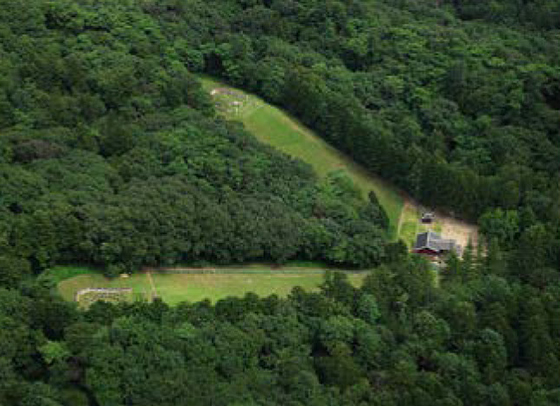
Gwangneung Tomb of King Sejo (r. 1455–68), the sev–enth ruler of Joseon, and his wife Queen Jeonghui
Rooted in Confucianism as its fundamental governing philosophy, the Joseon Dynasty highly regarded three locations imbued with regal presence: the royal palace, where the king resided; the royal tomb, where the body of the king was interred; and
the Jongmyo shrine, where his spirit tablet was finally ensconced. They served as a primary source of royal legitimacy and authority.
In particular, the royal tombs of Joseon were the embodiment of the strong belief in ancestor worship, which was praised as one of the most significant Confucian virtues and adopted as a critical element within the governing principles. The construction of a royal tomb proceeded according to a rigorous set of rules using the most accomplished artisans of the time. An ad hoc government body called a dogam was established to oversee the construction process. The space of a royal tomb was arranged in accordance with Confucian protocols, but always taking into full account the pertinent natural setting and topography. This resulted in diversity in their spatial layouts, a distinct characteristic of the royal tombs of the Joseon Dynasty compared to counterparts in such Asian countries as China, Japan, and Vietnam where the imposed spatial arrangements remained constant.
Here, the heritage values of the Joseon royal tombs as inscribed on the World Heritage list in 2009 are explored in comparison with emperors’ tombs in the neighboring countries of China and Vietnam.
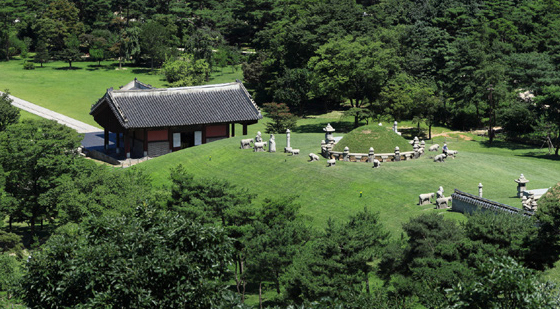
Uireung Tomb of King Gyeongjong (r. 1720–24), the 20th ruler of Joseon,
and his wife Queen Seonui
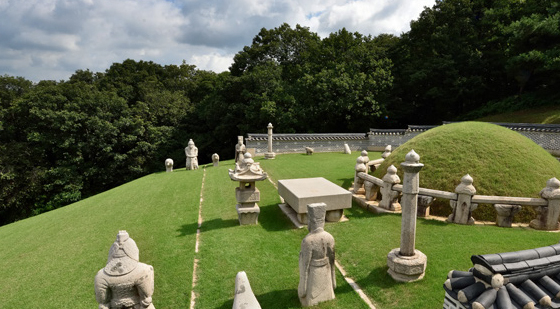
Hongneung Tomb of Queen Jeongseong, the wife of Jo–seon’s 21st ruler Yeongjo (r. 1724–76)
Imperial Tombs in China and Vietnam
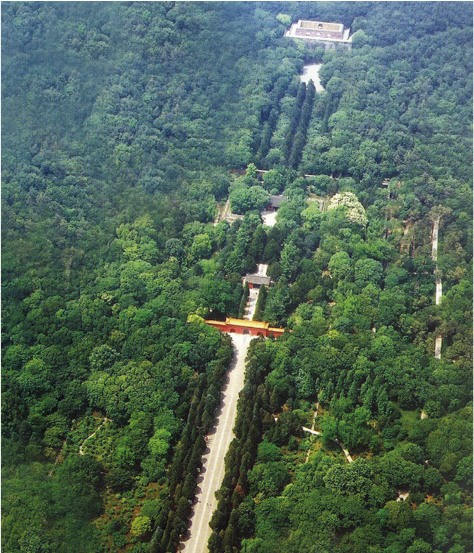
Ming Xiaoling Mausoleum of the Hong–wu Emperor
Korea and other countries within the Chinese cultural sphere, such as Japan and Vietnam, absorbed Chinese influences and integrated them into their respective cosmologies and beliefs in the afterlife to develop proprietary practices for grave construction. In this sense, it is an interesting exercise to investigate the royal tombs of the Joseon Dynasty in terms of their universal values that apply to all humanity, and also their unique characteristics in parallel with emperors’ mausoleums in China and Vietnam.
In China, the emperors’ tombs from the Ming (1368–1644) and Qing (1644–1911) Dynasties are the examples most closely associated with the Joseon royal tombs. The Xiaoling Mausoleum from the Ming Dynasty, in particular, is worth a closer look since it was applied as a reference when Emperor Gojong (r. 1863–1907) constructed the first imperial tomb in Korea after the declaration of the Korean Empire (1897–1910). The Xiaoling Mausoleum is the tomb of the Hongwu Emperor, the founder of the Ming Dynasty, and his wife Empress Ma. It is situated at the southern foot of Purple Mountain in Nanjing, China. Its construction started in 1382, and was only completed about 30 years later in 1405 during the reign of his son the Yongle Emperor. The succeeding Ming rulers modeled their tombs after this one.
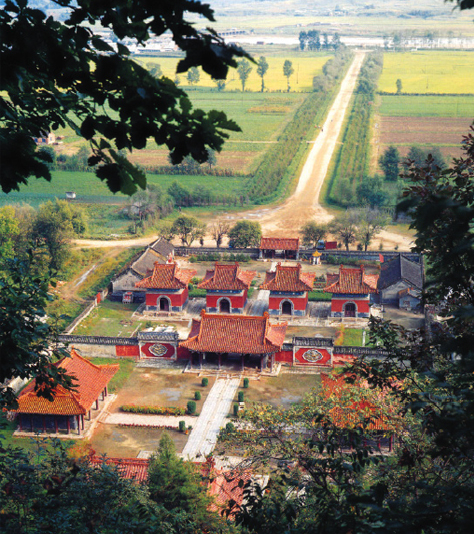
Yongling Mausoleum from the Qing Dynasty
In comparison with the Joseon royal tombs, the Xiaoling Mausoleum is larger in terms of the grave area, the number of stone guardian figures, and their size. It also shows features that are typical of Chinese imperial tombs but not found in Joseon examples. The burial mound is unmarked, the ceremonial shrine has auxiliary buildings on either side, and a pavilion structure stands in front of the burial area.
As with China, Vietnam has a long imperial period within its history. Among the Vietnamese rulers, the Nguyen Dynasty is noted for leaving the most prominent imperial tombs. Heavily influenced by Confucianism from China, the tombs of the Nguyen Dynasty share much in common with prototypes from Ming and Qing China.
Five imperial tombs survive from the Nguyen Dynasty. They are the Thien Tho Tomb of the dynasty’s first ruler Emperor Gia Long (r. 1802–20), the Hieu Tomb of Emperor Minh Mang (r. 1820–41), the Xuong Tomb of Emperor Thieu Tri (r. 1841–47), the Khiem Tomb of Emperor Tu Duc (r. 1847–83), and the Ung Tomb of Emperor Khai Dinh (r. 1916–25). The first four tombs embody traditional Vietnamese imperial tomb style, while the one built for Emperor Khai Dinh features a unique construction reflecting French influences.
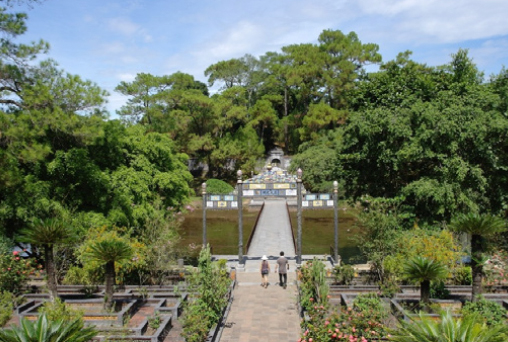
Hieu Tomb of Emperor Minh Mang (r.1820–41)from the Nguyen Dynasty
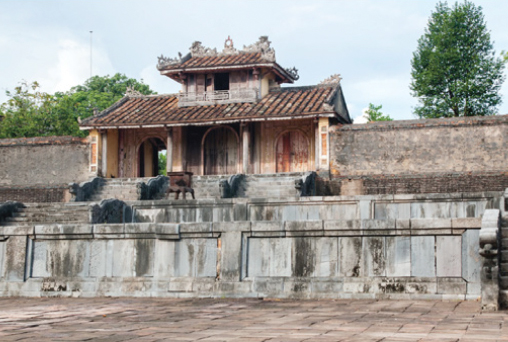
Xuong Tomb of Emperor Thieu Tri (r.1841–47) from the Nguyen Dynasty
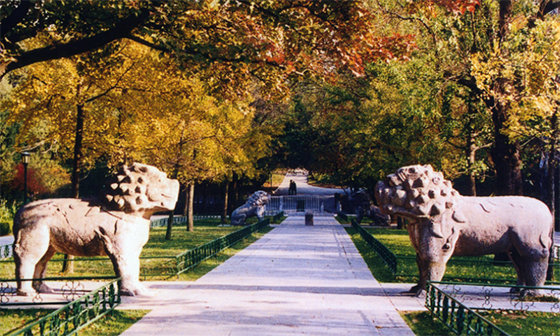
Stone animals at the Ming Xiaoling Mausoleum
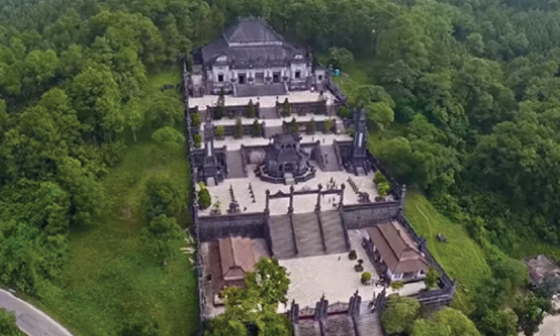
Ung Tomb of Emperor Khai Dinh (r. 1916–25) from the Nguyen Dynasty
An emperor’s tomb from the Nguyen Dynasty is composed of three areas, respectively for burying the body, enshrining a stele, and conducting ceremonial rites. A water channel runs around the front side of the tomb. In the burial area, both a stone chamber and an earthen mound are featured; the presence of the burial mound particularly demonstrates Chinese influences.
Joseon Royal Tombs and Chinese Emperors’ Mausoleums
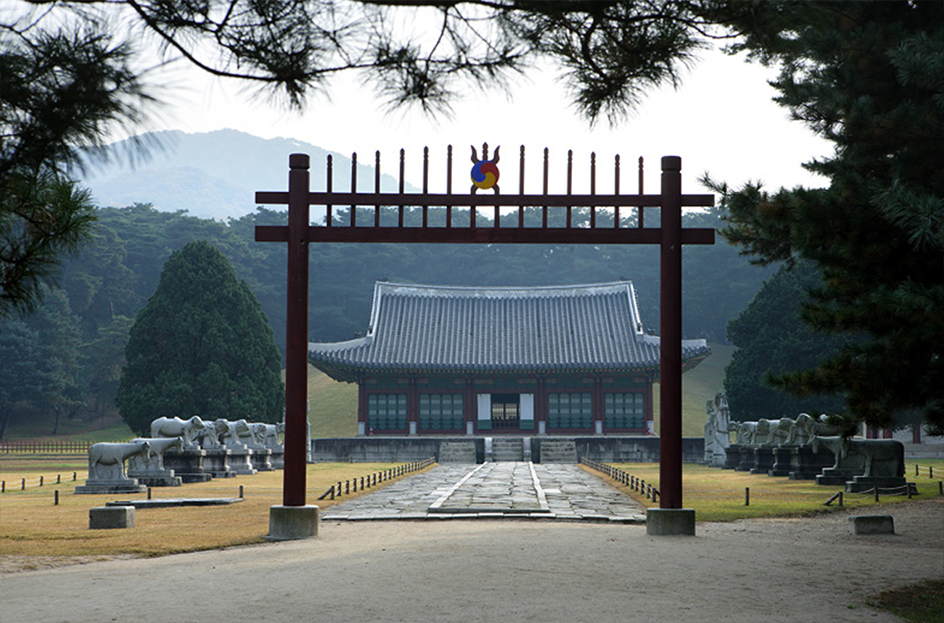
Hongneung Tomb of Emperor Gojong (r. 1863–1907), the 26th mon–arch of Joseon
Comparative analyses have been carried out between the Joseon and Chinese royal burial structures. Imperial tombs in China vary in form and scale depending upon when they were constructed and the potency of the occupant. Meanwhile, the protocols for tomb construction were consistently applied throughout the Joseon period, maintaining similar forms and arrangement across the many examples. It can be deduced that while Joseon culture was strongly influenced by China, it was not a passive consumer of Chinese tomb styles, but reflected traditional practices into its adaptations.
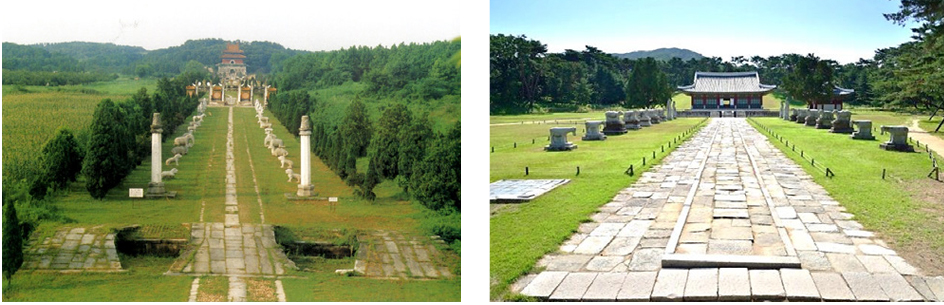
Layout of the Ming Xianling Mausoleum of Zhu Youyuan (left) and of Hongneung Tomb of Empress Myeongseong (right)
Despite their unique characteristics, the royal tombs of the Joseon Dynasty bear evidence of Ming and Qing influences. As stated earlier, Emperor Gojong applied the Ming Xiaoling Mausoleum as a model for the construction of Hongneung in the Cheongnyangni area of Seoul, Korea’s first tomb with imperial status, where Empress Myeongseong was buried. Hongneung’s ceremonial shrine, called a chimjeon (“sleeping quarters”), is rendered in a straight-linear layout mirroring that of the Xiaoling Mausoleum. Its worship road is lined with stone elephants and camels, which can also be found at the Xiaoling Mausoleum. However, Hongneung differs significantly from the Xiaoling Mausoleum with respect to its architectural layout and spatial composition. It exhibits more similarities with the Xianling Mausoleum of Zhu Youyuan (1476–1519), posthumously promoted to imperial status by his son the Jiajing Emperor of the Ming Dynasty. Compared with other imperial tombs, the Xianling Mausoleum is smaller not only in terms of the size of the grave area, but also in the number and variety of architectural elements and stone figures. This comparison contributes to refining the understanding of the origins of Chinese influence on Joseon’s royal tomb system that has been mainly focused on emperors’ tombs from the Ming and Qing Dynasties. It can be argued that one of the key sources of influence for the royal tombs of Joseon are the Chinese imperial mausoleums built for those who posthumously obtained the status of emperor.
Another influence from China stems from the tombs built for imperial family members, vassals, or high-ranking court officials, to which the origins of the stone horses, sheep, and tigers that stand around the burial mounds of Joseon royal tombs can be traced. For example, the tomb of Ming imperial relative Qiu Cheng, located in the vicinity of the Xiaoling Mausoleum, has stone representations of horses, sheep, and tigers, but in different positions from those found at Joseon royal tombs. Stone military officials at the tomb of Qiu Cheng show stunning similarities with the Geonwolleung Tomb of King Taejo (r. 1392–98), the founder of the Joseon Dynasty, in terms of their standing posture with hands folded in front holding a sword, and the style of the armor and hamlet. It is inferred that the tomb of Qiu Cheng, constructed about a century before Geonwolleung, and other Chinese tombs for imperial relatives have strong associations with the inspiration of royal tombs from the early Joseon period.
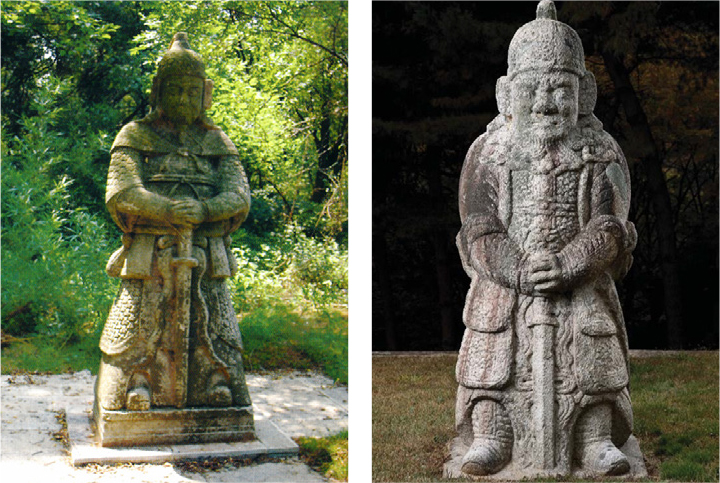
tone military official at the tomb of Qiu Cheng from the Ming Dynasty (left) and at Geonwolleung Tomb of King Taejo (right)
Countries, particularly those geographically close, exchange influences while persistently preserving their unique traditions and developing creative new cultural elements. Tomb construction is a good example of cultural influences from the outside sparking unique local adaptations. As a result of these cultural processes, China, Korea, and Vietnam have come to share a cultural background while still exhibiting unique royal tomb cultures.
Text by Hwang Jung-yon, Tangible Cultural Heritage Division, Cultural Heritage Administration